Intraperitoneal injection of the SIRT1 activator SRT1720 attenuates the progression of experimental osteoarthritis in mice
- PMID: 29922443
- PMCID: PMC5987681
- DOI: 10.1302/2046-3758.73.BJR-2017-0227.R1
Intraperitoneal injection of the SIRT1 activator SRT1720 attenuates the progression of experimental osteoarthritis in mice
Abstract
Objectives: This study aimed to examine the effects of SRT1720, a potent SIRT1 activator, on osteoarthritis (OA) progression using an experimental OA model.
Methods: Osteoarthritis was surgically induced by destabilization of the medial meniscus in eight-week-old C57BL/6 male mice. SRT1720 was administered intraperitoneally twice a week after surgery. Osteoarthritis progression was evaluated histologically using the Osteoarthritis Research Society International (OARSI) score at four, eight, 12 and 16 weeks. The expression of SIRT1, matrix metalloproteinase 13 (MMP-13), a disintegrin and metalloproteinase with thrombospondin motifs-5 (ADAMTS-5), cleaved caspase-3, PARP p85, and acetylated nuclear factor (NF)-κB p65 in cartilage was examined by immunohistochemistry. Synovitis was also evaluated histologically. Primary mouse epiphyseal chondrocytes were treated with SRT1720 in the presence or absence of interleukin 1 beta (IL-1β), and gene expression changes were examined by real-time polymerase chain reaction (PCR).
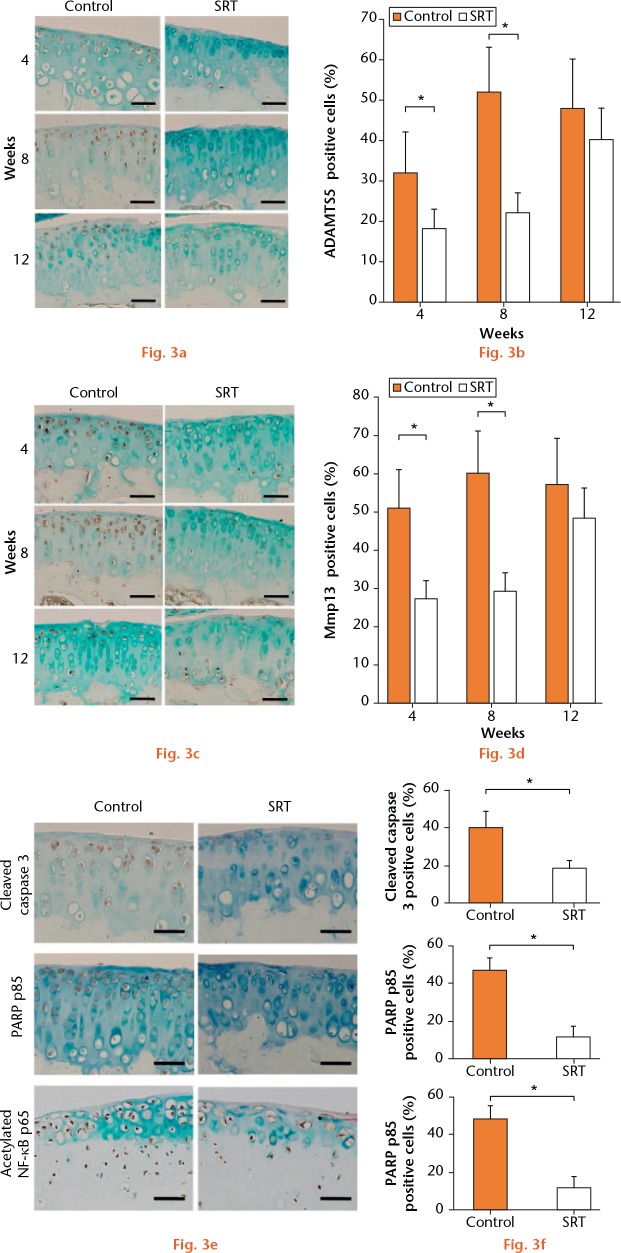
Results: The OARSI score was significantly lower in mice treated with SRT1720 than in control mice at eight and 12 weeks associated with the decreased size of osteophytes at four and eight weeks. The delayed OA progression in the mice treated with SRT1720 was also associated with increased SIRT1-positive chondrocytes and decreased MMP-13-, ADAMTS-5-, cleaved caspase-3-, PARP p85-, and acetylated NF-κB p65-positive chondrocytes and decreased synovitis at four and eight weeks. SRT1720 treatment partially rescued the decreases in collagen type II alpha 1 (COL2A1) and aggrecan caused by IL-1β, while also reducing the induction of MMP-13 by IL-1β in vitro.
Conclusion: The intraperitoneal injection of SRT1720 attenuated experimental OA progression in mice, indicating that SRT1720 could be a new therapeutic approach for OA.Cite this article: K. Nishida, T. Matsushita, K. Takayama, T. Tanaka, N. Miyaji, K. Ibaraki, D. Araki, N. Kanzaki, T. Matsumoto, R. Kuroda. Intraperitoneal injection of the SIRT1 activator SRT1720 attenuates the progression of experimental osteoarthritis in mice. Bone Joint Res 2018;7:252-262. DOI: 10.1302/2046-3758.73.BJR-2017-0227.R1.
Keywords: Osteoarthritis; SIRT1; SRT1720; Synovitis.
Conflict of interest statement
Conflicts of Interest Statement: None declared
Figures




References
-
- Hellio Le Graverand-Gastineau MP. OA clinical trials: current targets and trials for OA. Choosing molecular targets: what have we learned and where we are headed? Osteoarthritis Cartilage 2009;17:1393-1401. - PubMed
-
- Imai S, Armstrong CM, Kaeberlein M, Guarente L. Transcriptional silencing and longevity protein Sir2 is an NAD-dependent histone deacetylase. Nature 2000;403:795-800. - PubMed
-
- Vaquero A, Sternglanz R, Reinberg D. NAD+-dependent deacetylation of H4 lysine 16 by class III HDACs. Oncogene 2007;26:5505-5520. - PubMed
LinkOut - more resources
Full Text Sources
Other Literature Sources
Research Materials