


Biased agonism: the quest for the analgesic holy grail
- PMID: 29922742
- PMCID: PMC5999417
- DOI: 10.1097/PR9.0000000000000650
Biased agonism: the quest for the analgesic holy grail
Abstract
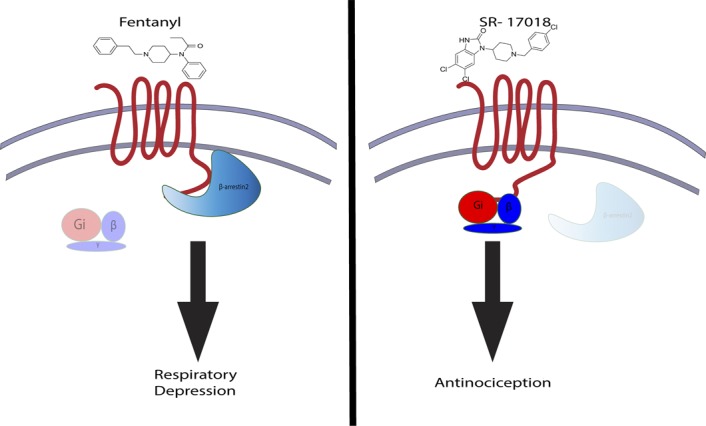
Opioids alleviate pain, but adverse effects severely limit their usefulness. To solve this problem, biased ligands favoring 1 signaling pathway downstream of the μ-opioid receptor over another are being developed. In the target article, the authors synthesize compounds that preferentially activate G-protein or β-arrestin signaling. They find that increased bias towards G-protein signaling produces better antinociception with minimal side effects in mice models. G-protein-biased opioids may provide a safer treatment strategy.
Keywords: Bias; Functional selectivity; Opioid; Signaling.
Conflict of interest statement
Sponsorships or competing interests that may be relevant to content are disclosed at the end of this article.
Figures
References
-
- Altarifi AA, David B, Muchhala KH, Blough BE, Akbarali H, Negus SS. Effects of acute and repeated treatment with the biased mu opioid receptor agonist TRV130 (oliceridine) on measures of antinociception, gastrointestinal function, and abuse liability in rodents. J Psychopharmacol 2017;31:730–9. - PMC - PubMed
-
- Bohn LM, Lefkowitz RJ, Gainetdinov RR, Peppel K, Caron MG, Lin FT. Enhanced morphine analgesia in mice lacking β-arrestin 2. Science 1999;286:2495–8. - PubMed
-
- DeWire SM, Yamashita DS, Rominger DH, Liu G, Cowan CL, Graczyk TM, Chen XT, Pitis PM, Gotchev D, Yuan C, Koblish M. A G protein-biased ligand at the μ-opioid receptor is potently analgesic with reduced gastrointestinal and respiratory dysfunction compared with morphine. J Pharmacol Exp Ther 2013;344:708–17. - PubMed
-
- Kenakin T, Christopoulos A. Signalling bias in new drug discovery: detection, quantification and therapeutic impact. Nat Rev Drug Discov 2013;12:205. - PubMed
Grants and funding
LinkOut - more resources
Full Text Sources
Other Literature Sources
Research Materials