Review
. 2018 Jul 30;47(15):5891-5918.
doi: 10.1039/c7cs00906b.

Continuous flow biocatalysis

Affiliations
Review

Continuous flow biocatalysis

Joshua Britton et al. Chem Soc Rev. .

Abstract

The continuous flow synthesis of active pharmaceutical ingredients, value-added chemicals, and materials has grown tremendously over the past ten years. This revolution in chemical manufacturing has resulted from innovations in both new methodology and technology. This field, however, has been predominantly focused on synthetic organic chemistry, and the use of biocatalysts in continuous flow systems is only now becoming popular. Although immobilized enzymes and whole cells in batch systems are common, their continuous flow counterparts have grown rapidly over the past two years. With continuous flow systems offering improved mixing, mass transfer, thermal control, pressurized processing, decreased variation, automation, process analytical technology, and in-line purification, the combination of biocatalysis and flow chemistry opens powerful new process windows. This Review explores continuous flow biocatalysts with emphasis on new technology, enzymes, whole cells, co-factor recycling, and immobilization methods for the synthesis of pharmaceuticals, value-added chemicals, and materials.


Conflict of interest statement

Conflict of interest

The authors declare the following competing financial interest: JB and GAW are co-founders of Synthase Inc., which is developing products related to the research described here. The terms of this arrangement have been reviewed and approved by the University of California, Irvine in accordance with its conflict of interest policies.

Figures

Figure 1
Figure 1
Continuous flow reactors used for continuous flow synthesis and biocatalysis. The prices given are estimates from recent experience.
Figure 2
Figure 2. Continuous flow basics and equipment.
A) The continuous flow systems depicted in this Review will use the legend shown here. B) Several different schematics of continuous flow systems. The first continuous flow system would be used for a synthetic transformation using two pumps to mix fluids before entering the reactor. The fluid then passes through the reactor before exiting through a backpressure regulator into the collection flask. The variables indicated in the scheme should be quoted (flow rate, reactor volume, internal diameter of the reactor tubing, and reactor temperature) in manuscripts. The second system is a simple continuous flow biocatalysis experiment. Here, a substrate solution is pumped through a packed bed reactor housing immobilized enzymes. The solution passes through the reactor to be modified before exiting into a collection flask. The third system is an advanced experimental set-up. Here, an organic solvent (such as ethyl acetate) is pumped through the packed bed reactor with the substrate solution. The organic phase dissolves the product to accelerate the enzymatic reaction, and a UV detector that can provide information back to the pumps monitors the out flow. Additionally, an in-line separator is used to separate the aqueous layer from the organic. In theory, this approach can provide a pure stream of product in the organic layer. C) Both semi-continuous and continuous pumps are shown. The benefits and disadvantages are described and a rough price given. The high price of continuous flow pumps often limits the construction of larger continuous flow systems. The cost indicated ($, USD) may vary amongst supplier and country.
Figure 3
Figure 3. Advantages and disadvantages of common continuous flow equipment.
Here, the advantages and disadvantages of each piece of modular continuous flow equipment are described from our personal experience. The cost indicated ($, USD) may vary amongst supplier and country.
Figure 4
Figure 4
The total number of patents and publications in continuous flow biocatalysis since 2000. This graph was constructed using data from Scifinder with the terms “continuous flow biocatalysis”. Data was analyzed to January 2018.
Figure 5
Figure 5
Examples of immobilization materials used for adsorption.
Figure 6
Figure 6
Examples of materials for covalent immobilization.
Figure 7
Figure 7
Examples of affinity immobilization.
Figure 8
Figure 8
Encapsulation immobilization.
Figure 9
Figure 9
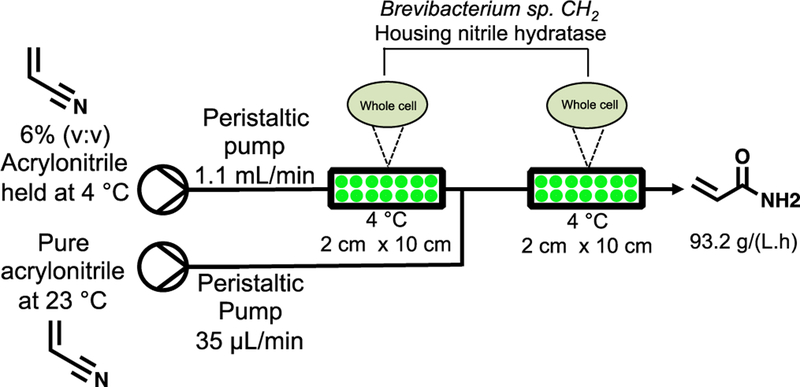
Whole cell continuous flow synthesis of acrylamide using two packed bed reactors housing Brevibacterium sp. CH2 expressing nitrile hydratase.
Figure 10
Figure 10
Whole cell continuous flow synthesis of maltotetraose using a packed bed reactor containing immobilized E. coli cells on calcium-alginate beads. Images were used with permission from Springer, Nature – 2018.
Figure 11
Figure 11
Whole cell continuous flow synthesis of cyclohexanol using immobilized Geotrichum candidum on BL-100 beads with super critical CO2.
Figure 12
Figure 12
Whole cell continuous flow hydrolysis of lactose using immobilized Kluyveromyces lactis on alginate. ss= stainless steel.
Figure 13
Figure 13
Whole cell continuous flow reduction of 2,5-hexanedione to (2R,5R)-hexanediol using immobilized Lactobacillus kefiri. Flow rates and pump type were omitted in the original publication.
Figure 14
Figure 14
Whole cell continuous flow reduction of acetophenone to (S)-1-phenylethanol using immobilized Rhodotorula glutinis on calcium alginate.
Figure 15
Figure 15
Whole cell continuous flow synthesis of biodiesel from palm oil using Aspergillus niger immobilized on polyurethane support particles.
Figure 16
Figure 16
Whole cell continuous flow resolution of (R,S)-flurbiprofen using dry mycelium of Aspergillus oryzau in a Vapourtec R2+/R4 reactor.
Figure 17
Figure 17
Whole cell continuous flow reduction of fluorinated acetophenone analogues using immobilized Geotrichum candidum on calcium alginate.
Figure 18
Figure 18
Continuous flow enantioselective esterification of rac-trans-2-phenyl-1-cyclohaxanol using an immobilized lipase expressed in Candida rugosa.
Figure 19
Figure 19
Continuous flow synthesis of alkyl esters using Novozyme 435 in a packed bed reactor.
Figure 20
Figure 20
Continuous flow epoxidation using Novozyme 435 in a packed bed reactor with hydrogen peroxide as the initial oxygen source.
Figure 21
Figure 21
Continuous flow ring opening polymerization of ε-caprolactone using Novozyme 435 in a microfluidic device. This figure was with permission. Copyright (2018) American Chemical Society.
Figure 22
Figure 22
A two-step continuous flow process that involves high temperature ring opening and then chiral resolution of the product by Novozyme 435. A) The chemoenzymatic synthesis. Here, a HPLC pump passes the reaction mixture through a reactor coil placed in a bench-top microwave reactor to implement a fast ring opening. B) The second step of the process is the chiral resolution of the trans product through use of Novozyme 435. This figure was used with permission. Copyright (2018) American Chemical Society. Mw=microwave.
Figure 23
Figure 23
Continuous flow esterification using an immobilized lipase from Rhizomucor miehei. A) The continuous flow system used a packed bed reactor of protein. B) The 3-D plot of the response surface methodology (RSM). In this plot, Q=flow rate and [s]= concentration of substrate. This figure was used with permission. Copyright (2018) American Chemical Society.
Figure 24
Figure 24
Continuous flow amidation and esterification of 3-amino-1,2-propanediol using Novozyme 435 in the production of ceramides.
Figure 25
Figure 25
The multi-step chemoenzymatic synthesis of chiral cyanohydrins using Novozyme 435, a (R)-selective hydroxynitrile lyase, and a room temperature chemical acylation. For the range of chemical functionality present for R, see the original publication.
Figure 26
Figure 26
Waste water treatment using an immobilized lipase on activated carbon to hydrolyze fats and oils in continuous flow. The top photographs are SEM images of the immobilized enzyme on the activated carbon. The photographs used in this figure were reproduced with permission from the Royal Society of Chemistry (2018).
Figure 27
Figure 27
Continuous flow synthesis of caffeic acid phenylethyl ester (CAPE) using immobilized Novozyme 435 in a microfluidic chip.
Figure 28
Figure 28
A continuous flow synthesis of sorbitol using a co-immobilized packed bed reactor of purified invertase and oxidoreductase contained within Zymomonas mobilis. A) The exploited biochemical transformation in this system. B) The continuous flow set-up.
Figure 29
Figure 29
A continuous flow degradation of paraoxon using immobilized organophosphatase immobilized onto cellulose fibers using a cellulose-binding domain.
Figure 30
Figure 30
Continuous flow reduction using penaerythritol tetranitrate reductase in a biphasic continuous flow reactor. UV optics was purchased from Ocean Optics, and measurements were collected at one to five minute intervals. The photographs used in this figure were reproduced with permission from the Royal Society of Chemistry (2018).
Figure 31
Figure 31
Continuous flow oxidation of phenols into phenol-containing polymers using horseradish peroxidase. The photographs used in this figure were reproduced with permission from Elsevier (2018).
Figure 32
Figure 32
Continuous flow phosphorylation using acid phosphatase immobilized into polymethacrylate beads.
Figure 33
Figure 33
Continuous flow C-C bond formation using wild-type transketolase. This reaction does not use immobilized enzyme. Additionally, the Mg2+ (9.8 mM) and thiamine diphosphate (2.4 mM) present in the reaction mixture have been omitted for clarity. The photographs used in this figure were reproduced with permission from Elsevier (2018).
Figure 34
Figure 34
Continuous flow oxygenation using a tube-in-tube reactor with 2-hydroxybiphenyl 3-monooxygenase and O2. The lower schematic used in this figure were reproduced from the original manuscript. The photographs used in this figure were reproduced with permission from John Wiley and Sons (2018).
Figure 35
Figure 35
Continuous flow synthesis of optically pure amines using immobilized E. coli cells on methacrylate polymer resin overexpressing ω-transaminase.
Figure 36
Figure 36
Continuous flow synthesis of different meso-compounds using a three-enzyme continuous flow system. A) The molecules possible through double reduction of starting compound 1. B) The microfluidic set up showing the two enzymes involved in this multi-step process. Not shown is the third enzyme (glucose 1-dehydrogenase) involved in co-factor regeneration. C) The effect of immobilizing either the (S)-selective or (R)-selective reductase at different points of the micro reactor and its effect on the ratio of compounds 3c/3d. For additional information and larger images, please see the original publication. This figure was used with permission. Copyright (2018) American Chemical Society.
Figure 37
Figure 37
Multi-step continuous flow biocatalysis using thin films and IMAC-based attachment. A) The continuous operation allowing protein purification and immobilization in ten minutes from cell lysate. First the column is charged with Ni2+, then PBS rinses out any residual Ni2+. The cell lysate is then recycled through the reactor five times before the immobilized protein is washed with a low concentration of imidazole. B) The different stripes and patterns possible when using this methodology. C) The enzyme immobilization mode utilizing polyhistidine tags on the protein. This figure was used with permission. Copyright (2018) John Wiley and Sons.
Figure 38
Figure 38
Continuous flow biocatalysis using a ketoreductase and NADP(H) co-immobilized into porous agarose beads. Under these conditions, the ketoreductase yielded the (S)-enantiomer, however; all other substrates yielded the (R)-enantiomer. IPA was used to regenerate the co-factor.
Figure 39
Figure 39
Continuous flow synthesis of amines from alanine as an amine source and an aldehyde amine acceptor using immobilized purified transaminase on cobalt-derivatized epoxy-resin. Additionally, this example uses a Zaiput Flow technologies liquid-liquid separator and polymer supported benzylamine to purify the reaction mixture and provide a means of recycling any unreacted substrate.
Figure 40
Figure 40
Continuous flow synthesis of aldehydes using immobilized purified transaminase on cobalt-derivatized epoxy-resin. Here, a toluene stream is added to the reaction mixture (50:50 v:v) to ensure the aldehyde is not immobilized onto the packed bed reactor. Simple acidification of the effluent stream with HCl allows a biphasic liquid-liquid extraction with a Zaiput liquid-liquid separator.
Figure 41
Figure 41
Continuous flow synthesis of a (S)-phenylalanine derivative using phenylalanine ammonia lyase from Aradidopis thaliana. The enzyme was expressed with a carbohydrate-binding domain at the C-terminus of the protein allowing rapid immobilization onto a carbohydrate based resin (Avicel).
Figure 42
Figure 42
Continuous flow synthesis of (L)-myo-inositol 1-phosphate using (L)-myo-inositol 1-phosphate synthase from Trypanosoma brucei immobilized onto IMAC resin.
Figure 43
Figure 43
Multi-step continuous flow synthesis of (2S,3R)-amino-1,3,4-butanetriol using a transketolase and transaminase in cascading continuous flow reactors.
Figure 44
Figure 44
Continuous flow oxidation of 2-methyl-1,3-propandiol using whole cells of Acetobacter aceti MIM 2000/28 immobilized onto alginate.
Figure 45
Figure 45
Continuous flow synthesis of the terpene amorpha-4,11-diene using a biphasic system comprised of buffer and pentane.
Figure 46
Figure 46
Continuous flow asymmetric reduction of ketones using an alcohol dehydrogenase immobilized onto HaloLink resin. The UV monitoring equipment was purchased from Uniqsis Ltd. The photographs used in this figure were reproduced with permission from The Royal Society of Chemistry (2018).
Figure 47
Figure 47
Chiral resolution of (D)- and (L)-alanine using whole cells with wild type (D)-amino acid oxidase. In this example, a batch vs. continuous flow experiment is done. A) The biocatalytic system used in both the continuous flow and batch experiment. Note that oxygen is required in the transformation. B) The Coflore agitated cell reactor (Coflore ACR) and a close up photograph of one of the agitators. C) The Coflore agitated tube reactor (Coflore ACR) with a close up photograph of the agitator movement. The photographs used in this figure were reproduced with permission from Science Direct (2018).
Figure 48
Figure 48
The variable diameter tube reactor for reducing 1-heptaldehyde to 1-heptanol using a thermophilic alcohol dehydrogenase. The larger diameter tubing (2.15 mm i.d.) at the start of the continuous flow system is more effective with higher substrate concentrations (300 mM) compared to the smaller diameter tubing (1.00 and 0.50 mm i.d.) that is more effective operating under lower substrate concentrations (~100–200 mM). This figure was used with permission. Copyright (2018) John Wiley & Sons.
Figure 49
Figure 49
Continuous flow phosphorylation of glucose using immobilized sucrose phosphorylase. The enzyme was immobilized onto silica springs using a silica-binding domain. Interestingly, the reaction was improved 10-fold in an 87 μL volume microfluidic chip. This figure was used with permission. Copyright (2018) American Chemical Society.
Figure 50
Figure 50
Continuous flow kinetic resolution of (rac)-methylbenzylamine using a (R)-selective ω-transaminase immobilized onto the surface of 3D printed reactor constructed from Nylon Taulman 618. The photographs used in this figure were reproduced with permission from The Royal Society of Chemistry (2018).
Figure 51
Figure 51
Continuous flow reduction of acetophenone using immobilized alcohol dehydrogenase. The photographs used in this figure were reproduced with permission from The Royal Society of Chemistry (2018).
Figure 52
Figure 52
Co-factors for biosynthsis. The most common reaction for each co-factor is as follows: NAD+ and NADP+ = hydride acceptor, NADH and NADPH = hydride addition, ATP = phosphoryl transfer, Sugar nucleotides = glycosyl transfer, Coenzyme A = acyl transfer, PAPS = sulfuryl transfer, S-Adenosyl methionine = methyl transfer, Flavins = oxygenation, PLP = transamination and Biotin = carboxylation.
Figure 53
Figure 53
Continuous electrochemical regeneration of NAD+ by use of a graphite electrode. A) The reaction scheme showing the conversion of glucose to gluconic acid using glucose dehydrogenase. B) The continuous flow set-up used for the reaction and the electrochemical oxidation of NADH to NAD+.
Figure 54
Figure 54
Continuous electrochemical regeneration of NAD+ using a Y-shaped system. A) The series of chemical reactions that take place in the system to convert NAD+ back into NADH for another enzymatic reaction. B) The reactor system showing the chemical composition of each stream. This figure was used with permission. Copyright (2018) American Chemical Society.
Figure 55
Figure 55
Continuous regeneration of NAD+ using a glassy carbon anode system. A) The continuous flow electrochemical set-up, the chemicals used for the regeneration and the biotranaformation of glucose, and the molecular structure of ABTS. B) The chain of chemical reactions that take place to regenerate NAD+ for biocatalysis.
Figure 56
Figure 56
The continuous reduction of FAD to facilitate styrene oxide production from styrene. A) The reactor set-up shows styrene oxide synthesis from styrene using the enzymes styrene monooxygenase and catalase, and co-factor FAD. B) A schematic of the electrochemical reactor. The photographs used in this figure were reproduced with permission from Elsevier (2018).
Figure 57
Figure 57
The continuous flow enatioselective reduction of an aryl ketone using co-immobilized alcohol dehydrogenase and formate dehydrogenase. Additionally, the co-factor NAD+ is immobilized on agarose microbeads. The lower figure shows the chemical transformations that occur to make this a renewable system.
Figure 58
Figure 58
Continuous resolution of (S)-phenylethanol using immobilized Novozyme 435 for (R)-selective esterification with vinyl laurate. This figure has been simplified to match the text, for the in depth schematic and information on the separators, see the original publication.
Figure 59
Figure 59
Continuous kinetic resolution of (R,S)-Flurbiprofen using an immobilized lipase and n-butanol.
Figure 60
Figure 60
Continuous resolution of (RS)-phenylethanol using an immobilized lipase, vinyl propionate, and super critical CO2.
Figure 61
Figure 61
Continuous resolution of 1,5-dihydroxy-1,2,3,4-tetrahydronaphthalene using an immobilized lipase.
Figure 62
Figure 62
Continuous resolution using either an immobilized lipase from Candida antartica or an immobilized lipase from Pseudomonas fluorescens.
Figure 63
Figure 63
Continuous resolution of 2-acetoxy-2-(2-chlorophenyl)acetate using an immobilized mutant esterase from from Pseudomonas putida.
Figure 64
Figure 64
Continuous resolution of racemic N-Boc-phenylalanine ethyl thioester using cartridges filed with immobilized acylase and grafted silica gel.
Figure 65
Figure 65
Continuous flow lipase resolution of a cyclopropane carboxylate ester in a packed bed reactor for a total residence time of 40 min.
Figure 66
Figure 66
Continuous flow resolution of (±)-1,3,6-tri-O-benzyl-myo-inositol with vinyl acetate and Novozyme 435.

References

    1. Britton J and Raston CL, Chem. Soc. Rev, 2017, 46, 1250–1271. - PubMed
    1. Lévesque F and Seeberger PH, Angew. Chem. Int. Edit, 2012, 51, 1706–1709. - PubMed
    1. Gutmann B, Cantillo D and Kappe CO, Angew. Chem. Int. Edit, 2015, 54, 6688–6728. - PubMed
    1. Baumann M and Baxendale IR, Beilstein J. Org. Chem, 2015, 11, 1194–1219. - PMC - PubMed
    1. Britton J and Jamison TF, Angew. Chem. Int. Edit, 2017, 129, 8949–8953.

Substances