


Emotional face recognition in male adolescents with autism spectrum disorder or disruptive behavior disorder: an eye-tracking study
- PMID: 29922873
- PMCID: PMC6133091
- DOI: 10.1007/s00787-018-1174-4
Emotional face recognition in male adolescents with autism spectrum disorder or disruptive behavior disorder: an eye-tracking study
Abstract
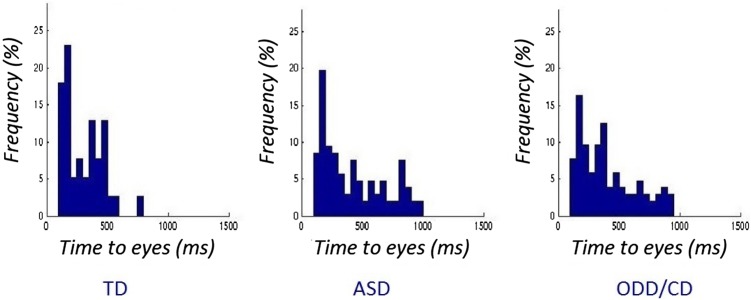
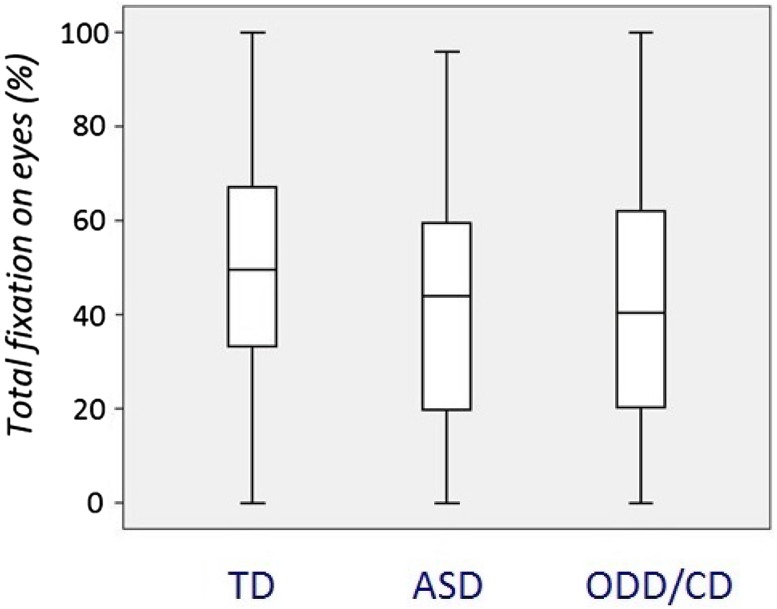
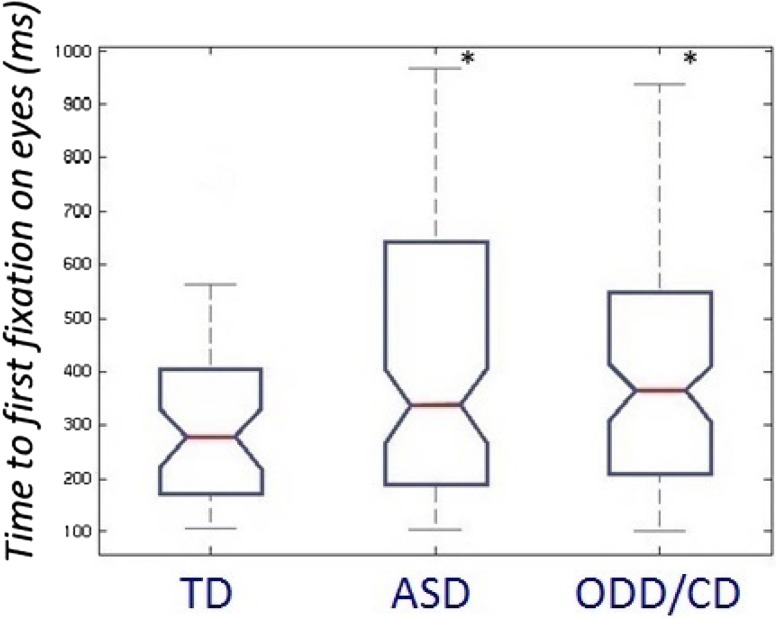
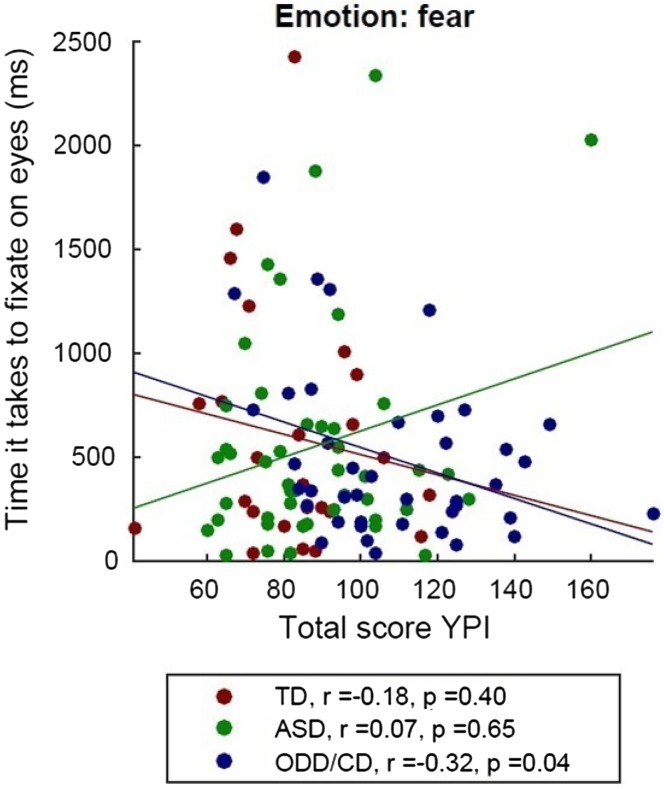
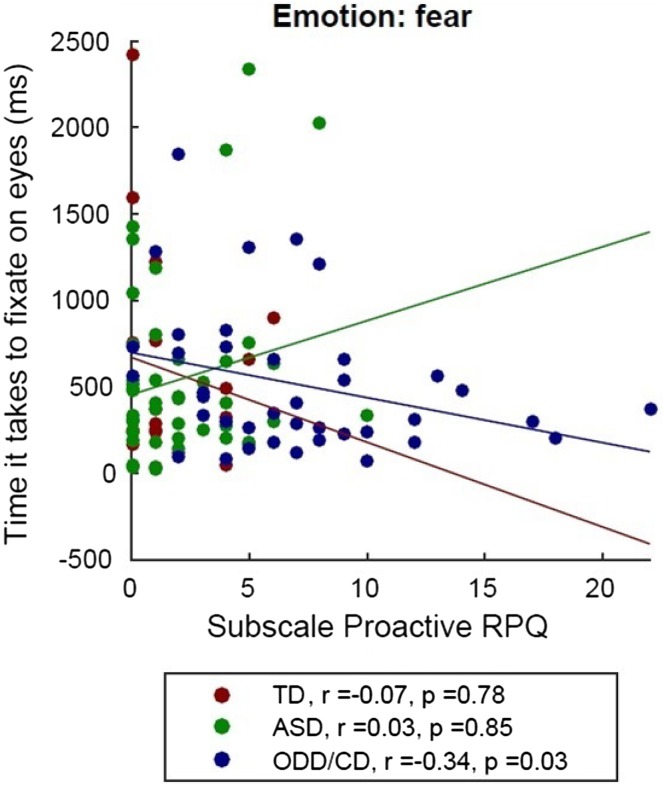
Autism Spectrum Disorder (ASD), Oppositional Defiant Disorder (ODD), and Conduct Disorder (CD) are often associated with emotion recognition difficulties. This is the first eye-tracking study to examine emotional face recognition (i.e., gazing behavior) in a direct comparison of male adolescents with Autism Spectrum Disorder or Oppositional Defiant Disorder/Conduct Disorder, and typically developing (TD) individuals. We also investigate the role of psychopathic traits, callous-unemotional (CU) traits, and subtypes of aggressive behavior in emotional face recognition. A total of 122 male adolescents (N = 50 ASD, N = 44 ODD/CD, and N = 28 TD) aged 12-19 years (M = 15.4 years, SD= 1.9) were included in the current study for the eye-tracking experiment. Participants were presented with neutral and emotional faces using a Tobii 1750 eye-tracking monitor to record gaze behavior. Our main dependent eye-tracking variables were: (1) fixation duration to the eyes of a face and (2) time to the first fixation to the eyes. Since distributions of eye-tracking variables were not completely Gaussian, non-parametric tests were chosen to investigate gaze behavior across the diagnostic groups with Autism Spectrum Disorder, Oppositional Defiant Disorder/Conduct Disorder, and Typically Developing individuals. Furthermore, we used Spearman correlations to investigate the links with psychopathy, callous, and unemotional traits and subtypes of aggression as assessed by questionnaires. The relative total fixation duration to the eyes was decreased in both the Autism Spectrum Disorder group and the Oppositional Defiant Disorder/Conduct Disorder group for several emotional expressions. In both the Autism Spectrum Disorder and the Oppositional Defiant Disorder/Conduct Disorder group, increased time to first fixation on the eyes of fearful faces only was nominally significant. The time to first fixation on the eyes was nominally correlated with psychopathic traits and proactive aggression. The current findings do not support strong claims for differential cross-disorder eye-gazing deficits and for a role of shared underlying psychopathic traits, callous-unemotional traits, and aggression subtypes. Our data provide valuable and novel insights into gaze timing distributions when looking at the eyes of a fearful face.
Keywords: Aggression; Autism spectrum disorder; Callous and unemotional traits; Conduct disorder; Eye-tracking; Oppositional defiant disorder; Psychopathy.
Conflict of interest statement
CC.A.H. Bours, M.J. Bakker-Huvenaars, J. Tramper, N. Bielczyk, A. N. Baanders, K.S. Nijhof, N.N.J. Lambregts-Rommelse, P. Medendorp, and F. Scheepers declared to have no conflicts of interest. J.C. Glennon has been in the past 3 years a consultant to Boehringer Ingelheim GmbH on matters unrelated to this paper. Jan K Buitelaar has been in the past 3 years a consultant to/member of advisory board of/and/or speaker for Janssen Cilag BV, Eli Lilly, Lundbeck, Shire, Roche, Novartis, Medice, and Servier. He is not an employee of any of these companies, and not a stock shareholder of any of these companies. He has no other financial or material support, including expert testimony, patents, and royalties.
Figures
References
-
- American Psychiatric Association (2013) Diagnostic and statistical manual of mental disorders (5th edn)
-
- Andershed HA, Kerr M, Stattin H, Levander S. Psychopaths: current international perspectives. Den Haag: Elsevier; 2002. Psychopathic traits in non-referred youths: a new assessment tool; pp. 131–158.
-
- APA (2013) Autism, psychology topics
-
- Association, A. P. (2000) Diagnostic criteria from dsm-iv-tr. American Psychiatric Pub
MeSH terms
Grants and funding
LinkOut - more resources
Full Text Sources
Other Literature Sources
Medical
