


Effects of endurance exercise training on inflammatory circulating progenitor cell content in lean and obese adults
- PMID: 29923191
- PMCID: PMC6046088
- DOI: 10.1113/JP276023
Effects of endurance exercise training on inflammatory circulating progenitor cell content in lean and obese adults
Abstract
Key points: Chronic inflammation underlies many of the health decrements associated with obesity. Circulating progenitor cells can sense and respond to inflammatory stimuli, increasing the local inflammatory response within tissues. Here we show that 6 weeks of endurance exercise training significantly decreases inflammatory circulating progenitor cells in obese adults. These findings provide novel cellular mechanisms for the beneficial effects of exercise in obese adults.
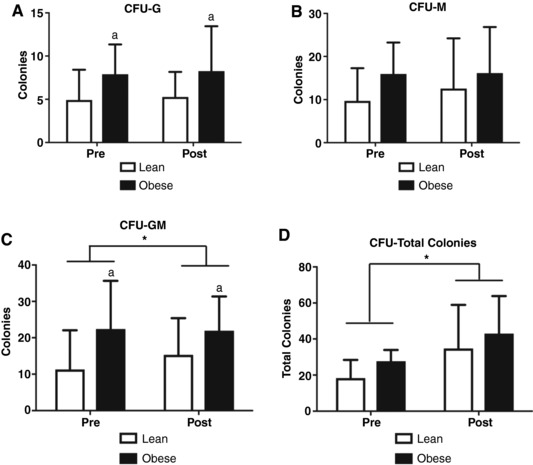
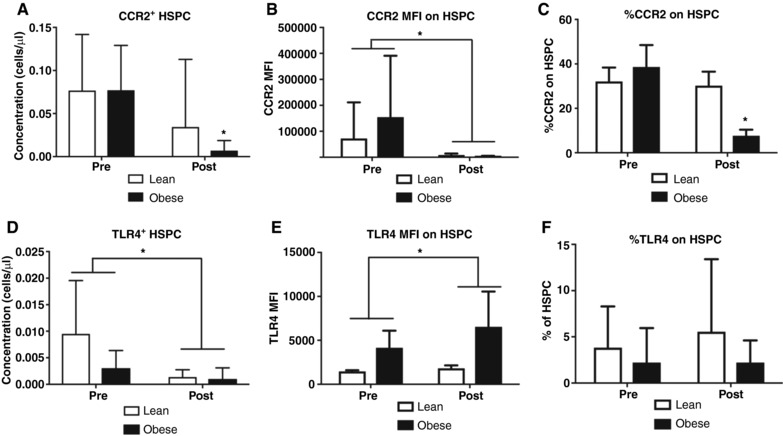
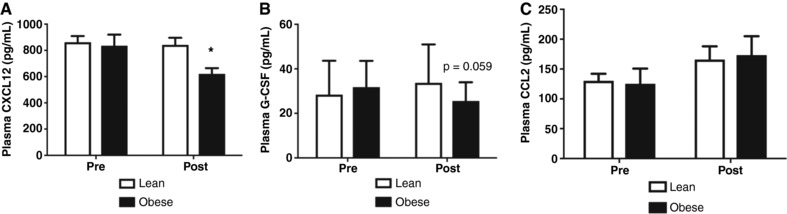
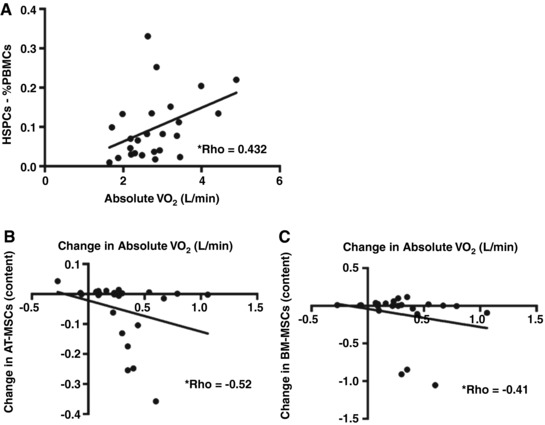
Abstract: Circulating progenitor cells (CPCs) and subpopulations are normally found in the bone marrow, but can migrate to peripheral tissues to participate in local inflammation and/or remodelling. The purpose of this study was to compare the CPC response, particularly the inflammatory-primed haematopoietic stem and progenitor (HSPC) subpopulation, to a 6 week endurance exercise training (EET) intervention between lean and obese adults. Seventeen healthy weight (age: 23.9 ± 5.4 years, body mass index (BMI): 22.0 ± 2.6 kg m-2 ) and 10 obese (age: 29.0 ± 8.0 years, BMI: 33.1 ± 6.0 kg m-2 ) previously sedentary adults participated in an EET. Blood was collected before and after EET for quantification of CPCs and subpopulations via flow cytometry, colony forming unit assays and plasma concentrations of C-X-C motif chemokine 12 (CXCL12), granulocyte-colony stimulating factor (G-CSF), and chemokine (C-C motif) ligand 2 (CCL2). Exercise training reduced the number of circulating HSPCs and adipose tissue-derived mesenchymal stem cells (AT-MSCs). EET increased the colony forming potential of granulocytes and macrophages irrespective of BMI. EET reduced the number of HSPCs expressing the chemokine receptor CCR2 and the pro-inflammatory marker TLR4. EET-induced changes in adipose tissue-derived MSCs and bone marrow-derived MSCs were negatively related to changes in absolute fitness. Our results indicate that EET, regardless of BMI status, decreases CPCs and subpopulations, particularly those primed for contribution to tissue inflammation.
Keywords: Hematopoietic stem cells; Inflammation; Mesenchymal stem cell; Obesity; chemokine c receptor 2.
© 2018 The Authors. The Journal of Physiology © 2018 The Physiological Society.
Figures
Comment in
-
Fat or thin, exercise wins: endurance exercise training reduces inflammatory circulating progenitor cells in lean and obese adults.J Physiol. 2018 Nov;596(22):5305-5306. doi: 10.1113/JP277229. Epub 2018 Oct 21. J Physiol. 2018. PMID: 30298546 Free PMC article. No abstract available.
References
-
- Adler BJ, Kaushansky K & Rubin CT (2014). Obesity‐driven disruption of haematopoiesis and the bone marrow niche. Nat Rev Endocrinol 10, 737–748. - PubMed
-
- Allen JM, Mailing LJ, Niemiro GM, Moore R, Cook MD, White BA, Holscher HD & Woods JA (2018). Exercise alters gut microbiota composition and function in lean and obese humans. Med Sci Sports Exerc 50, 747–757. - PubMed
-
- Baker JM, De Lisio M & Parise G (2011). Endurance exercise training promotes medullary hematopoiesis. FASEB J 25, 4348–4357. - PubMed
Publication types
MeSH terms
LinkOut - more resources
Full Text Sources
Other Literature Sources
Medical
