


Urodynamic characteristics of detrusor underactivity in women with voiding dysfunction
- PMID: 29924821
- PMCID: PMC6010249
- DOI: 10.1371/journal.pone.0198764
Urodynamic characteristics of detrusor underactivity in women with voiding dysfunction
Abstract
Introduction and hypothesis: Voiding dysfunction has gained interest due to its high prevalence in the elderly. This study characterized bladder dysfunction in women with voiding dysfunction using video urodynamic studies (VUDS) focused on detrusor underactivity (DU).
Methods: We studied 1914 women in which first-line medical treatment failed. Age, comorbidities, and urodynamic parameters were analyzed to determine the association between bladder sensation and contractility.
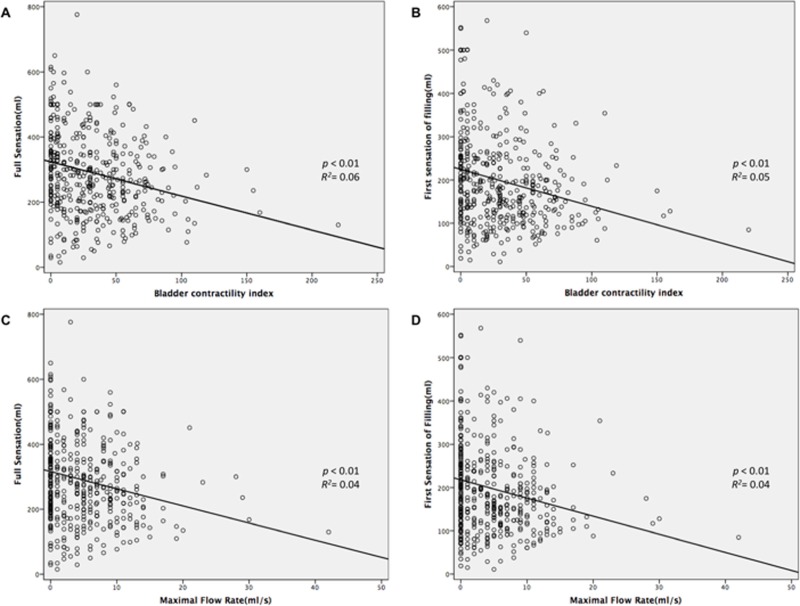
Results: VUDS were normal in 2.9% (n = 56) of patients and showed DU in 23.1% (n = 443), detrusor hyperactivity and impaired contractility (DHIC) in 12.0% (n = 231), hypersensitive bladder in 17.0% (n = 325), detrusor overactivity (DO) in 2.6% (n = 49) and bladder outlet obstruction in 42.3% (n = 810). The mean age of patients in the DU and DHIC groups was significantly older than in women with normal VUDS and those with hypersensitive bladders (p<0.01). Decreased bladder sensation and larger cystometric bladder capacity were noted in the DU group compared to the DHIC, HSB, and DO groups. Bladder sensation was negatively associated with the bladder contractility. Bladder contractility index and voiding efficiency were lower in the DU and DHIC groups compared to the normal group.
Conclusions: The bladder conditions of women with voiding dysfunction included DU, DHIC, HSB and DO. Bladder contractility index and voiding efficiency were significantly lowest in DU and DHIC groups and lower in HSB and DO groups than normal tracing group. Reduced bladder sensation was noted in DU and negatively associated with detrusor contractility.
Conflict of interest statement
The authors have declared that no competing interests exist.
Figures
References
-
- Haylen BT, de Ridder D, Freeman RM, Swift SE, Berghmans B, Lee J, et al. An International Urogynecological Association (IUGA)/International Continence Society (ICS) joint report on the terminology for female pelvic floor dysfunction. Neurourol Urodyn. 2010;29(1):4–20. doi: 10.1002/nau.20798 . - DOI - PubMed
-
- Groutz A, Gordon D, Lessing JB, Wolman I, Jaffa A, David MP. Prevalence and characteristics of voiding difficulties in women: are subjective symptoms substantiated by objective urodynamic data? Urology. 1999;54(2):268–72. . - PubMed
-
- Choi YS, Kim JC, Lee KS, Seo JT, Kim HJ, Yoo TK, et al. Analysis of female voiding dysfunction: a prospective, multi-center study. Int Urol Nephrol. 2013;45(4):989–94. doi: 10.1007/s11255-013-0475-2 . - DOI - PubMed
-
- Kuo H-C. Clinical symptoms are not reliable in the diagnosis of lower urinary tract dysfunction in women. J Formos Med Assoc. 2012;111(7):386–91. https://doi.org/10.1016/j.jfma.2011.05.014 - DOI - PubMed
-
- Abrams P, Cardozo L, Fall M, Griffiths D, Rosier P, Ulmsten U, et al. The standardisation of terminology of lower urinary tract function: report from the Standardisation Sub-committee of the International Continence Society. Am J Obstet Gynecol. 2002;187(1):116–26. . - PubMed
MeSH terms
LinkOut - more resources
Full Text Sources
Other Literature Sources
Medical
