


Reversing Mechanoinductive DSP Expression by CRISPR/dCas9-mediated Epigenome Editing
- PMID: 29924937
- PMCID: PMC6118013
- DOI: 10.1164/rccm.201711-2242OC
Reversing Mechanoinductive DSP Expression by CRISPR/dCas9-mediated Epigenome Editing
Abstract
Rationale: DSP (desmoplakin), the most abundant component of desmosomes, which maintain the mechanical integrity of epithelium, is a genome-wide association study-identified genetic risk locus in human idiopathic pulmonary fibrosis (IPF). Subjects with IPF express a significantly higher level of DSP than control subjects.
Objectives: Determine potential mechanisms by which DSP is regulated in lung fibrosis.
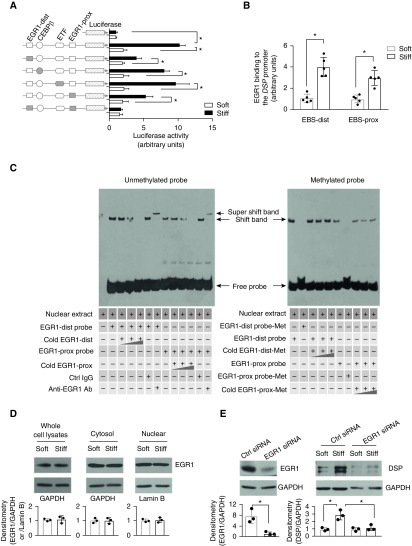
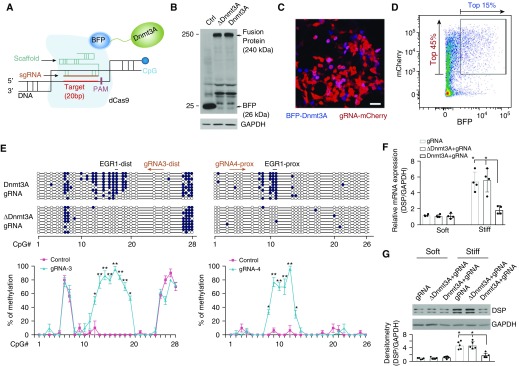
Methods: Matrigel-coated soft and stiff polyacrylamide gels were made to simulate the stiffness of normal and fibrotic lungs. Quantitative chromatin immunoprecipitation and electrophoretic mobility shift assay were used to evaluate transcription factor binding to the DSP promoter. Targeted DNA methylation was achieved by CRISPR (clustered regularly interspaced short palindromic repeats)/dCas9 (deactivated CRISPR-associated protein-9 nuclease)-mediated Dnmt3A (DNA methyltransferase 3A) expression under the guidance of sequence-specific single guide RNAs.
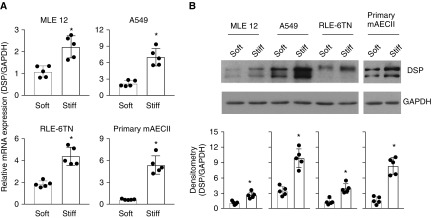
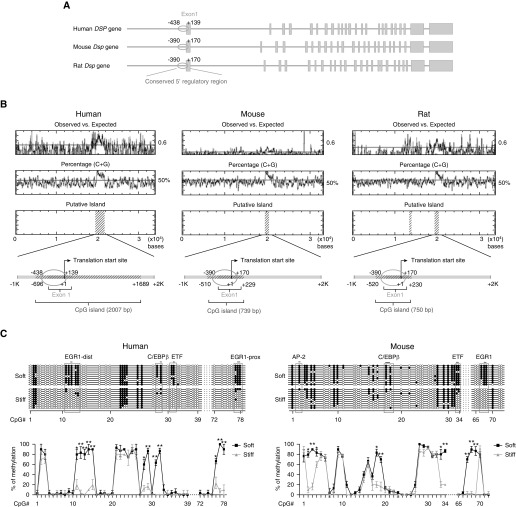
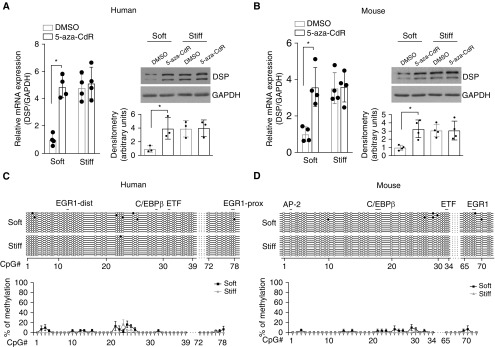
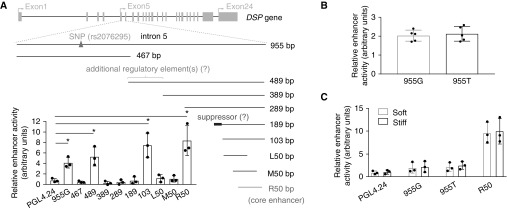
Measurements and main results: Stiff matrix promotes DSP gene expression in both human and rodent lung epithelial cells as compared with soft matrix. A conserved region in the proximal DSP promoter is hypermethylated under soft matrix conditions and becomes hypomethylated/demethylated under stiff matrix conditions. Demethylation of this conserved DSP promoter region is associated with transactivation of transcription factor EGR1 (early growth response protein 1), resulting in EGR1-dependent DSP overexpression. Targeted DNA methylation by CRISPR/dCas9/Dnmt3A-mediated epigenome editing blocks EGR1 binding to the DSP promoter and inhibits stiff matrix-induced DSP overexpression.
Conclusions: DSP is a matrix stiffness-regulated mechanosensitive gene. CRISPR/dCas9-Dnmt3A-mediated epigenome editing reverses DSP overexpression by reestablishment of the epigenetic control of DSP under the mechanically homeostatic environment. It provides a useful tool for investigations of the functional role of DSP in the pathogenesis of lung fibrosis.
Keywords: CRISPR/dCas9; desmoplakin; epigenome editing; lung fibrosis; matrix stiffness.
Figures
Comment in
-
Epigenome Editing Enters the Arena. A New Tool to Reveal (and Reverse?) Pathologic Gene Regulation.Am J Respir Crit Care Med. 2018 Sep 1;198(5):549-551. doi: 10.1164/rccm.201807-1239ED. Am J Respir Crit Care Med. 2018. PMID: 30016116 No abstract available.
References
-
- American Thoracic Society; European Respiratory Society. American Thoracic Society/European Respiratory Society International Multidisciplinary Consensus Classification of the Idiopathic Interstitial Pneumonias. This joint statement of the American Thoracic Society (ATS), and the European Respiratory Society (ERS) was adopted by the ATS board of directors, June 2001 and by the ERS Executive Committee, June 2001. Am J Respir Crit Care Med. 2002;165:277–304. - PubMed
-
- Garantziotis S, Schwartz DA. Host-environment interactions in pulmonary fibrosis. Semin Respir Crit Care Med. 2006;27:574–580. - PubMed
-
- Taskar VS, Coultas DB. Is idiopathic pulmonary fibrosis an environmental disease? Proc Am Thorac Soc. 2006;3:293–298. - PubMed
Publication types
MeSH terms
Substances
Grants and funding
LinkOut - more resources
Full Text Sources
Other Literature Sources
Research Materials
Miscellaneous
