


Liver maximum capacity (LiMAx) test as a helpful prognostic tool in acute liver failure with sepsis: a case report
- PMID: 29925334
- PMCID: PMC6011251
- DOI: 10.1186/s12871-018-0538-0
Liver maximum capacity (LiMAx) test as a helpful prognostic tool in acute liver failure with sepsis: a case report
Abstract
Background: Acute liver failure (ALF) is a life-threatening entity particularly when infectious complications worsen the clinical course. Urgent liver transplantation (LT) is frequently the only curative treatment. However, in some cases, recovery is observed under conservative treatment. Therefore, prognostic tools for estimating course of the disease are of great clinical interest. Since laboratory parameters sometimes lack sensitivity and specificity, enzymatic liver function measured by liver maximum capacity (LiMAx) test may offer novel and valuable additional information in this setting.
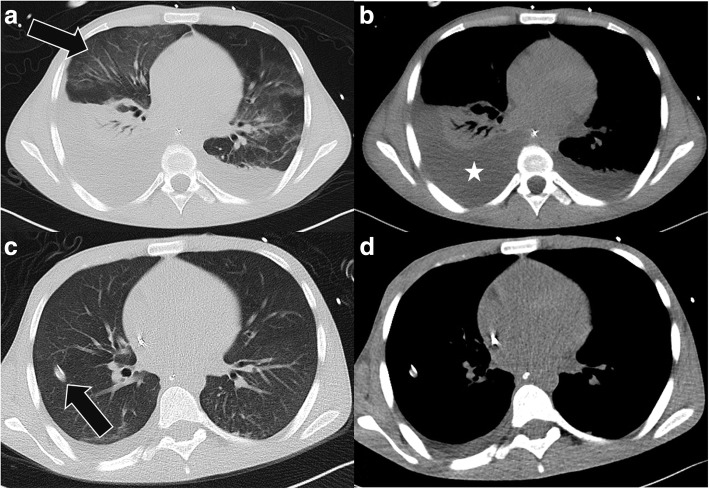
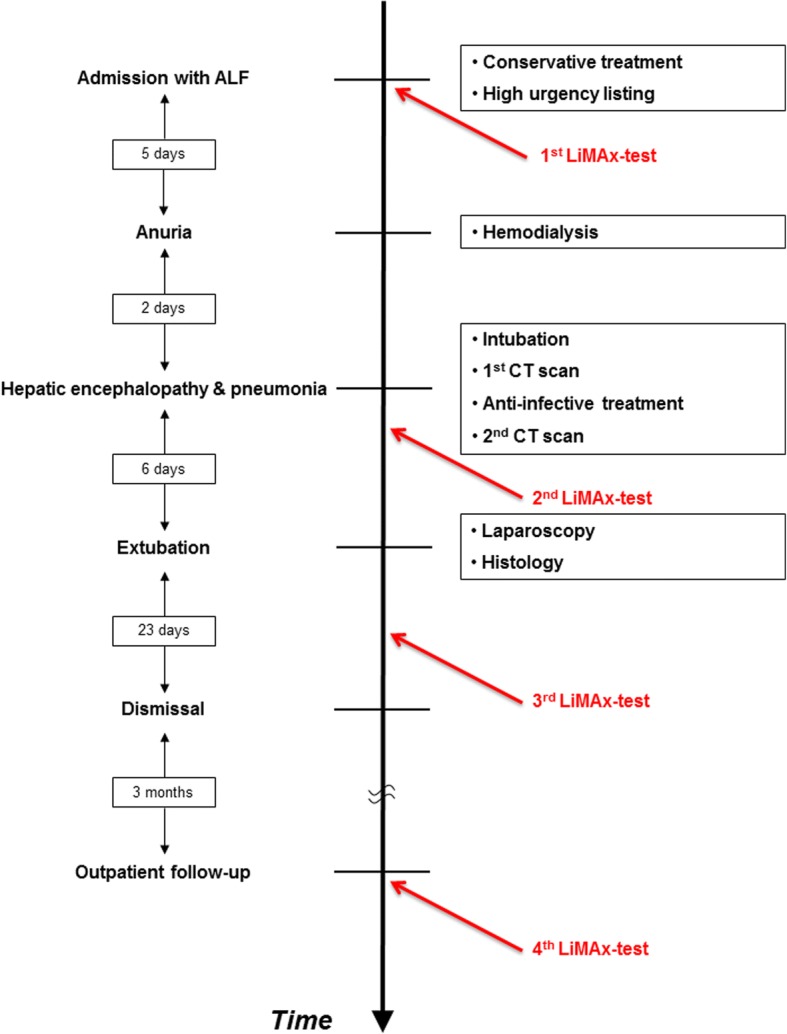
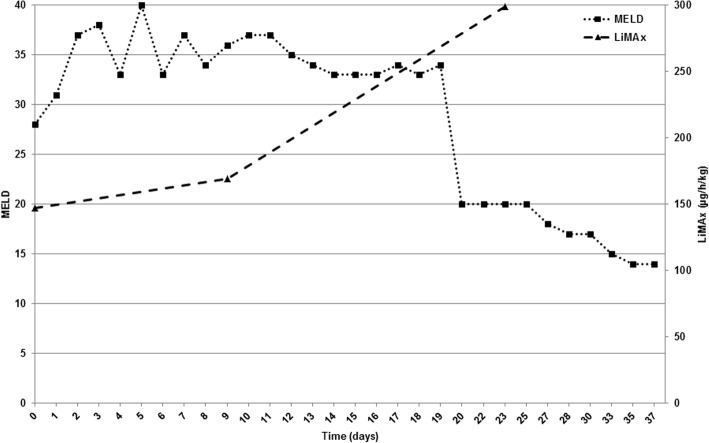
Case presentation: We here report the case of a formerly healthy 20-year old male caucasian patient who was admitted to our clinic for ALF of unknown origin in December 2017. Laboratory parameters confirmed the diagnosis with an initial MELD score of 28 points. Likewise, enzymatic liver function was significantly impaired with a value of 147 [> 315] μg/h/kg. Clinical and biochemical analyses for viral-, autoimmune-, or drug-induced hepatitis were negative. Liver synthesis parameters further deteriorated reaching a MELD score of 40 points whilst clinical course was complicated by septic pneumonia leading to severe hepatic encephalopathy grade III-IV, finally resulting in mechanical ventilation of the patient. Interestingly, although clinical course and laboratory data suggested poor outcome, serial LiMAx test revealed improvement of the enzymatic liver function at this time point increasing to 169 μg/h/kg. Clinical condition and laboratory data slowly improved likewise, however with significant time delay of 11 days. Finally, the patient could be dismissed from our clinic after 37 days.
Conclusion: Estimating prognosis in patients with ALF is challenging by use of the established scores. In our case, improvement of enzymatic liver function measured by the LiMAx test was the first parameter predicting beneficial outcome in a patient with ALF complicated by sepsis.
Keywords: Acute liver failure; King’s college criteria; LiMAx; Liver transplantation; MELD score.
Conflict of interest statement
Ethics approval and consent to participate
The ethics committee of the University of Duisburg-Essen (“Ethik-Kommission der Medizinischen Fakultät der Universität Duisburg-Essen”, Director Prof. Dr. U. Schara) approved the anonymous collection and publication of data for this case report.
Consent for publication
Written informed consent was obtained from the participant for publication of this article and any accompanying tables/images. A copy of the written consent is available for review by the Editor of this journal. The abstract was presented at the 27th annual congress of the “Gesellschaft für Gastroenterologie in Nordrhein-Westfalen” on 7th/8th june 2018 (Gastroenterologe (2018) 13: 215. 10.1007/s11377-018-0258-5). Permission from the copyright holder was obtained.
Competing interests
MB received consultant fee from Humedics. All other authors declare that they have no competing interests.
Publisher’s Note
Springer Nature remains neutral with regard to jurisdictional claims in published maps and institutional affiliations.
Figures
References
-
- Polson J, Lee WM. American Association for the Study of liver disease. AASLD position paper: the management of acute liver failure Hepatol Baltim Md. 2005;41:1179–1197. - PubMed
Publication types
MeSH terms
LinkOut - more resources
Full Text Sources
Other Literature Sources
