. 2018 Jun 27;285(1881):20180792.
doi: 10.1098/rspb.2018.0792.

Future effects of climate and land-use change on terrestrial vertebrate community diversity under different scenarios

Affiliations

Future effects of climate and land-use change on terrestrial vertebrate community diversity under different scenarios

Tim Newbold. Proc Biol Sci. .

Abstract

Land-use and climate change are among the greatest threats facing biodiversity, but understanding their combined effects has been hampered by modelling and data limitations, resulting in part from the very different scales at which land-use and climate processes operate. I combine two different modelling paradigms to predict the separate and combined (additive) effects of climate and land-use change on terrestrial vertebrate communities under four different scenarios. I predict that climate-change effects are likely to become a major pressure on biodiversity in the coming decades, probably matching or exceeding the effects of land-use change by 2070. The combined effects of both pressures are predicted to lead to an average cumulative loss of 37.9% of species from vertebrate communities under 'business as usual' (uncertainty ranging from 15.7% to 54.2%). Areas that are predicted to experience the effects of both pressures are concentrated in tropical grasslands and savannahs. The results have important implications for the conservation of biodiversity in future, and for the ability of biodiversity to support important ecosystem functions, upon which humans rely.

Keywords: biodiversity; climate change; future; global; land-use change; scenarios.


Conflict of interest statement

I declare I have no competing interests.

Figures
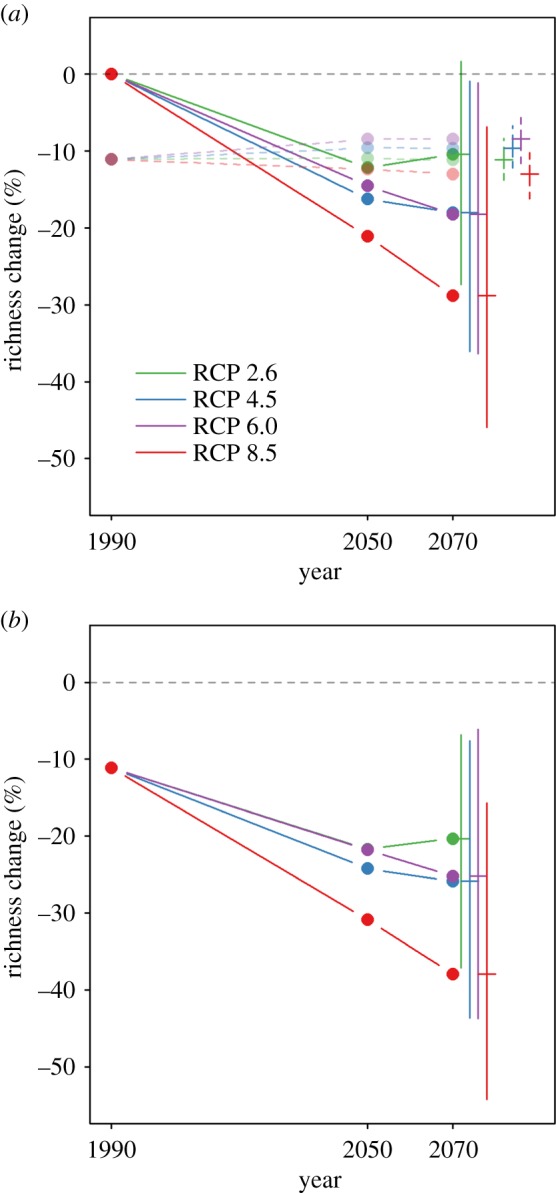
Figure 1.
Figure 1.
Predicted species richness of ecological communities under future climate and land-use change. All values are expressed relative to a pre-human baseline. Separate effects of climate (solid, opaque lines) and land use (dashed, translucent lines) are shown in (a), while combined effects of both pressures (assuming no interactions) are shown in (b). Error bars show estimated uncertainty in the projections for the year 2070: 95% confidence intervals for land-use impact models, range of estimates across the distribution model ensemble for the climate impact models and combined (additive) uncertainty for the combined projections. Results for both land-use and climate impacts are based on the final projections at a spatial resolution of 0.5°.
Figure 2.
Figure 2.
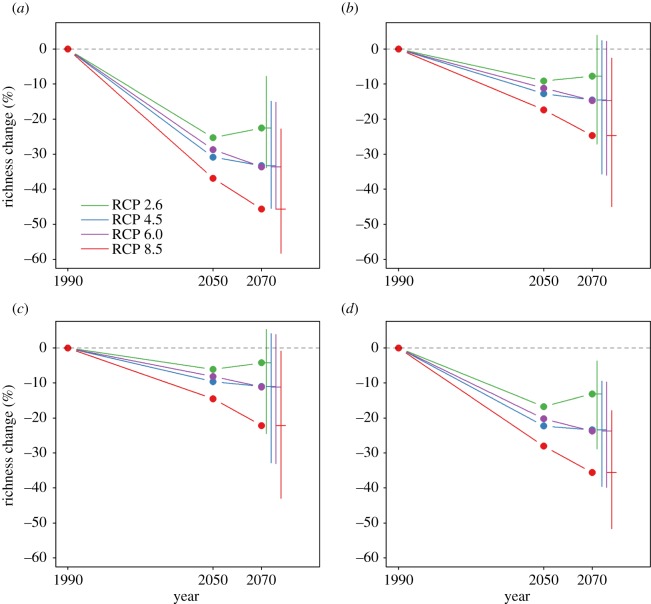
Predicted species richness of ecological communities under future climate change, for separate vertebrate clades. Predictions are shown for (a) amphibians, (b) birds, (c) mammals and (d) reptiles. Error bars show estimated uncertainty in the projections for the year 2070, expressed as the range of estimates across the distribution model ensemble.
Figure 3.
Figure 3.
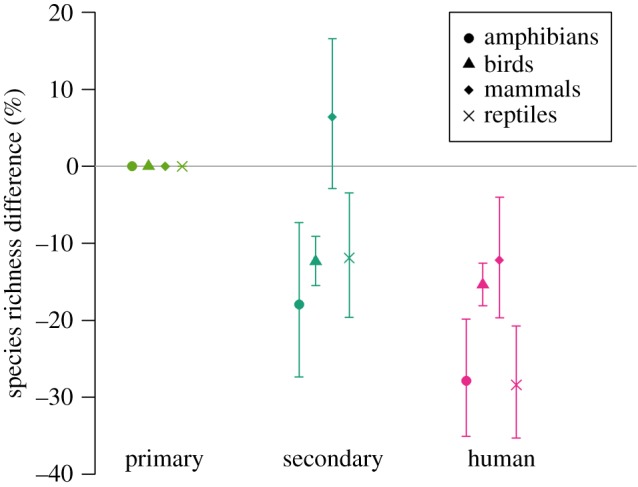
Response of each major vertebrate clade to land use. Unlike the main models of the response to land use, which combined all vertebrate classes and thus used data for many more sites (electronic supplementary material, figure S7), a much simpler classification of land use was used here, with categories of primary vegetation (pristine habitat with no record of destruction), secondary vegetation (natural habitat recovering after some recorded historical destruction) and human (plantations, croplands, pastures and areas of human settlement). Error bars show 95% confidence limits around the modelled responses. (Online version in colour.)
Figure 4.
Figure 4.
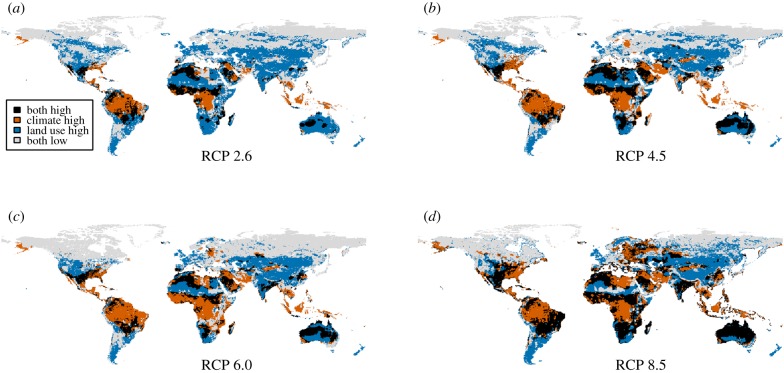
Spatial patterns of biodiversity loss from climate and land-use change by 2070. Areas with more than 10% net loss of species from climate change are shown in brown; areas with more than 10% loss of species from land-use change in blue; areas where more than 10% losses from each pressure overlap are shown in black; and areas with less than 10% losses from both pressures are shown in grey. Projections are shown for each of the socio-economic and greenhouse-gas-emission scenarios: (a) RCP 2.6; (b) RCP 4.5; (c) RCP 6.0 and (d) RCP 8.5. Results for both land-use and climate impacts are based on the final projections at a spatial resolution of 0.5°.
Figure 5.
Figure 5.
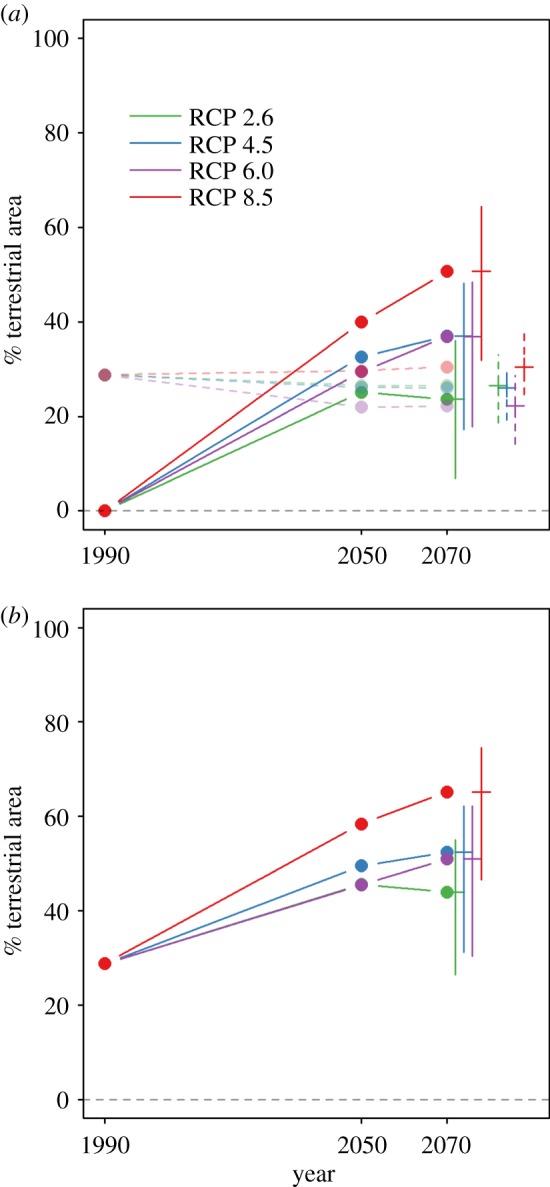
Predicted percentage of the Earth's terrestrial surface exceeding 20% species loss under future climate and land-use change. All values are expressed relative to a pre-human baseline. Separate effects of climate (solid, opaque lines) and land use (dashed, translucent lines) are shown in (a), while combined effects of both pressures (assuming no interactions) are shown in (b). Error bars show estimated uncertainty in the projections for the year 2070: 95% confidence intervals for land-use impact models, and range of estimates across the distribution model ensemble for the climate impact models. Results for both land-use and climate impacts are based on the final projections at a spatial resolution of 0.5°.

References

    1. Tittensor DP, et al. 2014. A mid-term analysis of progress toward international biodiversity targets. Science 346, 241–244. ( 10.1126/science.1257484) - DOI - PubMed
    1. Maxwell SL, Fuller RA, Brooks TM, Watson JEM. 2016. Biodiversity: the ravages of guns, nets and bulldozers. Nature 536, 143–145. ( 10.1038/536143a) - DOI - PubMed
    1. Newbold T, et al. 2015. Global effects of land use on local terrestrial biodiversity. Nature 520, 45–50. ( 10.1038/nature14324) - DOI - PubMed
    1. Kerr JT, et al. 2015. Climate change impacts on bumblebees converge across continents. Science 349, 177–180. ( 10.1126/science.aaa7031) - DOI - PubMed
    1. Warren MS, et al. 2001. Rapid responses of British butterflies to opposing forces of climate and habitat change. Nature 414, 65–69. ( 10.1038/35102054) - DOI - PubMed

Publication types