. 2018 Jun 20;10(6):795.
doi: 10.3390/nu10060795.

Personalized Nutrition-Genes, Diet, and Related Interactive Parameters as Predictors of Cancer in Multiethnic Colorectal Cancer Families

Affiliations

Personalized Nutrition-Genes, Diet, and Related Interactive Parameters as Predictors of Cancer in Multiethnic Colorectal Cancer Families

S Pamela K Shiao et al. Nutrients. .

Abstract

To personalize nutrition, the purpose of this study was to examine five key genes in the folate metabolism pathway, and dietary parameters and related interactive parameters as predictors of colorectal cancer (CRC) by measuring the healthy eating index (HEI) in multiethnic families. The five genes included methylenetetrahydrofolate reductase (MTHFR) 677 and 1298, methionine synthase (MTR) 2756, methionine synthase reductase (MTRR 66), and dihydrofolate reductase (DHFR) 19bp, and they were used to compute a total gene mutation score. We included 53 families, 53 CRC patients and 53 paired family friend members of diverse population groups in Southern California. We measured multidimensional data using the ensemble bootstrap forest method to identify variables of importance within domains of genetic, demographic, and dietary parameters to achieve dimension reduction. We then constructed predictive generalized regression (GR) modeling with a supervised machine learning validation procedure with the target variable (cancer status) being specified to validate the results to allow enhanced prediction and reproducibility. The results showed that the CRC group had increased total gene mutation scores compared to the family members (p < 0.05). Using the Akaike's information criterion and Leave-One-Out cross validation GR methods, the HEI was interactive with thiamine (vitamin B1), which is a new finding for the literature. The natural food sources for thiamine include whole grains, legumes, and some meats and fish which HEI scoring included as part of healthy portions (versus limiting portions on salt, saturated fat and empty calories). Additional predictors included age, as well as gender and the interaction of MTHFR 677 with overweight status (measured by body mass index) in predicting CRC, with the cancer group having more men and overweight cases. The HEI score was significant when split at the median score of 77 into greater or less scores, confirmed through the machine-learning recursive tree method and predictive modeling, although an HEI score of greater than 80 is the US national standard set value for a good diet. The HEI and healthy eating are modifiable factors for healthy living in relation to dietary parameters and cancer prevention, and they can be used for personalized nutrition in the precision-based healthcare era.

Keywords: colorectal cancer; gene-diet interaction; multiethnic groups; predictor.


Conflict of interest statement

The authors declare no potential conflicts of interest with respect to the research, authorship, and/or publication of this article.

Figures
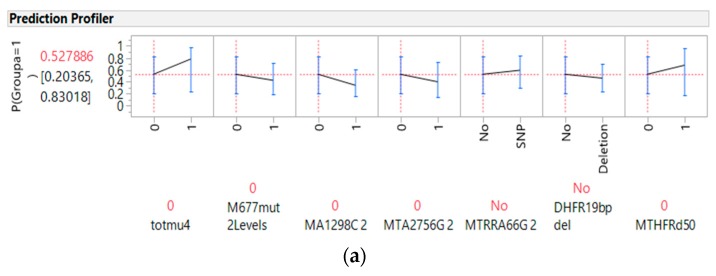
Figure 1
Figure 1
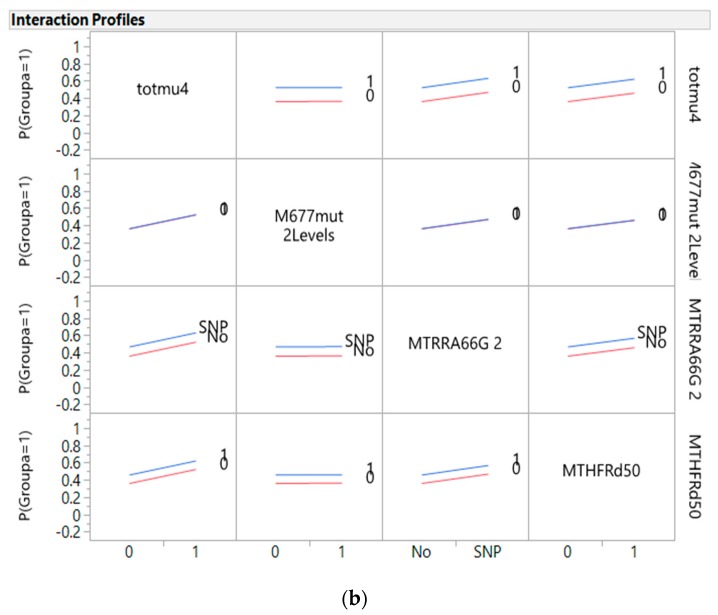
Genes involved in the prediction of colorectal cancer: (a) per single gene profiler, total polymorphism score and total methylenetetrahydrofolate reductase (MTHFR) enzyme deficiency (calculated based on MTHFR 677 and 1298 (presented as M677mut 2Levels and MA1298C 2) polymorphism mutation alleles), (b) interaction profilers of selected gene parameters and colorectal cancer. Note that the MTHFR 677 polymorphism status (0 or 1) overlapped with no discrimination against other genetic factors in regard to its association with cancer risk; p(Groupa) = 1 is the probability of predicting a level 1 (cancer status versus 0, the control status) response, MTA2756G 2: methionine synthase A2756G in 2 levels, MTRRA66G 2: methionine synthase reductase A66G in 2 levels, DHFR19bp del: dihydrofolate reductase 19 base pair deletion, MTHFRd50: MTHFR enzyme deficient 50% or higher.
Figure 1
Figure 1
Genes involved in the prediction of colorectal cancer: (a) per single gene profiler, total polymorphism score and total methylenetetrahydrofolate reductase (MTHFR) enzyme deficiency (calculated based on MTHFR 677 and 1298 (presented as M677mut 2Levels and MA1298C 2) polymorphism mutation alleles), (b) interaction profilers of selected gene parameters and colorectal cancer. Note that the MTHFR 677 polymorphism status (0 or 1) overlapped with no discrimination against other genetic factors in regard to its association with cancer risk; p(Groupa) = 1 is the probability of predicting a level 1 (cancer status versus 0, the control status) response, MTA2756G 2: methionine synthase A2756G in 2 levels, MTRRA66G 2: methionine synthase reductase A66G in 2 levels, DHFR19bp del: dihydrofolate reductase 19 base pair deletion, MTHFRd50: MTHFR enzyme deficient 50% or higher.
Figure 2
Figure 2
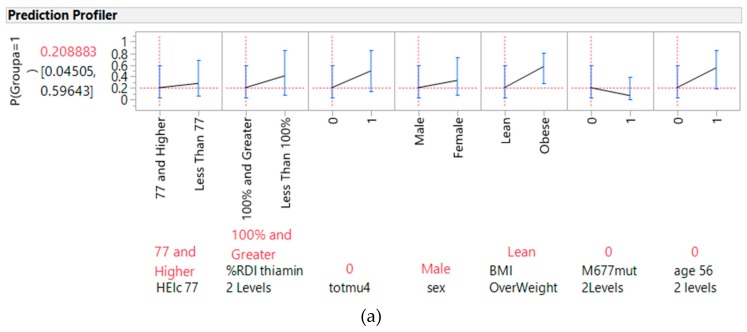
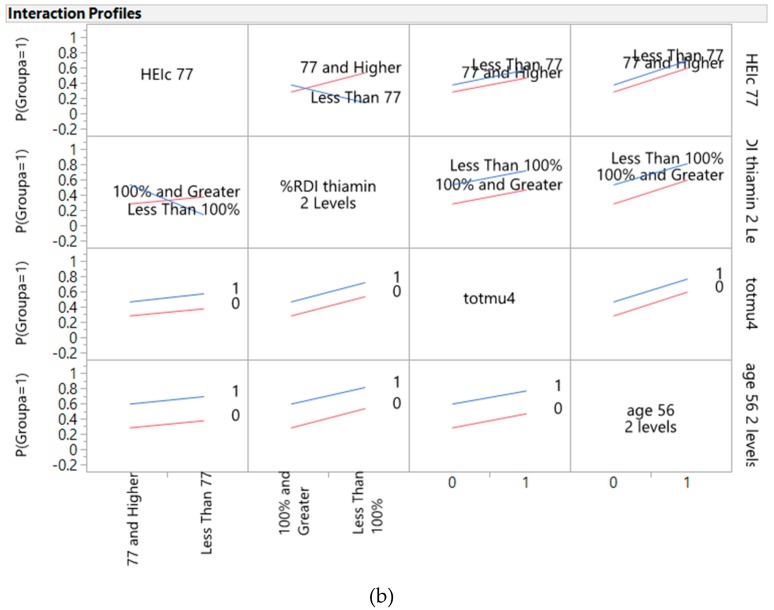
Gene-diet interactions relevant for the prediction of cancer: (a) prediction profiler, (b) interaction profiles (Healthy Eating Index interactions with with thiamine, with non-parallel lines for associations with cancer). Note: p(Groupa) = 1 is the probability of predicting a level 1 (cancer status versus 0, the control status) response.
Figure 2
Figure 2
Gene-diet interactions relevant for the prediction of cancer: (a) prediction profiler, (b) interaction profiles (Healthy Eating Index interactions with with thiamine, with non-parallel lines for associations with cancer). Note: p(Groupa) = 1 is the probability of predicting a level 1 (cancer status versus 0, the control status) response.
Figure 3
Figure 3
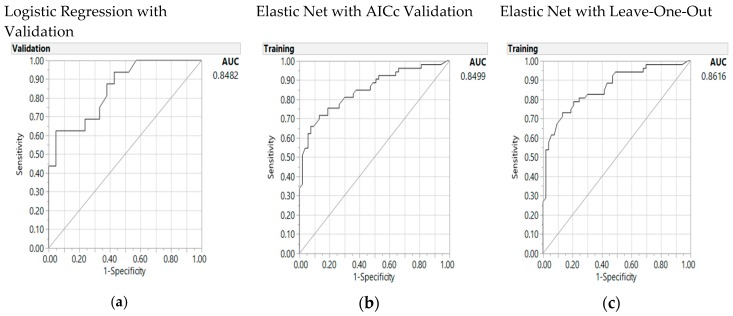
Area under the receiver operating characteristic curve (AUC) for the baseline logistic regression model (a), the Elastic Net with Akaike’s information criteria with correction (AICc) validation model (b), and the Leave-One-Out validation model (c) for the predictors of colorectal cancer with addition of the MTHFR 677 polymorphism and its interaction with overweight status.

References

    1. Magalhães B., Peleteiro B., Lunet N. Dietary patterns and colorectal cancer: Systematic review and meta-analysis. Eur. J. Cancer Prev. 2012;21:15–23. doi: 10.1097/CEJ.0b013e3283472241. - DOI - PubMed
    1. Fan Y., Jin X., Man C., Gao Z., Wang X. Meta-analysis of the association between the inflammatory potential of diet and colorectal cancer risk. Oncotarget. 2017;8:59592–59600. doi: 10.18632/oncotarget.19233. - DOI - PMC - PubMed
    1. Tárraga López P.J., Albero J.S., Rodríguez-Montes J.A. Primary and secondary prevention of colorectal cancer. Clin. Med. Insights Gastroenterol. 2014;7:33–46. doi: 10.4137/CGast.S14039. - DOI - PMC - PubMed
    1. Cavicchia P.P., Steck S.E., Hurley T.G., Hussey J.R., Ma Y., Ockene I.S., Hebert J.R. A new dietary inflammatory index predicts interval changes in serum high-sensitivity C.-reactive protein. J. Nutr. 2009;139:2365–2372. doi: 10.3945/jn.109.114025. - DOI - PMC - PubMed
    1. Shivappa N., Steck S.E., Hurley T.G., Hussey J.R., Hebert J.R. Designing and developing a literature-derived, population-based dietary inflammatory index. Public. Health Nutr. 2014;17:1689–1696. doi: 10.1017/S1368980013002115. - DOI - PMC - PubMed