Causes of Death After Nonfatal Opioid Overdose
- PMID: 29926090
- PMCID: PMC6143082
- DOI: 10.1001/jamapsychiatry.2018.1471
Causes of Death After Nonfatal Opioid Overdose
Erratum in
-
Omission of Grant Number.JAMA Psychiatry. 2018 Aug 1;75(8):867. doi: 10.1001/jamapsychiatry.2018.2102. JAMA Psychiatry. 2018. PMID: 30073311 Free PMC article. No abstract available.
Abstract
Importance: A recent increase in patients presenting with nonfatal opioid overdoses has focused clinical attention on characterizing their risks of premature mortality.
Objective: To describe all-cause mortality rates, selected cause-specific mortality rates, and standardized mortality rate ratios (SMRs) of adults during their first year after nonfatal opioid overdose.
Design, setting, and participants: This US national longitudinal study assesses a cohort of patients aged 18 to 64 years who were Medicaid beneficiaries and experienced nonfatal opioid overdoses. The Medicaid data set included the years 2001 through 2007. Death record information was obtained from the National Death Index. Data analysis occurred from October 2017 to January 2018.
Main outcomes and measures: Crude mortality rates per 100 000 person-years were determined in the first year after nonfatal opioid overdose. Standardized mortality rate ratios (SMR) were estimated for all-cause and selected cause-specific mortality standardized to the general population with respect to age, sex, and race/ethnicity.
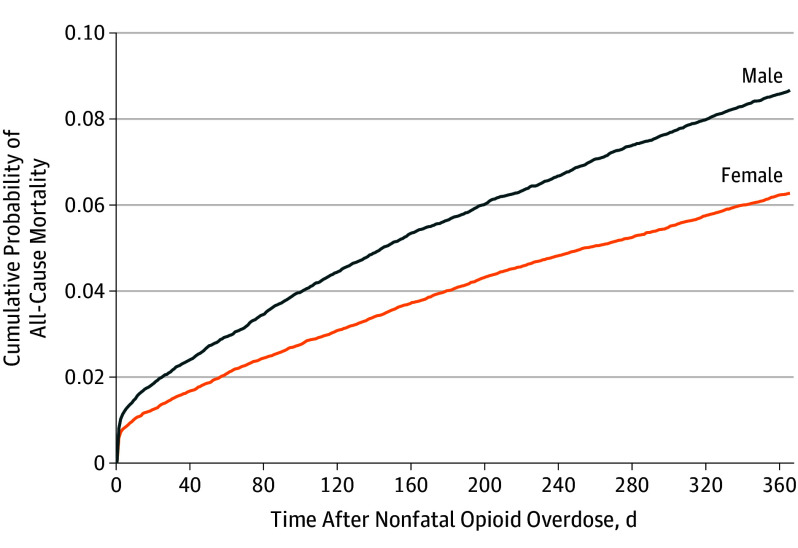
Results: The primary cohort included 76 325 adults and 66 736 person-years of follow-up. During the first year after nonfatal opioid overdose, there were 5194 deaths, the crude death rate was 778.3 per 10 000 person-years, and the all-cause SMR was 24.2 (95% CI, 23.6-24.9). The most common immediate causes of death were substance use-associated diseases (26.2%), diseases of the circulatory system (13.2%), and cancer (10.3%). For every cause examined, SMRs were significantly elevated, especially with respect to drug use-associated diseases (SMR, 132.1; 95% CI, 125.6-140.0), HIV (SMR, 45.9; 95% CI, 39.5-53.0), chronic respiratory diseases (SMR, 41.1; 95% CI, 36.0-46.8), viral hepatitis (SMR, 30.6; 95% CI, 22.9-40.2), and suicide (SMR, 25.9; 95% CI, 22.6-29.6), particularly including suicide among females (SMR, 47.9; 95% CI, 39.8-52.3).
Conclusions and relevance: In a US national cohort of adults who had experienced a nonfatal opioid overdose, a marked excess of deaths was attributable to a wide range of substance use-associated, mental health, and medical conditions, underscoring the importance of closely coordinating the substance use, mental health, and medical care of this patient population.
Conflict of interest statement
Figures
References
-
- Weiss AJ, Elixhauser A, Barret ML, Steiner CA, Bailer MK, O’Malley L. Opioid-related inpatient stays and emergency department visits by state, 2009-2014; Statistical Brief 219. https://www.hcup-us.ahrq.gov/reports/statbriefs/sb219-Opioid-Hospital-St.... Published December 2016. Accessed May 11, 2018.
-
- Degenhardt L, Bucello C, Mathers B, et al. Mortality among regular or dependent users of heroin and other opioids: a systematic review and meta-analysis of cohort studies. Addiction. 2011;106(1):32-51. - PubMed
-
- Degenhardt L, Larney S, Randall D, Burns L, Hall W. Causes of death in a cohort treated for opioid dependence between 1985 and 2005. Addiction. 2014;109(1):90-99. - PubMed
-
- Bargagli AM, Hickman M, Davoli M, et al. ; COSMO European Group . Drug-related mortality and its impact on adult mortality in eight European countries. Eur J Public Health. 2006;16(2):198-202. - PubMed
Publication types
MeSH terms
Substances
Grants and funding
LinkOut - more resources
Full Text Sources
Other Literature Sources
Medical