Review
. 2018 Jun;32(6):543-558.
doi: 10.1007/s40263-018-0530-8.

Disability Outcome Measures in Phase III Clinical Trials in Multiple Sclerosis

Affiliations
Review

Disability Outcome Measures in Phase III Clinical Trials in Multiple Sclerosis

Bernard M J Uitdehaag. CNS Drugs. 2018 Jun.

Abstract

Accumulating neurological disability has a substantial impact on the lives of patients with multiple sclerosis (MS). As well as the established Expanded Disability Status Scale (EDSS), several other outcome measures are now available for assessing disability progression in MS. This review extends the findings of a previous analysis of relapsing-remitting MS (RRMS) trials published up to 2012, to determine whether there has been a shift in outcome measures used to assess disability in phase III clinical trials in RRMS and progressive MS. Forty relevant trials were identified (RRMS, n = 16; progressive MS, n = 18; other/mixed phenotypes, n = 6). Sustained EDSS worsening, particularly over 3 months, was included as an endpoint in almost all identified trials. Other disability-related endpoints included the Multiple Sclerosis Functional Composite z-score and scores for the physical component summary of the Multiple Sclerosis Impact Scale and Medical Outcomes Study Short-Form (36-item) Health Survey. Tests assessing manual dexterity, ambulation, vision and cognition were also employed, and in some trials, composite endpoints were used. However, there was no obvious trend in choice of disability outcome measures over time. Sustained EDSS worsening over short time periods continues to be the most widely used measure of disability progression in pivotal MS trials, despite its well-recognised limitations. A new tool set is needed for use in MS clinical trials that detects the benefit of potential treatments that slow (or reverse) progressive disability.


Conflict of interest statement

Funding

Nicky French, PhD, of Anthemis Consulting Ltd provided editorial support, funded by Teva Pharmaceutical Industries, Frazer, PA, USA. Teva provided a single medical-accuracy review of the final draft. The author was not compensated and retained full editorial control over the content of the paper. Open access was funded by VU University Medical Center, as part of the Springer Compact agreement.

Conflict of interest

The author has received consultancy fees from Genzyme, Biogen Idec, Teva, Merck Serono and Roche.

Figures
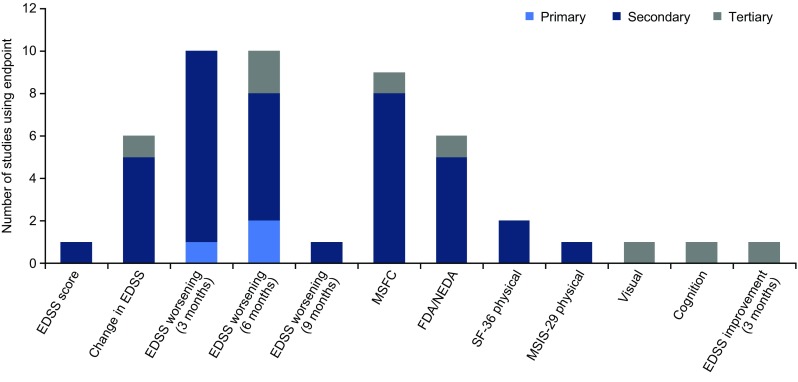
Fig. 1
Fig. 1
Disability outcomes measures used in phase III relapsing multiple sclerosis or RRMS trials (n = 16). Includes unpublished trials and trials published from 2012 onwards (with the exception of the DEFINE and CONFIRM trials, which are included in the review by Lavery et al. [20]). EDSS Expanded Disability Status Scale, FDA freedom from disease activity, MSFC Multiple Sclerosis Functional Composite, MSIS Multiple Sclerosis Impact Scale, NEDA no evidence of disease activity, SF-36 Medical Outcomes Study Short-Form (36-item) Health Survey, RRMS relapsing-remitting multiple sclerosis
Fig. 2
Fig. 2
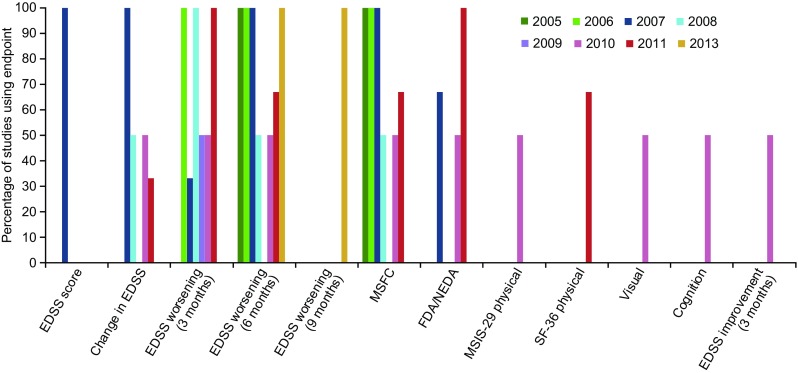
Disability outcome measures used over time in phase III relapsing multiple sclerosis or RRMS trials (n = 16). Includes unpublished trials and trials published from 2012 onwards (with the exception of the DEFINE and CONFIRM trials, which are included in the review by Lavery et al. [20]); ongoing trials were sourced from ClinicalTrials.gov; dates refer to study initiation. EDSS Expanded Disability Status Scale, FDA freedom from disease activity, MSFC Multiple Sclerosis Functional Composite, MSIS Multiple Sclerosis Impact Scale, NEDA no evidence of disease activity, SF-36 Medical Outcomes Study Short-Form (36-item) Health Survey, RRMS relapsing-remitting multiple sclerosis. There was one trial published in 2014, which did not include any disability outcome measures
Fig. 3
Fig. 3
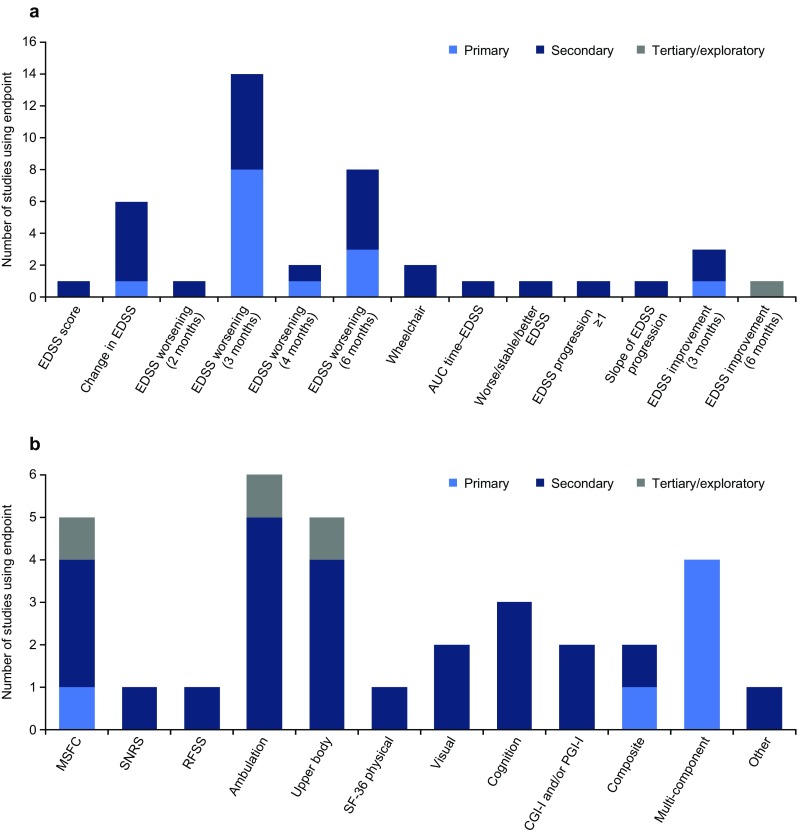
Disability outcome measures used in phase III progressive MS trials (n = 18): a EDSS-related measures; b other outcome measures. Includes unpublished trials and trials published from 1997 onwards; note that in some trials, endpoints relating to the same measure were included as both primary and secondary endpoints (e.g. time to 3-month worsening of EDSS and the proportion of patients with 3-month worsening of EDSS). AUC area under the curve, CGI-I Clinical Global Impression of Improvement, EDSS Expanded Disability Status Scale, MSFC Multiple Sclerosis Functional Composite, MS multiple sclerosis, PGI-I Patient Global Impression of Improvement, RFSS Regional Functional System Score, SF-36 Medical Outcomes Study Short-Form (36-item) Health Survey, SNRS Scripps Neurologic Rating Scale
Fig. 4
Fig. 4
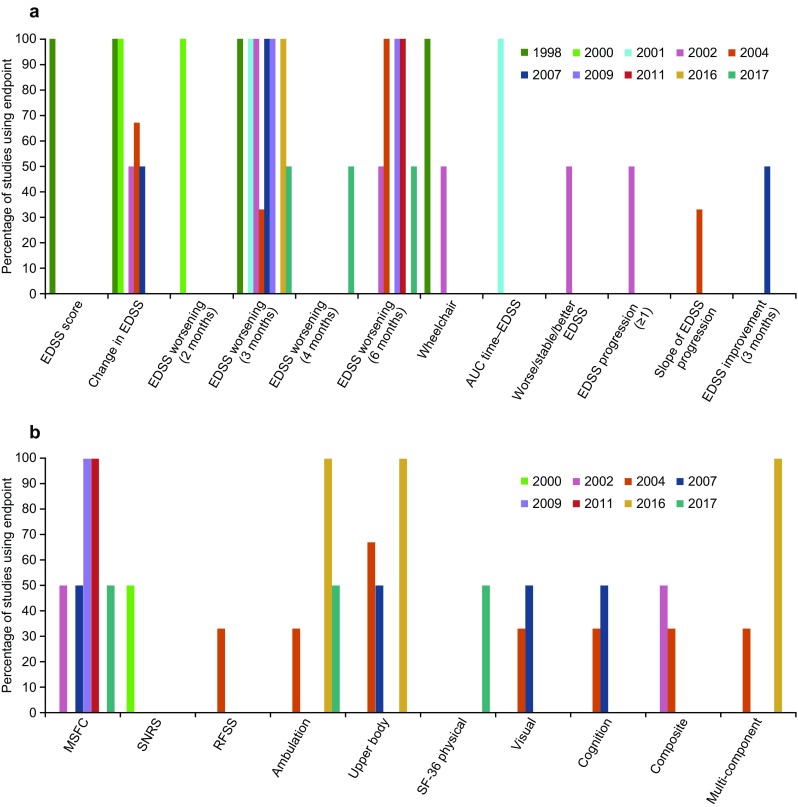
Disability outcome measures used over time in phase III progressive MS trials published since 2007 (n = 18): a EDSS-related measures; b other outcome measures. Published trials only (trials could not be assessed according to start date, as this was not available for all published trials). EDSS Expanded Disability Status Scale, MS multiple sclerosis, MSFC Multiple Sclerosis Functional Composite, RFSS Regional Functional Scoring Scale, SF–36 Medical Outcomes Study Short-Form (36-item) Health Survey, SNRS Scripps Neurologic Rating Scale

References

    1. Confavreux C, Vukusic S, Moreau T, et al. Relapses and progression of disability in multiple sclerosis. N Engl J Med. 2000;343:1430–1438. doi: 10.1056/NEJM200011163432001. - DOI - PubMed
    1. Confavreux C, Vukusic S. Accumulation of irreversible disability in multiple sclerosis: from epidemiology to treatment. Clin Neurol Neurosurg. 2006;108:327–332. doi: 10.1016/j.clineuro.2005.11.018. - DOI - PubMed
    1. Tremlett H, Zhao Y, Rieckmann P, et al. New perspectives in the natural history of multiple sclerosis. Neurology. 2010;74:2004–2015. doi: 10.1212/WNL.0b013e3181e3973f. - DOI - PubMed
    1. Ertekin O, Ozakbas S, Idiman E. Caregiver burden, quality of life and walking ability in different disability levels of multiple sclerosis. NeuroRehabilitation. 2014;34:313–321. - PubMed
    1. Green G, Todd J. ‘Restricting choices and limiting independence’: social and economic impact of multiple sclerosis upon households by level of disability. Chronic Illn. 2008;4:160–172. doi: 10.1177/1742395307087457. - DOI - PubMed

MeSH terms