


Neonatal interventions for preventing cerebral palsy: an overview of Cochrane Systematic Reviews
- PMID: 29926474
- PMCID: PMC6513209
- DOI: 10.1002/14651858.CD012409.pub2
Neonatal interventions for preventing cerebral palsy: an overview of Cochrane Systematic Reviews
Abstract
Background: Cerebral palsy is an umbrella term that encompasses disorders of movement and posture attributed to non-progressive disturbances occurring in the developing foetal or infant brain. As there are diverse risk factors and aetiologies, no one strategy will prevent cerebral palsy. Therefore, there is a need to systematically consider all potentially relevant interventions for prevention.
Objectives: PrimaryTo summarise the evidence from Cochrane Systematic Reviews regarding effects of neonatal interventions for preventing cerebral palsy (reducing cerebral palsy risk).SecondaryTo summarise the evidence from Cochrane Systematic Reviews regarding effects of neonatal interventions that may increase cerebral palsy risk.
Methods: We searched the Cochrane Database of Systematic Reviews (27 November 2016) for reviews of neonatal interventions reporting on cerebral palsy. Two review authors assessed reviews for inclusion, extracted data, and assessed review quality (using AMSTAR and ROBIS) and quality of the evidence (using the GRADE approach). Reviews were organised by topic; findings were summarised in text and were tabulated. Interventions were categorised as effective (high-quality evidence of effectiveness); possibly effective (moderate-quality evidence of effectiveness); ineffective (high-quality evidence of harm); probably ineffective (moderate-quality evidence of harm or lack of effectiveness); and no conclusions possible (low- to very low-quality evidence).
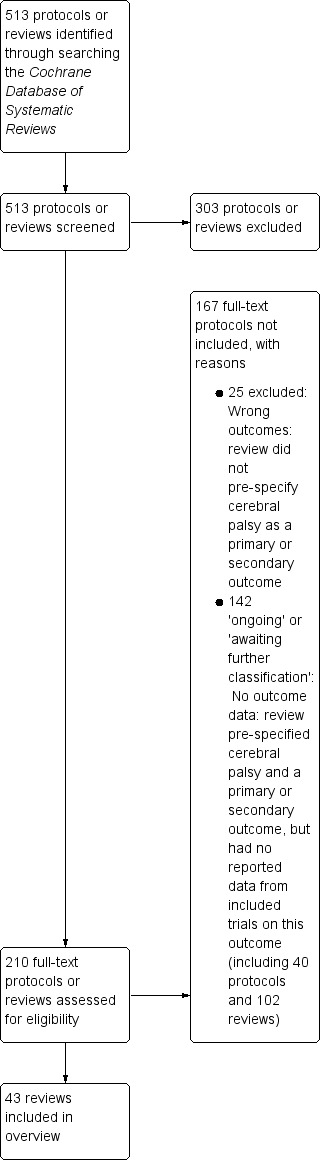
Main results: Forty-three Cochrane Reviews were included. A further 102 reviews pre-specified the outcome cerebral palsy, but none of the included randomised controlled trials (RCTs) reported this outcome. Included reviews were generally of high quality and had low risk of bias, as determined by AMSTAR and ROBIS. These reviews involved 454 RCTs; data for cerebral palsy were available from 96 (21%) RCTs involving 15,885 children. Review authors considered interventions for neonates with perinatal asphyxia or with evidence of neonatal encephalopathy (3); interventions for neonates born preterm and/or at low or very low birthweight (33); and interventions for other specific groups of 'at risk' neonates (7). Quality of evidence (GRADE) ranged from very low to high.Interventions for neonates with perinatal asphyxia or with evidence of neonatal encephalopathyEffective interventions: high-quality evidence of effectivenessResearchers found a reduction in cerebral palsy following therapeutic hypothermia versus standard care for newborns with hypoxic ischaemic encephalopathy (risk ratio (RR) 0.66, 95% confidence interval (CI) 0.54 to 0.82; seven trials; 881 children).No conclusions possible: very low-quality evidenceOne review observed no clear differences in cerebral palsy following therapeutic hypothermia versus standard care.Interventions for neonates born preterm and/or at low or very low birthweightPossibly effective interventions: moderate-quality evidence of effectivenessResearchers found a reduction in cerebral palsy with prophylactic methylxanthines (caffeine) versus placebo for endotracheal extubation in preterm infants (RR 0.54, 95% CI 0.32 to 0.92; one trial; 644 children).Probably ineffective interventions: moderate-quality evidence of harmResearchers reported an increase in cerebral palsy (RR 1.45, 95% CI 1.06 to 1.98; 12 trials; 1452 children) and cerebral palsy in assessed survivors (RR 1.50, 95% CI 1.13 to 2.00; 12 trials; 959 children) following early (at less than eight days of age) postnatal corticosteroids versus placebo or no treatment for preventing chronic lung disease in preterm infants.Probably ineffective interventions: moderate-quality evidence of lack of effectivenessTrial results showed no clear differences in cerebral palsy following ethamsylate versus placebo for prevention of morbidity and mortality in preterm or very low birthweight infants (RR 1.13, 95% CI 0.64 to 2.00; three trials, 532 children); volume expansion versus no treatment (RR 0.76, 95% CI 0.48 to 1.20; one trial; 604 children); gelatin versus fresh frozen plasma (RR 0.94, 95% CI 0.52 to 1.69; one trial, 399 children) for prevention of morbidity and mortality in very preterm infants; prophylactic indomethacin versus placebo for preventing mortality and morbidity in preterm infants (RR 1.04, 95% CI 0.77 to 1.40; four trials; 1372 children); synthetic surfactant versus placebo for respiratory distress syndrome in preterm infants (RR 0.76, 95% CI 0.55 to 1.05; five trials; 1557 children); or prophylactic phototherapy versus standard care (starting phototherapy when serum bilirubin reached a pre-specified level) for preventing jaundice in preterm or low birthweight infants (RR 0.96, 95% CI 0.50 to 1.85; two trials; 756 children).No conclusions possible: low- to very low-quality evidenceNo clear differences in cerebral palsy were observed with interventions assessed in 21 reviews.Interventions for other specific groups of 'at risk' neonatesNo conclusions possible: low- to very low-quality evidenceReview authors observed no clear differences in cerebral palsy with interventions assessed in five reviews.
Authors' conclusions: This overview summarises evidence from Cochrane Systematic Reviews regarding effects of neonatal interventions on cerebral palsy, and can be used by researchers, funding bodies, policy makers, clinicians, and consumers to aid decision-making and evidence translation. To formally assess other benefits and/or harms of included interventions, including impact on risk factors for cerebral palsy, review of the included Reviews is recommended.Therapeutic hypothermia versus standard care for newborns with hypoxic ischaemic encephalopathy can prevent cerebral palsy, and prophylactic methylxanthines (caffeine) versus placebo for endotracheal extubation in preterm infants may reduce cerebral palsy risk. Early (at less than eight days of age) postnatal corticosteroids versus placebo or no treatment for preventing chronic lung disease in preterm infants may increase cerebral palsy risk.Cerebral palsy is rarely identified at birth, has diverse risk factors and aetiologies, and is diagnosed in approximately one in 500 children. To date, only a small proportion of Cochrane Systematic Reviews assessing neonatal interventions have been able to report on this outcome. There is an urgent need for long-term follow-up of RCTs of such interventions addressing risk factors for cerebral palsy (through strategies such as data linkage with registries) and for consideration of the use of relatively new interim assessments (including the General Movements Assessment). Such RCTs must be rigorous in their design and must aim for consistency in cerebral palsy outcome measurement and reporting to facilitate pooling of data and thus to maximise research efforts focused on prevention.
Conflict of interest statement
Emily Shepherd, Rehana Abdus Salam, Shanshan Han, Sarah McIntyre, Maria Makrides, Philippa Middleton, Caroline Crowther: none known.
Nadia Badawi was an author of one of the included reviews (Jones 2009). As pre‐specified in our protocol, data extraction and quality assessment for this review were carried out by two other overview authors, who were not authors of this review.
Update of
References
References to included reviews
AlFaleh 2014
Almadhoob 2015
Barrington 2010
Chaudhari 2012
Cleminson 2015
Conde‐Agudelo 2016
Cools 2015
Darlow 2016
Doyle 2014
Doyle 2014b
Finer 2006
Fowlie 2010
Halliday 2003
Henderson‐Smart 2010
Henderson‐Smart 2010b
Henderson‐Smart 2010c
Ho 2015
Howlett 2015
Hunt 2010
Jacobs 2013
Jones 2009
Kamlin 2003
Moe‐Byrne 2016
More 2016
Ohlsson 2014
Ohlsson 2015
Okwundu 2012
Osborn 2001
Osborn 2004
Osborn 2007
Osborn 2007b
Seger 2009
Shah 2007
Shah 2012
-
- Shah VS, Ohlsson A, Halliday HL, Dunn M. Early administration of inhaled corticosteroids for preventing chronic lung disease in ventilated very low birth weight preterm neonates. Cochrane Database of Systematic Reviews 2012, Issue 5. [DOI: 10.1002/14651858.CD001969.pub3; PUBMED: 22592680] - DOI - PubMed
Smit 2013
Soll 2000
Soll 2010
Spittle 2015
-
- Spittle A, Orton J, Anderson PJ, Boyd R, Doyle LW. Early developmental intervention programmes provided post hospital discharge to prevent motor and cognitive impairment in preterm infants. Cochrane Database of Systematic Reviews 2015, Issue 11. [DOI: 10.1002/14651858.CD005495.pub4; PUBMED: 26597166] - DOI - PMC - PubMed
Tan 2005
Weston 2016
Wheeler 2010
Whyte 2011
References to excluded reviews
Atherton 2012
Barlow 2015
Bredemeyer 2012
Brown 2016
Carr 2003
Davis 2001
Ethawi 2016
-
- Ethawi YH, Abou Mehrem A, Minski J, Ruth CA, Davis PG. High frequency jet ventilation versus high frequency oscillatory ventilation for pulmonary dysfunction in preterm infants. Cochrane Database of Systematic Reviews 2016, Issue 5. [DOI: 10.1002/14651858.CD010548.pub2; PUBMED: 27149997] - DOI - PMC - PubMed
Hancock 2013
Jones 2003
-
- Jones CA, Walker KS, Henderson‐Smart DJ. Antiviral therapy for symptomatic congenital cytomegalovirus infection in neonates and infants up to 3 months of age. Cochrane Database of Systematic Reviews 2003, Issue 3. [DOI: 10.1002/14651858.CD004340] - DOI
Lewin 2010
-
- Lewin S, Munabi‐Babigumira S, Glenton C, Daniels K, Bosch‐Capblanch X, Wyk BE, et al. Lay health workers in primary and community health care for maternal and child health and the management of infectious diseases. Cochrane Database of Systematic Reviews 2010, Issue 3. [DOI: 10.1002/14651858.CD004015.pub3; PUBMED: 20238326] - DOI - PMC - PubMed
Malviya 2013
Morag 2016
Okwundu 2014
-
- Okwundu CI, Uthman OA, Smith J. Transcutaneous screening for hyperbilirubinemia in neonates. Cochrane Database of Systematic Reviews 2014, Issue 4. [DOI: 10.1002/14651858.CD011060] - DOI
Pammi 2011
Pammi 2015
Pammi 2015b
Scholefield 2013
Shah 2012b
Suresh 2003
Thukral 2015
Upadhyay 2016
-
- Upadhyay A, Chawla D, Joshi P, Davis PG. Short‐duration versus standard‐duration antibiotic regimens for the treatment of neonatal bacterial infection. Cochrane Database of Systematic Reviews 2016, Issue 1. [DOI: 10.1002/14651858.CD012063] - DOI
Ward 2003
Whitelaw 2001
Whitelaw 2001b
Additional references
AAP 2014
Access Economics 2008
-
- Access Economics. The Economic Impact of Cerebral Palsy in Australia in 2007. Sydney: Cerebral Palsy Australia, 2008.
ACPR Group 2013
-
- Australian Cerebral Palsy Register (ACPR) Group. Report of the Australian Cerebral Palsy Register, Birth Years 1993–2006. ACPR Group: Sydney, 2013.
Badawi 2005
-
- Badawi N, Felix JF, Kurinczuk JJ, Dixon G, Watson L, Keogh JM, et al. Cerebral palsy following term newborn encephalopathy: a population‐based study. Developmental Medicine and Child Neurology 2005;47(5):293‐8. [PUBMED: 15892370] - PubMed
Blair 1988
-
- Blair E, Stanley FJ. Intrapartum asphyxia: a rare cause of cerebral palsy. Journal of Pediatrics 1988;112(4):515‐9. [PUBMED: 3351675] - PubMed
Blair 2001
-
- Blair E, Watson L, Badawi N, Stanley FJ. Life expectancy among people with cerebral palsy in Western Australia. Developmental Medicine and Child Neurology 2001;43(8):508‐15. [PUBMED: 11508916] - PubMed
Blair 2006
Bosanquet 2013
Cans 2000
Cans 2004
CDC 2004
-
- Centers for Disease Control and Prevention (CDC). Economic costs associated with mental retardation, cerebral palsy, hearing loss, and vision impairment ‐ United States, 2003. Morbidity and Mortality Weekly Report 2004;53(3):57‐9. [PUBMED: 14749614] - PubMed
Colver 2012
-
- Colver A. Outcomes for people with cerebral palsy: life expectancy and quality of life. Paediatrics and Child Health 2012;22(9):384‐7. [DOI: 10.1016/j.paed.2012.03.003] - DOI
Covidence 2015
-
- Covidence. About Covidence. www.covidence.org (accessed 17 May 2015).
Davis 2010
Dixon 2002
-
- Dixon G, Badawi N, Kurinczuk JJ, Keogh JM, Silburn SR, Zubrick SR. Early developmental outcomes after newborn encephalopathy. Pediatrics 2002;109(1):26‐33. [PUBMED: 11773538] - PubMed
Doyle 2009
Drougia 2007
-
- Drougia A, Giapros V, Krallis N, Theocharis P, Nikaki A, Tzoufi M. Incidence and risk factors for cerebral palsy in infants with perinatal problems: a 15‐year review. Early Human Development 2007;83(8):541‐7. [PUBMED: 10.1016/j.earlhumdev.2006.10.004; PUBMED: 17188824] - PubMed
Ellenberg 2013
Farquhar 2015
Germany 2013
-
- Germany L, Ehlinger V, Klapouszczak D, Delobel M, Hollódy K, Sellier E, et al. Trends in prevalence and characteristics of post‐neonatal cerebral palsy cases: a European registry‐based study. Research in Developmental Disabilities 2013;34(5):1669‐77. [DOI: 10.1016/j.ridd.2013.02.016; PUBMED: 23500161] - DOI - PubMed
Hadders‐Algra 2016
Hemming 2005
Higgins 2011
-
- Higgins JPT, Green S, editors. Cochrane Handbook for Systematic Reviews of Interventions Version 5.1.0 (updated March 2011). The Cochrane Collaboration, 2011. Available from handbook.cochrane.org.
Himpens 2008
-
- Himpens E, Broeck C, Oostra A, Calders P, Vanhaesebrouck P. Prevalence, type, distribution, and severity of cerebral palsy in relation to gestational age: a meta‐analytic review. Developmental Medicine and Child Neurology 2008;50(5):334‐40. [DOI: 10.1111/j.1469-8749.2008.02047.x; PUBMED: 18355333] - DOI - PubMed
Jacobsson 2004
Jones 2012
Kruse 2009
Lassi 2015
MacLennan 2015
McIntyre 2010
McIntyre 2011
McIntyre 2013
Moreno‐De‐Luca 2012
Morgan 2016
-
- Morgan C, Crowle C, Goyen T‐A, Hardman C, Jackman M, Novak I, et al. Sensitivity and specificity of General Movements Assessment for diagnostic accuracy of detecting cerebral palsy early in an Australian context. Journal of Paediatrics and Child Health 2016;52(1):54‐9. [DOI: 10.1111/jpc.12995; PUBMED: 26289780] - DOI - PubMed
Morris 2007
-
- Morris C. Definition and classification of cerebral palsy: a historical perspective. Developmental Medicine and Child Neurology 2007;109:3‐7. [PUBMED: 17370476] - PubMed
Murphy 1997
Mutch 1992
-
- Mutch L, Alberman E, Hagberg B, Kodama K, Perat MV. Cerebral palsy epidemiology: where are we now and where are we going?. Developmental Medicine and Child Neurology 1992;34(6):547‐51. [PUBMED: 1612216] - PubMed
Nelson 2008
Novak 2012
Oskoui 2013
Oskoui 2015
O’Callaghan 2009
O’Shea 2008
Reid 2012
Reid 2015
RevMan 2014 [Computer program]
-
- Nordic Cochrane Centre, The Cochrane Collaboration. Review Manager 5 (RevMan5). Version 5.3. Copenhagen: Nordic Cochrane Centre, The Cochrane Collaboration, 2014.
Robertson 2012
Rosenbaum 2007
-
- Rosenbaum P, Paneth N, Leviton A, Goldstein M, Bax M, Damiano D, et al. A report: the definition and classification of cerebral palsy April 2006. Developmental Medicine and Child Neurology 2007;109:8‐14. [PUBMED: 17370477] - PubMed
Sellier 2015
-
- Sellier E, Platt MJ, Andersen GL, Krägeloh‐Mann I, Cruz J, Cans C, et al. Decreasing prevalence in cerebral palsy: a multi‐site European population‐based study, 1980 to 2003. Developmental Medicine and Child Neurology 2016; Vol. 58, issue 1:85‐92. [DOI: 10.1111/dmcn.12865; PUBMED: 26330098] - DOI - PubMed
Shea 2009
-
- Shea BJ, Hamel C, Wells GA, Bouter LM, Kristjansoon E, Grimshaw J, et al. AMSTAR is a reliable and valid measurement tool to assess the methodological quality of systematic reviews. Journal of Clinical Epidemiology 2009;62(10):1013‐20. [DOI: 10.1016/j.jclinepi.2008.10.009; PUBMED: 19230606] - DOI - PubMed
Shepherd 2016
Smithers‐Sheedy 2014
Tran 2005
Walstab 2004
-
- Walstab JE, Bell RJ, Reddihough DS, Brennecke SP, Bessell CK, Beischer NA. Factors identified during the neonatal period associated with risk of cerebral palsy. Australian & New Zealand Journal of Obstetrics & Gynaecology 2004;44(3):342‐6. [DOI: 10.1111/j.1479-828X.2004.00249.x; PUBMED: 15282008] - DOI - PubMed
Publication types
MeSH terms
LinkOut - more resources
Full Text Sources
Other Literature Sources
Medical
Research Materials
