


Exploring novel key regulators in breast cancer network
- PMID: 29927945
- PMCID: PMC6013121
- DOI: 10.1371/journal.pone.0198525
Exploring novel key regulators in breast cancer network
Abstract
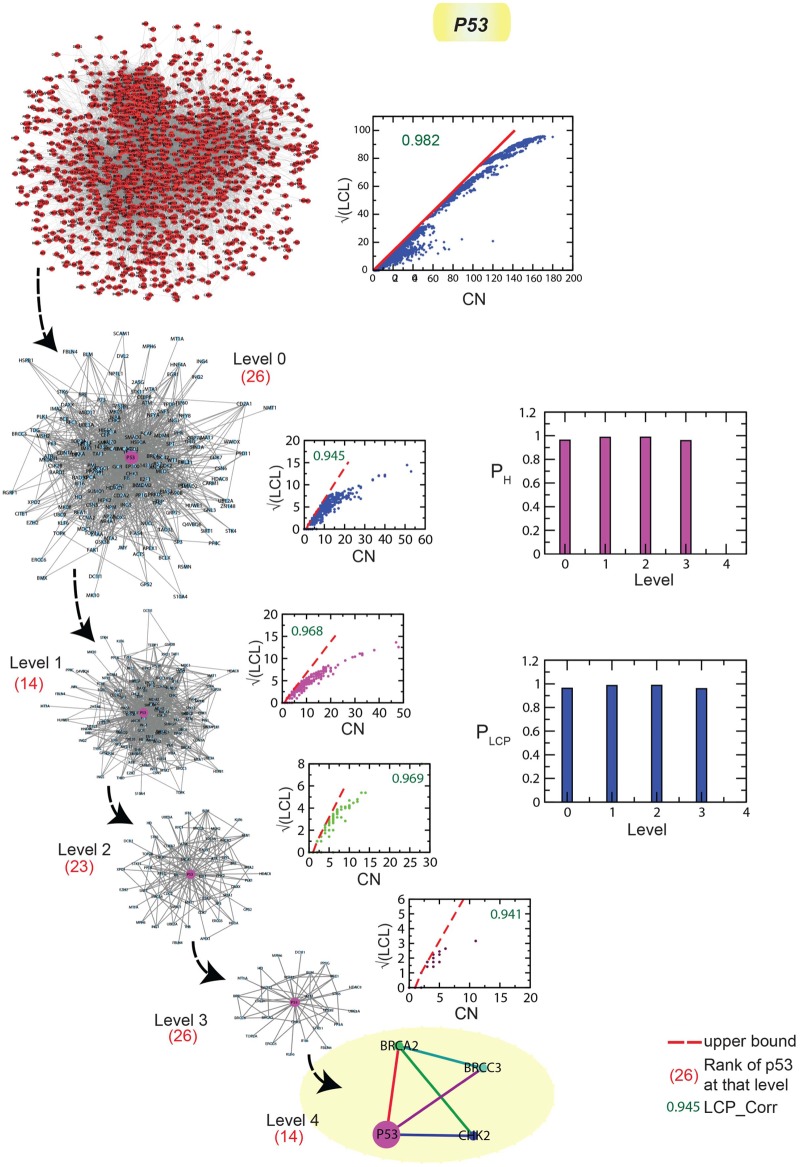
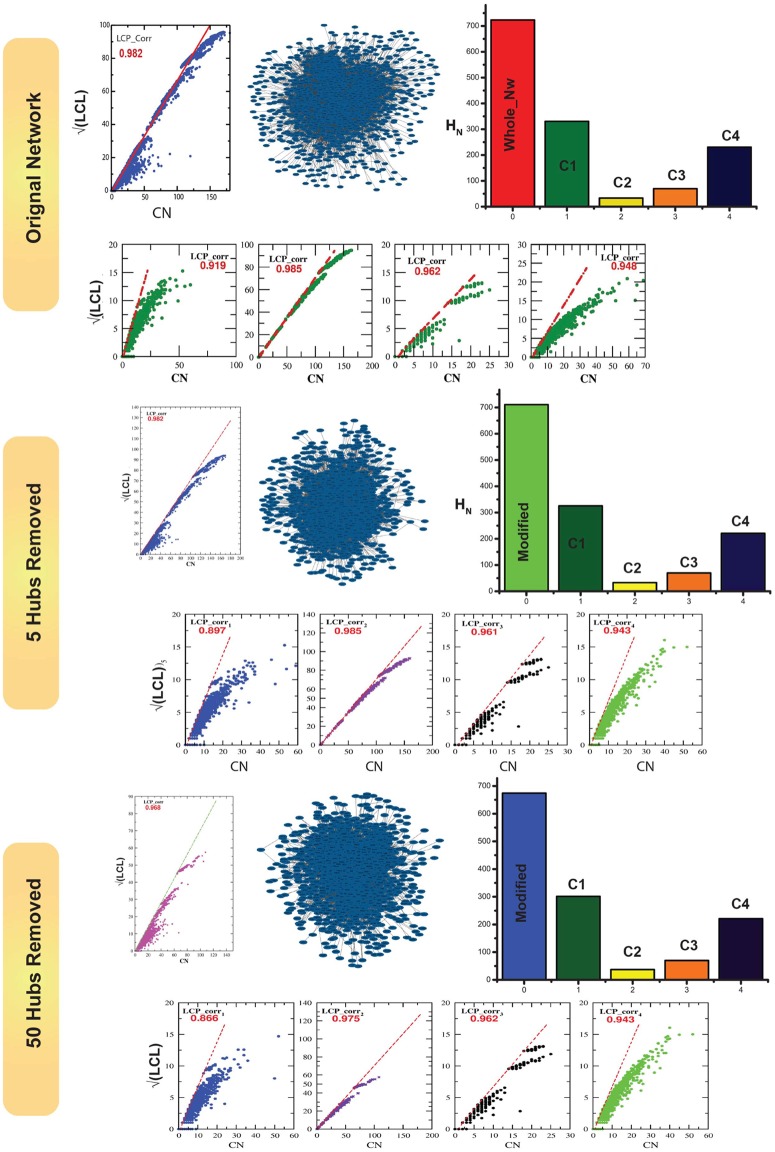
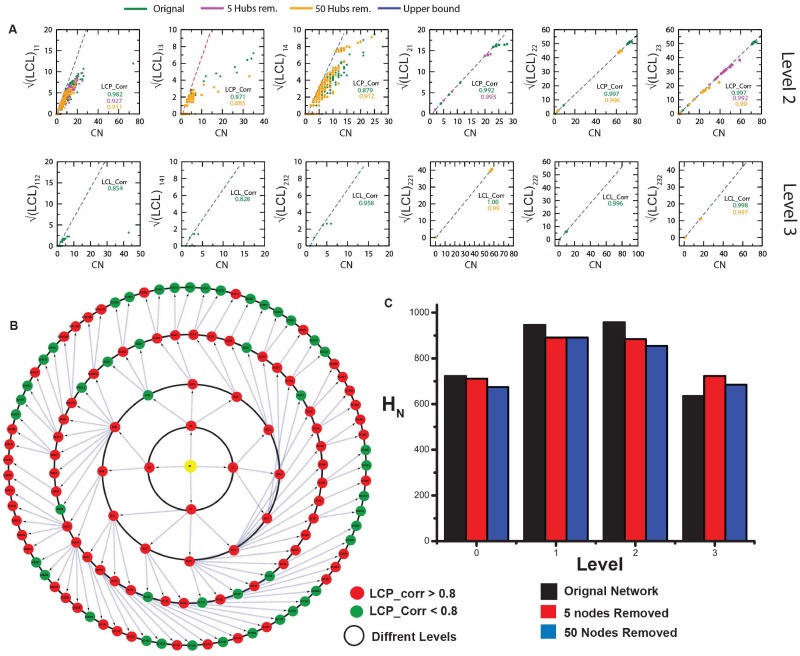
The breast cancer network constructed from 70 experimentally verified genes is found to follow hierarchical scale free nature with heterogeneous modular organization and diverge leading hubs. The topological parameters (degree distributions, clustering co-efficient, connectivity and centralities) of this network obey fractal rules indicating absence of centrality lethality rule, and efficient communication among the components. From the network theoretical approach, we identified few key regulators out of large number of leading hubs, which are deeply rooted from top to down of the network, serve as backbone of the network, and possible target genes. However, p53, which is one of these key regulators, is found to be in low rank and keep itself at low profile but directly cross-talks with important genes BRCA2 and BRCA3. The popularity of these hubs gets changed in unpredictable way at various levels of organization thus showing disassortive nature. The local community paradigm approach in this network shows strong correlation of nodes in majority of modules/sub-modules (fast communication among nodes) and weak correlation of nodes only in few modules/sub-modules (slow communication among nodes) at various levels of network organization.
Conflict of interest statement
The authors have declared that no competing interests exist.
Figures
References
-
- Kamangar F, Dores GM, Anderson WF. Patterns of cancer incidence, mortality, and prevalence across five continents: defining priorities to reduce cancer disparities in different geographic regions of the world. Journal of clinical oncology. 2006. May 10;24(14):2137–50. doi: 10.1200/JCO.2005.05.2308 - DOI - PubMed
-
- Cai Q, Zhang B, Sung H, Low SK, Kweon SS, Lu W, et al. Genome-wide association analysis in East Asians identifies breast cancer susceptibility loci at 1q32. 1, 5q14. 3 and 15q26. 1. Nature genetics. 2014. August;46(8):886 doi: 10.1038/ng.3041 - DOI - PMC - PubMed
-
- van der Hage JA, van de Velde CJ, Julien JP, Tubiana-Hulin M, Vandervelden C, Duchateau L, et al. Preoperative chemotherapy in primary operable breast cancer: results from the European Organization for Research and Treatment of Cancer trial 10902. Journal of Clinical Oncology. 2001. November 15;19(22):4224–37. doi: 10.1200/JCO.2001.19.22.4224 - DOI - PubMed
-
- Fatouros M, Baltoyiannis G, Roukos DH. The predominant role of surgery in the prevention and new trends in the surgical treatment of women with BRCA1/2 mutations. Annals of surgical oncology. 2008. January 1;15(1):21–33. doi: 10.1245/s10434-007-9612-4 - DOI - PubMed
-
- Murphy JA, Milner TD, O’Donoghue JM. Contralateral risk-reducing mastectomy in sporadic breast cancer. The Lancet Oncology. 2013. June 1;14(7):e262–9. doi: 10.1016/S1470-2045(13)70047-0 - DOI - PubMed
Publication types
MeSH terms
Substances
LinkOut - more resources
Full Text Sources
Other Literature Sources
Medical
Research Materials
Miscellaneous
