


Genome-wide identification and comprehensive analysis of the NAC transcription factor family in Sesamum indicum
- PMID: 29927997
- PMCID: PMC6013105
- DOI: 10.1371/journal.pone.0199262
Genome-wide identification and comprehensive analysis of the NAC transcription factor family in Sesamum indicum
Abstract
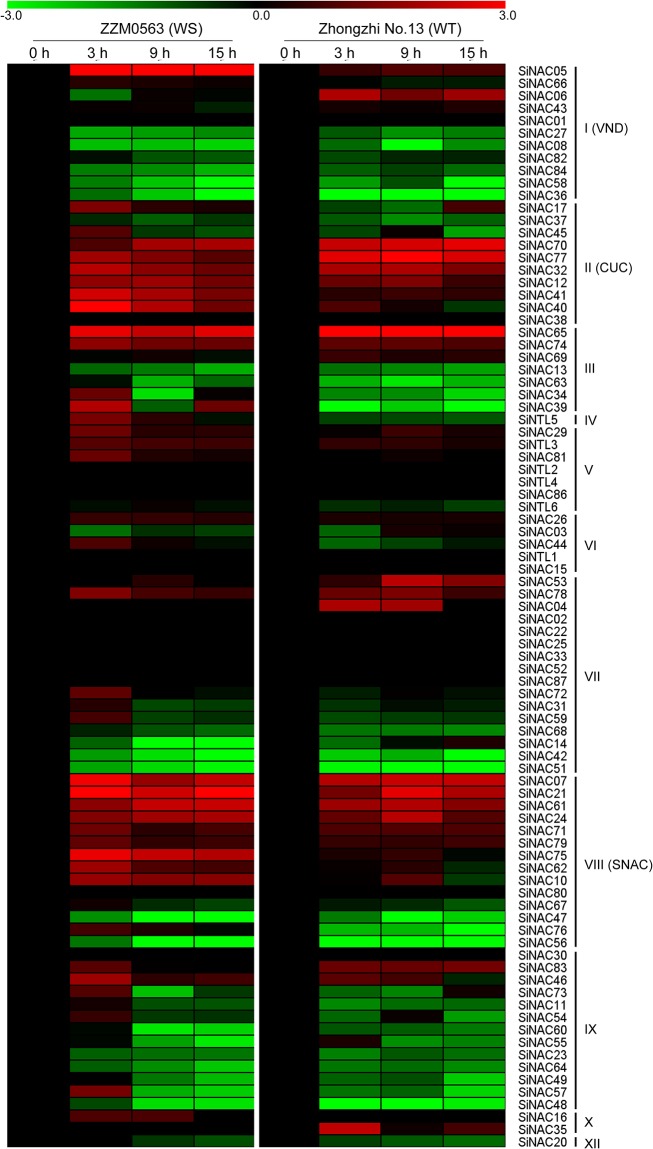
The NAM, ATAF1/2, and CUC2 (NAC) family constitutes a large family of plant-specific transcription factors, involved in many aspects of physiological processes and a variety of abiotic stresses. There is little information concerning the NAC family in Sesamum indicum. In this study, 87 sesame NAC genes were identified and phylogenetically clustered into 12 groups with Arabidopsis NAC genes. A total of 83 SiNAC genes were distributed non-randomly on the 16 linkage groups in sesame. Four and 49 SiNACs were found to be tandemly and segmentally duplicated, respectively. Expression profiles of SiNAC genes in different tissues (root, stem, leaf, flower, seed, and capsule) and in response to drought and waterlogging stresses by using RNA-seq data demonstrated that 23 genes were highly expressed in all tissues, 18 and 31 SiNACs respond strongly to drought and waterlogging stresses, respectively. In addition, the expression of 30 SiNAC genes distributed in different subgroups was analyzed with quantitative real-time RT-PCR under cold, osmotic, and salt stresses, revealed that their expression patterns vary in response to abiotic stresses. SiNAC genes displayed diverse expression patterns among the different tissues and stress treatments, suggested that their contribution to plant growth and development in sesame and multiple stress resistance in sesame. In this study, NAC transcription factors were analyzed in sesame and some specific candidate SiNAC genes in response to abiotic stress for functional study were identified. This study provides valuable information to deepen our understanding of the abiotic stress responses by NAC transcription factors in sesame.
Conflict of interest statement
The authors have declared that no competing interests exist.
Figures



References
-
- Miyake Y, Fukumoto S, Okada M, Sakaida K, Nakamura Y, Osawa T. Antioxidative catechol lignans converted from sesamin and sesaminol triglucoside by culturing with Aspergillus. Journal of agricultural and food chemistry. 2005;53(1):22–7. doi: 10.1021/jf048743h . - DOI - PubMed
-
- Meshi T, Iwabuchi M. Plant transcription factors. Plant & cell physiology. 1995;36(8):1405–20. . - PubMed
-
- Puranik S, Sahu PP, Srivastava PS, Prasad M. NAC proteins: regulation and role in stress tolerance. Trends in plant science. 2012;17(6):369–81. doi: 10.1016/j.tplants.2012.02.004 . - DOI - PubMed
-
- Aida M, Ishida T, Fukaki H, Fujisawa H, Tasaka M. Genes involved in organ separation in Arabidopsis: an analysis of the cup-shaped cotyledon mutant. The Plant cell. 1997;9(6):841–57. doi: 10.1105/tpc.9.6.841 . - DOI - PMC - PubMed
-
- Mmadi MA, Dossa K, Wang LH, Zhou R, Wang YY, Cisse N, et al. Functional Characterization of the Versatile MYB Gene Family Uncovered Their Important Roles in Plant Development and Responses to Drought and Waterlogging in Sesame. Genes-Basel. 2017;8(12). doi: 10.3390/Genes8120362 - DOI - PMC - PubMed
Publication types
MeSH terms
Substances
LinkOut - more resources
Full Text Sources
Other Literature Sources
