. 2014:46:389-433.
doi: 10.1016/B978-0-12-417010-0.00005-7.

Voltage-Gated Sodium Channels as Insecticide Targets

Affiliations

Voltage-Gated Sodium Channels as Insecticide Targets

Kristopher S Silver et al. Adv In Insect Phys. 2014.

Abstract

Voltage-gated sodium channels are critical for the generation and propagation of action potentials. They are the primary target of several classes of insecticides, including DDT, pyrethroids and sodium channel blocker insecticides (SCBIs). DDT and pyrethroids preferably bind to open sodium channels and stabilize the open state, causing prolonged currents. In contrast, SCBIs block sodium channels by binding to the inactivated state. Many sodium channel mutations are associated with knockdown resistance (kdr) to DDT and pyrethroids in diverse arthropod pests. Functional characterization of kdr mutations together with computational modelling predicts dual pyrethroid receptor sites on sodium channels. In contrast, the molecular determinants of the SCBI receptor site remain largely unknown. In this review, we summarize current knowledge about the molecular mechanisms of action of pyrethroids and SCBIs, and highlight the differences in the molecular interaction of these insecticides with insect versus mammalian sodium channels.


Figures
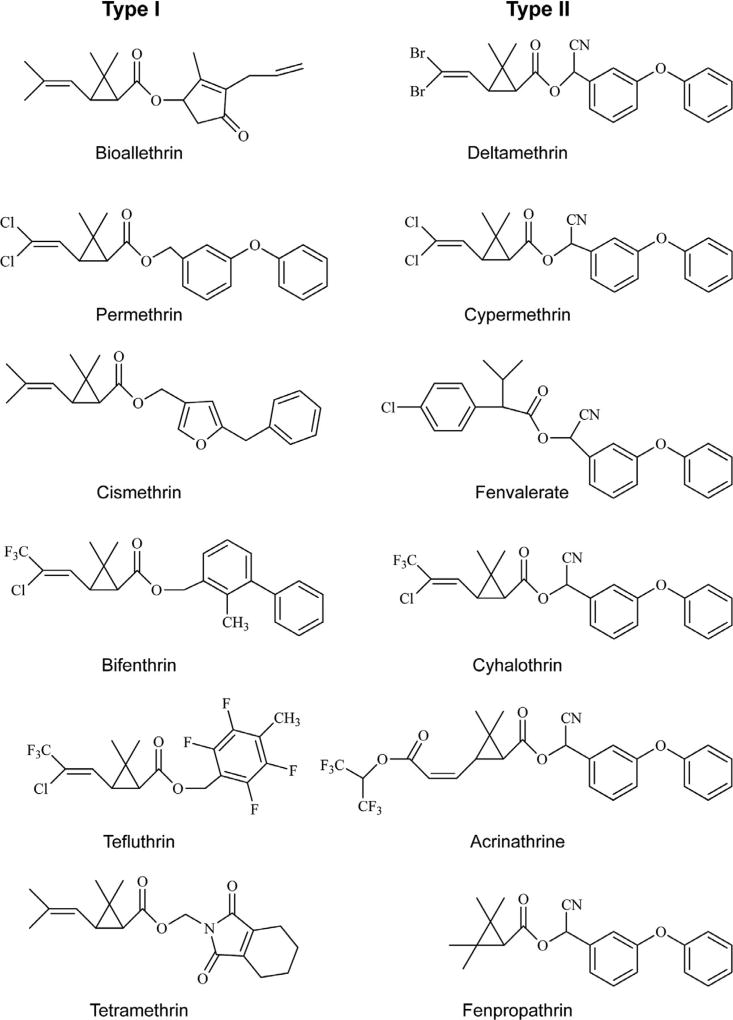
Figure 5.1
Figure 5.1
Chemical structures of Type I and II pyrethroid insecticides.
Figure 5.2
Figure 5.2
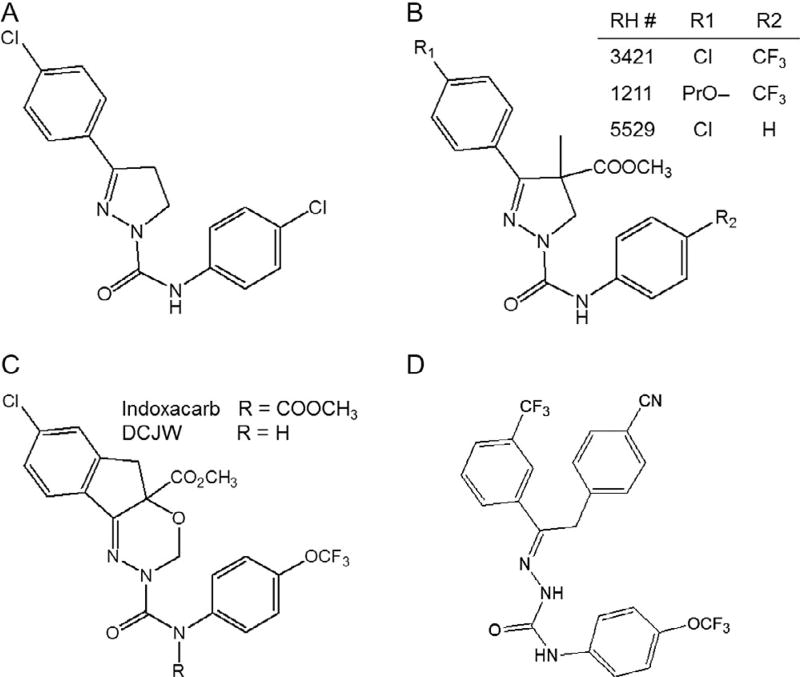
Chemical structures of SCBIs. (A) PH 60–41, (B) RH compounds, (C) indoxacarb and its N-decarbomethoxyllated metabolite, DCJW, and (D) metaflumizone.
Figure 5.3
Figure 5.3
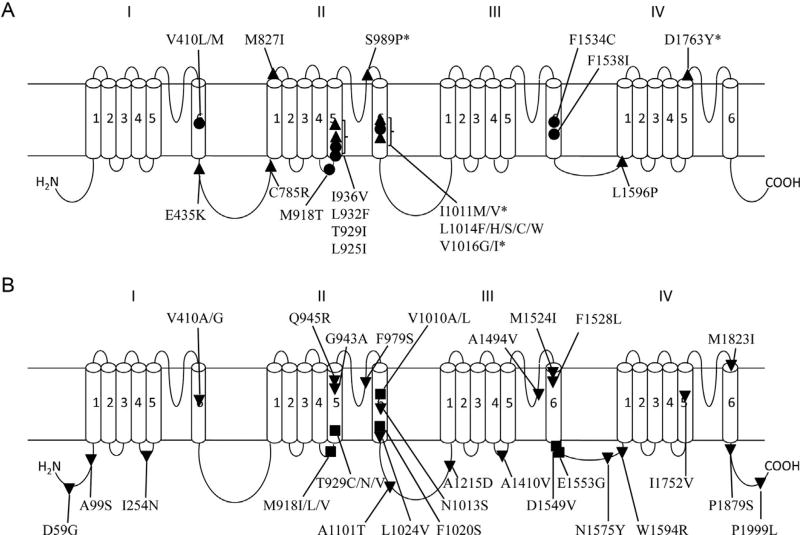
Sodium channel mutations associated with pyrethroid resistance. Sodium channel proteins contain four homologous repeats (I–IV), each having six transmembrane segments (1–6). (A) kdr mutations functionally confirmed in Xenopus oocytes. Solid circles and up triangles denote mutations from more than one species and or a single species, respectively. The four mutations that have been examined in oocytes, but did not reduce pyrethroid sensitivity, are marked with asterisk (*). (B) Sodium channel mutations that have not been examined functionally in oocytes. Solid circles denote those detected in more than one species and down triangles for those from a single species. Positions of mutations are designated based on house fly numbering (GenBank accession number: AAB47604). See Rinkevich et al. (2013), Kristensen (2005), Li et al. (2012), and Xu et al. (2012) for details on these mutations.
Figure 5.4
Figure 5.4
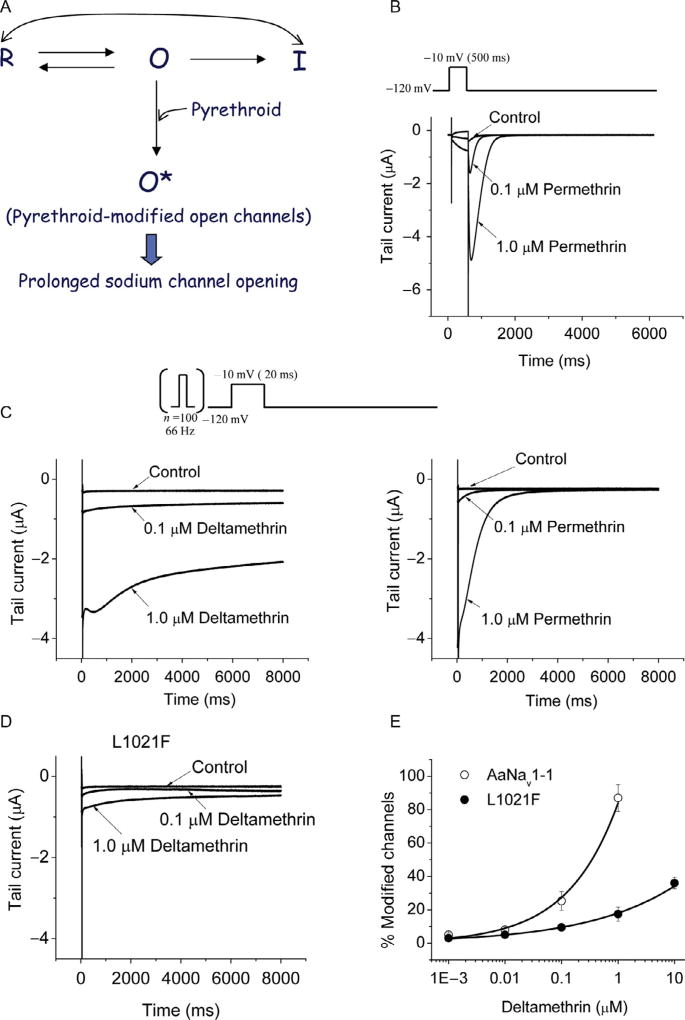
Mode of action of pyrethroids. (A) Schematic diagram showing different states of the sodium channel. Pyrethroids (particularly Type II pyrethroids) preferably bind to the open state, but Type I pyrethroids can also bind to the resting state. R, resting state; O, open state; I, inactivated state; O*, pyrethroid-modified open state. (B and C) Tail currents induced by deltamethrin and permethrin (single pulse vs. multiple pulses). (D) Tail currents from AaNav1–1 channels carrying L1021F (equivalent to L1014F in the house fly sodium channel). (E) Dose-response curves for deltamethrin on AaNav1–1 and L1021F channels. Percentage of channel modification by pyrethroids was determined using a method developed by Tatebayashi and Narahashi (1994).
Figure 5.5
Figure 5.5
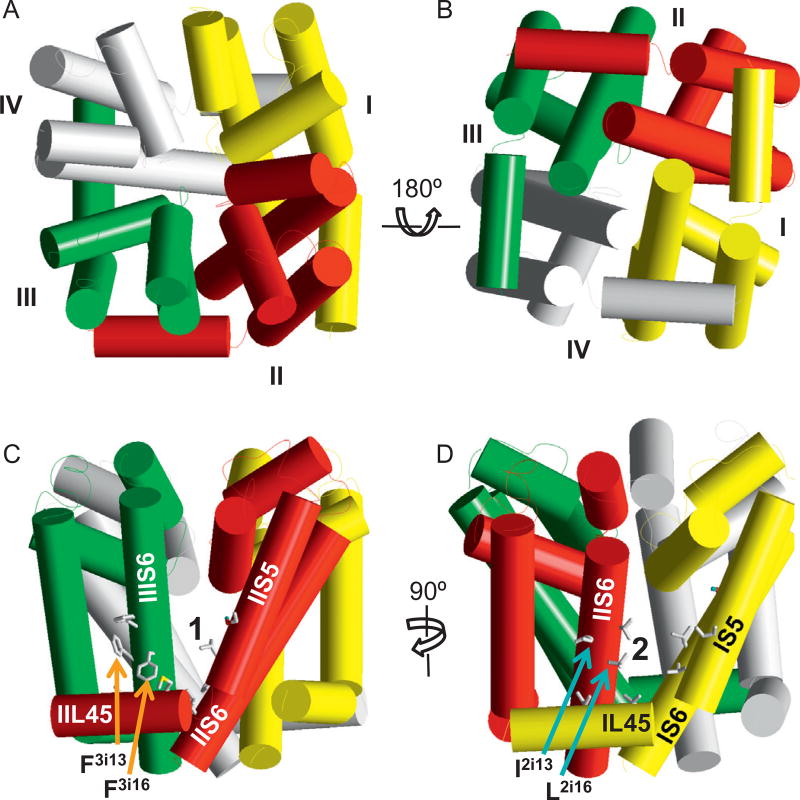
Pyrethroid receptor sites. NavAb-based model of the pore-forming module of insect sodium channel AaNav1–1. Helices are shown as cylinders. Repeat domains I, II, III, and IV are yellow, red, green, and grey, respectively. The four repeat domains are arranged clockwise in the extracellular view (A) and anticlockwise at the cytoplasmic view (B). At the side views of the channel, side chains of pyrethroid-sensing residues in site 1 (C) and Site 2 (D) are shown by sticks. Note that Site 1 is located in II/III domain interface and Site 2 in I/II domain interface.
Figure 5.6
Figure 5.6
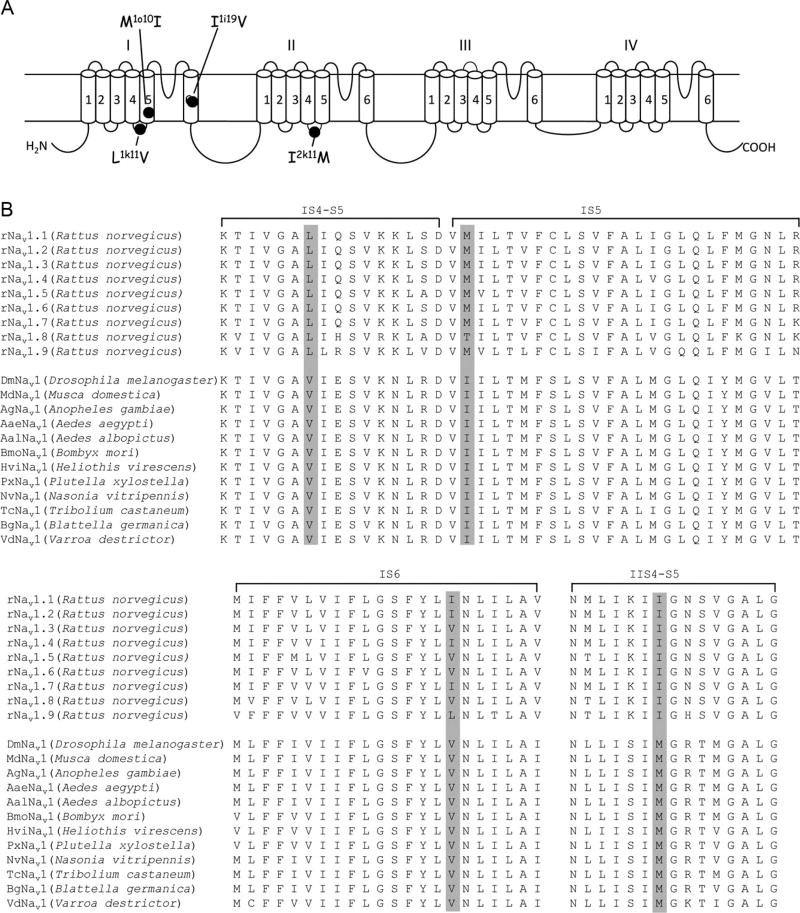
Molecular basis of different pyrethroid sensitivities among insect and mammalian sodium channels. (A) Topology of the Nav1.4 protein indicating the residues that contribute to the resistance of mammalian sodium channels to pyrethroids. (B) Sequence alignments of mammalian and insect sodium channels in the regions that are critical for the binding and action of pyrethroids.
Figure 5.7
Figure 5.7
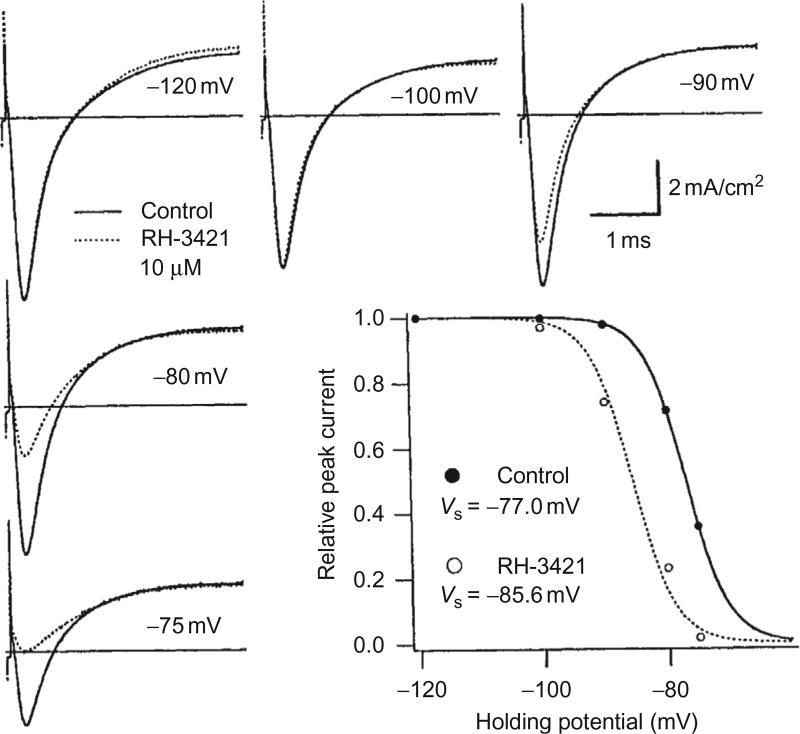
Dihydropyrazole block appears as a parallel shift of the steady-state slow inactivation curve in the direction of hyperpolarization. Ionic current traces from voltage-clamped crayfish giant axons were scaled by a common factor so that the peak at −120 mV matched the peak before treatment with the dihydropyrazole. Peak/Na was depressed most at depolarized potentials, whereas outward current, /K, was not affected by the treatment. The graph shows plots of peak current normalized to the value at − 120mV. RH-3421 (10µM) appears to shift the steady-state inactivation relation to the left by 8.6 mV. Reproduced from Salgado (1992) with permission from the American Society for Pharmacology and Experimental Therapeutics.
Figure 5.8
Figure 5.8
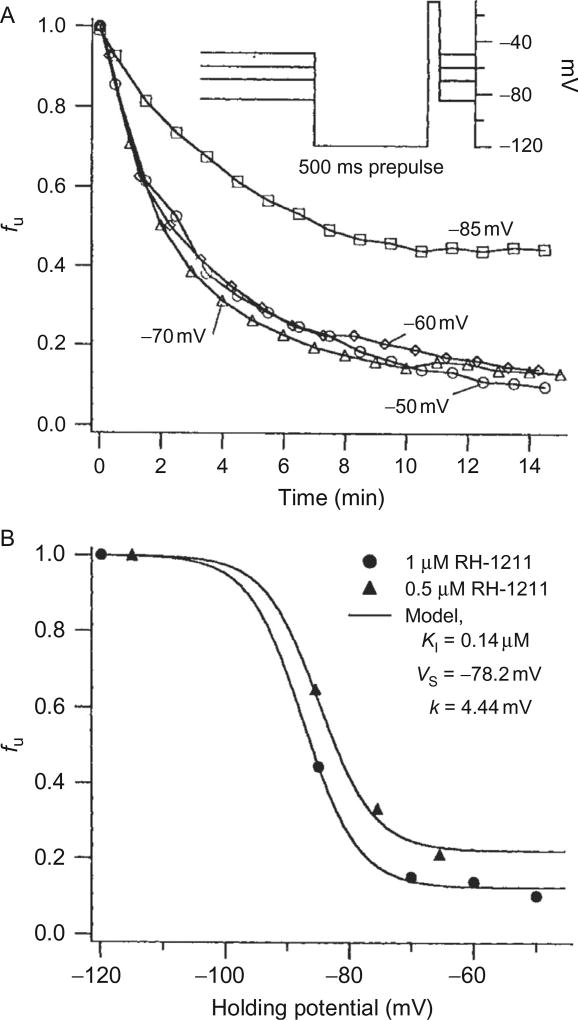
The model for state-dependent block of sodium channels by SCBIs predicts that block is voltage dependent only over the range over which inactivation occurs. In order to observe block directly at strong depolarizations, where inactivation is complete, the axon was held at various potentials as in Fig. 5.7, but a 500-ms hyperpolarizing prepulse to − 120 mV was applied just before the 10-ms test pulse during which INa was measured (see inset protocol). The prepulse was of sufficient amplitude and duration to remove inactivation completely, without interfering with block. (A) Time course of fu, the fraction of channels unblocked, following steps from −120 mV to various other potentials, in an axon equilibrated with 1 µM RH-1211. Steady-state block from this and another axon treated with 0.5 µM RH-1211 are plotted in (B). The solid curves in (B) were plotted according to Eq. (5.2), with KI= 0.14 µM, VS= 78.2mV, and k=4.44 mV. Reproduced from Salgado (1992) with permission from the American Society for Pharmacology and Experimental Therapeutics.
Figure 5.9
Figure 5.9
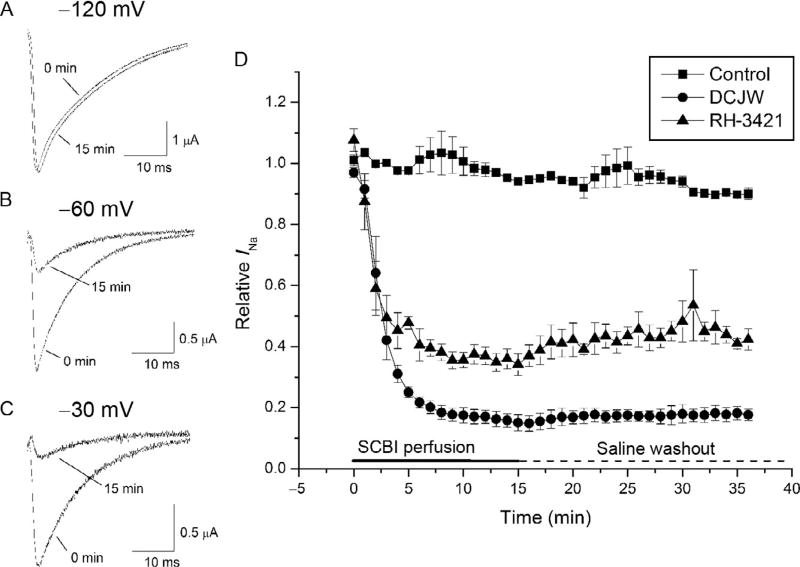
Voltage-dependent inhibition of Nav1.4 sodium channels by DCJW and RH-3421. Example traces of Nav1.4 currents in Xenopus oocytes recorded before and after treatment with DCJW at holding potentials of − 120 (A), −60 (B), or −30 mV (C). (D) Slow onset of block by DCJW or RH-3421 at a holding potential of −30 mV. Block was resistant to washout with insecticide-free saline. A 2-s hyperpolarizing pulse to − 120 mV was used to relieve channel inactivation, but not block by SCBIs, prior to the test pulse. Modified and reprinted from Neurotoxicology 81; Silver K, and Soderlund, DM; Action of pyrazoline-type insecticides at neuronal target sites; pp. 136–143; 2005, with permission from Elsevier.
Figure 5.10
Figure 5.10
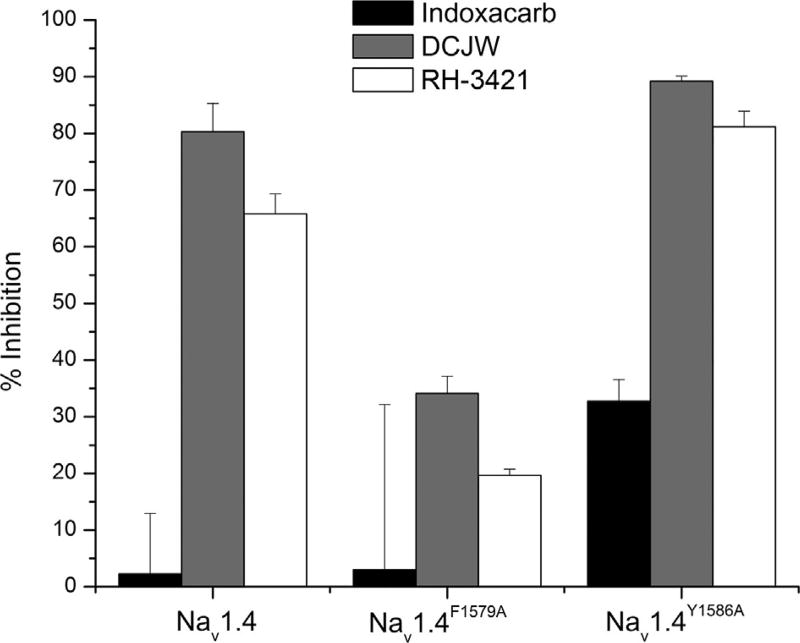
Effect of alanine substitution at F1579 (F4il5A) or Y1586 (Y4i22A) in Nav1.4 channels on sensitivity to inhibition by SCBIs. Nav1.4 channels were expressed in Xenopus oocytes equilibrated with indoxacarb, DCJW, or RH-3421 for 15 min at a holding potential of −30 mV. A 2-s hyperpolarizing pulse to −120 mV was used to relieve channel inactivation, but not block by SCBIs, prior to the test pulse.

References

    1. Ahmad M, Hollingworth RM. Synergism of insecticides provides evidence of metabolic mechanisms of resistance in the obliquebanded leafroller Choristoneura rosaceana (Lepidoptera: Tortricidae) Pest Manag. Sci. 2004;60:465–473. - PubMed
    1. Ahmad M, Hollingworth RM, Wise JC. Broad-spectrum insecticide resistance in obliquebanded leafroller Choristoneura rosaceana (Lepidoptera: Tortricidae) from Michigan. Pest Manag. Sci. 2002;58:834–838. - PubMed
    1. BASF Agricultural Products. Metaflumizone world-wide technical brochure 2007
    1. Bloomquist JR. Ion channels as targets for insecticides. Annu. Rev. Entomol. 1996;41:163–190. - PubMed
    1. Bloomquist JR, Soderlund DM. Pyrethroid insecticides and DDT modify alkaloid-dependent sodium channel activation and its enhancement by sea anemone toxin. Mol. Pharmacol. 1988;33:543–550. - PubMed

LinkOut - more resources