


DeSanto-Shinawi Syndrome: First Case in South America
- PMID: 29928181
- PMCID: PMC6006642
- DOI: 10.1159/000488815
DeSanto-Shinawi Syndrome: First Case in South America
Abstract
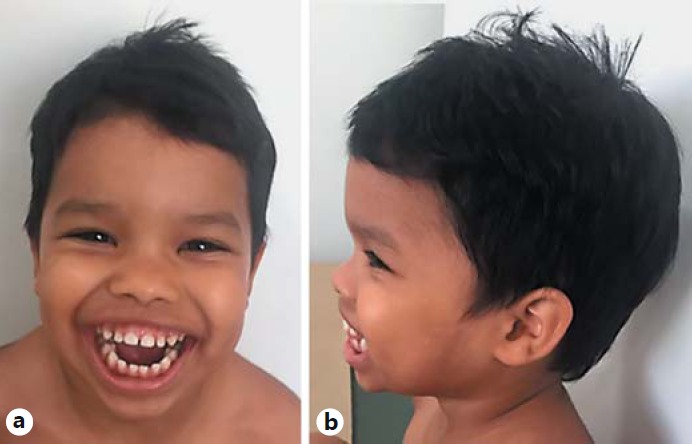
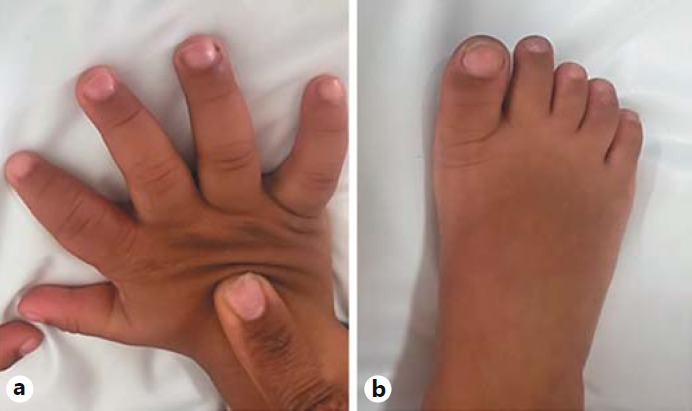
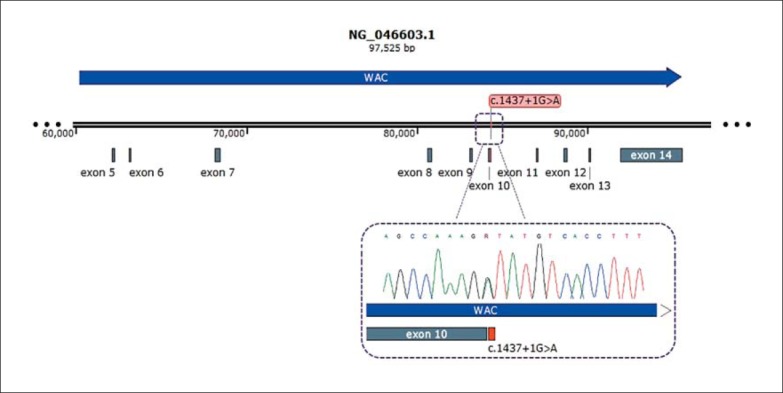
Pathogenic variants in WAC are uncommon causes of developmental delay and neurobehavioral phenotypes. The clinical features associated with WAC haploinsufficiency include recognizable dysmorphic facial features that were recently delineated as DeSanto-Shinawi syndrome (DESSH; OMIM 616708). Additional clinical features include hypotonia, hearing and vision abnormalities, gastrointestinal problems, and behavioral difficulties. Here, we report a case of a 4-year-old Colombian male patient with typical dysmorphic facial features, developmental delay, hyperactivity, and recurrent respiratory infections. His immune workup revealed hypogammaglobulinemia, and clinical exome sequencing revealed a novel intronic variant in WAC (c.1437+1G>A). To the best of our knowledge, this is the first case of DESSH in South America, underlining the accumulating evidence of the significant role of WAC haploinsufficiency in neurobehavioral phenotypes. Although this report suggested the potential involvement of WAC in immune regulation, additional reports are required to confirm our observations.
Keywords: Dysmorphic facial features; Intellectual disability; WAC.
Figures
References
-
- de Ligt J, Willemsen MH, van Bon BW, Kleefstra T, Yntema HG, et al. Diagnostic exome sequencing in persons with severe intellectual disability. N Engl J Med. 367((2012)):1921–1929. - PubMed
-
- DeSanto C, D'Aco K, Araujo GC, Shannon N, DDD Study, et al. WAC loss-of-function mutations cause a recognisable syndrome characterised by dysmorphic features, developmental delay and hypotonia and recapitulate 10p11.23 microdeletion syndrome. J Med Genet. 52((2015)):754–761. - PubMed
-
- Dietzl G, Chen D, Schnorrer F, Su KC, Barinova Y, et al. A genome-wide transgenic RNAi library for conditional gene inactivation in Drosophila. Nature. 448((2007)):151–156. - PubMed
-
- Gilissen C, Hehir-Kwa JY, Thung DT, van de Vorst M, van Bon BW, et al. Genome sequencing identifies major causes of severe intellectual disability. Nature. 511((2014)):344–347. - PubMed
-
- Harris J, Lang T, Thomas JPW, Sukkar MB, Nabar NR, Kehrl JH. Autophagy and inflammasomes. Mol Immunol. 86((2017)):10–15. - PubMed
Grants and funding
LinkOut - more resources
Full Text Sources
Other Literature Sources
