


Assessment of Sleep Deprivation and Fatigue Among Chemical Transportation Drivers in Chonburi, Thailand
- PMID: 29928529
- PMCID: PMC6005926
- DOI: 10.1016/j.shaw.2017.06.014
Assessment of Sleep Deprivation and Fatigue Among Chemical Transportation Drivers in Chonburi, Thailand
Abstract
Background: Fatigue and sleepiness are inter-related and common among road transport drivers. In this study, sleep deprivation and fatigue among chemical transportation drivers were examined.
Methods: A cross-sectional study surveying 107 drivers from three hazardous types of chemical production and transportation industries (nonflammable gases, flammable gases, and flammable liquids) was conducted. Data on sleep deprivation were collected using questionnaires of the Stanford Sleeping Scale and the Groningen Sleep Quality Scale. Fatigue was assessed using an interview questionnaire and a flicker fusion instrument.
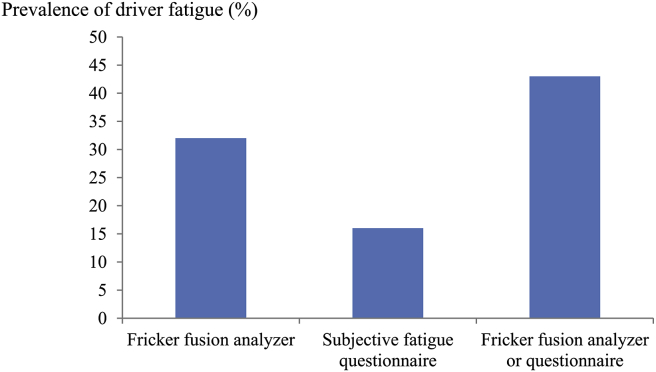
Results: Chemical drivers had a mean sleeping scale (Stanford Sleeping Scale) of 1.98 (standard deviation 1.00) and had a mean score of 1.89 (standard deviation 2.06) on the Groningen Sleep Quality Scale. High-risk drivers had higher scores in both the Stanford Sleeping Scale and the Groningen Sleep Quality Scale with a mean score of 2.59 and 4.62, respectively, and those differences reached statistical significance (p < 0.05). The prevalence of fatigue, as assessed through a critical flicker fusion analyzer, subjective fatigue question, and either of the instruments, was 32.32%, 16.16%, and 43.43%, respectively. Drivers who slept <7 hours and had poor sleep quality were found to have more fatigue than those who slept enough and well. Drivers who had a more sleepiness score resulted in significantly more objective fatigue than those who had a less sleepiness score.
Conclusion: Sleep quality and sleeping hour can affect a driver's fatigue. Optimization of work-rest model should be considered to improve productivity, driver retention, and road safety.
Keywords: chemical transportation; drivers; fatigue; road safety; sleep deprivation.
Figures
References
-
- Department of Land Transport, Ministry of Transport (MOT). Traffic statistics [Internet]. 2015 [cited 2015 Sept 10]. Available from: http://www.mot.go.th/statmot.html.
-
- Jamroz K., Smolarek L. Driver fatigue and road safety on Poland’s national roads. Int J Occup Saf Ergon. 2013;19(2):297–309. - PubMed
-
- Workplace Safety and Health Guidelines. Fatigue management [Internet]. 2010 [cited 2016 Dec 31]. Available from: https://www.wshc.sg/files/wshc/upload/cms/file/2014/Fatigue Management.pdf.
-
- Shen J., Barbera J., Shapiro C.M. Distinguishing sleepiness and fatigue: focus on definition and measurement. Sleep Med Rev. 2006;10:63–76. - PubMed
-
- Mohren D., Jansen N., van Amelsvoort L., Kant I.J. Wilco Publishers; Amersfoort: 2007. An epidemiological approach of fatigue and work. Experiences from the Maastricht Cohort Study.
LinkOut - more resources
Full Text Sources
Other Literature Sources
