


Cardiac responses to viewing facial emotion differentiate frontotemporal dementias
- PMID: 29928652
- PMCID: PMC5989744
- DOI: 10.1002/acn3.563
Cardiac responses to viewing facial emotion differentiate frontotemporal dementias
Abstract
Objective: To establish proof-of-principle for the use of heart rate responses as objective measures of degraded emotional reactivity across the frontotemporal dementia spectrum, and to demonstrate specific relationships between cardiac autonomic responses and anatomical patterns of neurodegeneration.
Methods: Thirty-two patients representing all major frontotemporal dementia syndromes and 19 healthy older controls performed an emotion recognition task, viewing dynamic, naturalistic videos of facial emotions while ECG was recorded. Cardiac reactivity was indexed as the increase in interbeat interval at the onset of facial emotions. Gray matter associations of emotional reactivity were assessed using voxel-based morphometry of patients' brain MR images.
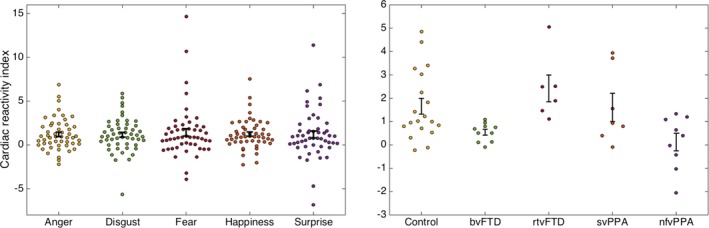
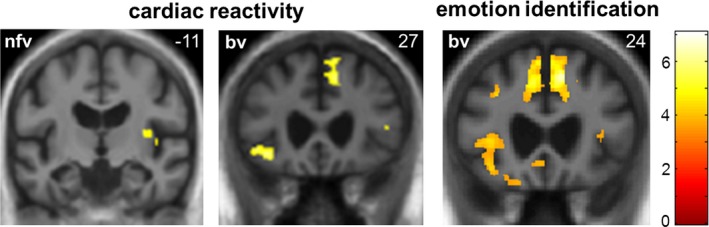
Results: Relative to healthy controls, all patient groups had impaired emotion identification, whereas cardiac reactivity was attenuated in those groups with predominant fronto-insular atrophy (behavioral variant frontotemporal dementia and nonfluent primary progressive aphasia), but preserved in syndromes focused on the anterior temporal lobes (right temporal variant frontotemporal dementia and semantic variant primary progressive aphasia). Impaired cardiac reactivity correlated with gray matter atrophy in a fronto-cingulo-insular network that overlapped correlates of cognitive emotion processing.
Interpretation: Autonomic indices of emotional reactivity dissociate from emotion categorization ability, stratifying frontotemporal dementia syndromes and showing promise as novel biomarkers. Attenuated cardiac responses to the emotions of others suggest a core pathophysiological mechanism for emotional blunting and degraded interpersonal reactivity in these diseases.
Figures
References
-
- Chan D, Anderson V, Pijnenburg Y, et al. The clinical profile of right temporal lobe atrophy. Brain 2009;132(Pt 5):1287–1298. - PubMed
-
- Rosen HJ, Pace‐Savitsky K, Perry RJ, et al. Recognition of emotion in the frontal and temporal variants of frontotemporal dementia. Dement Geriatr Cogn Disord 2004;17:277–281. - PubMed
Grants and funding
LinkOut - more resources
Full Text Sources
Other Literature Sources
