


Abdominal DIBH reduces the cardiac dose even further: a prospective analysis
- PMID: 29929560
- PMCID: PMC6013896
- DOI: 10.1186/s13014-018-1062-6
Abdominal DIBH reduces the cardiac dose even further: a prospective analysis
Abstract
Background: Deep inspiration breath hold (DIBH) can be performed using different breathing maneuvers, such as DIBH with a thoracic breathing maneuver (T-DIBH) and DIBH with an abdominal breathing maneuver (A-DIBH). Dosimetric benefits of A-DIBH were investigated in the treatment of left-sided breast cancer radiotherapy (RT) with both 3-Dimensional conformal radiation therapy (3D-CRT) and intensity-modulated radiotherapy (IMRT) techniques.
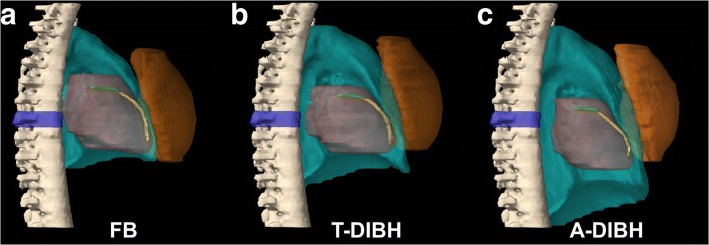
Methods: Twenty-two patients with left-sided breast cancer were enrolled in this study. 3D-CRT and IMRT plans were generated for each patient with three different CT scans of free breathing (FB), T-DIBH and A-DIBH. There were total of six treatment plans generated for each patient: FB_3D-CRT; TDIBH_3D-CRT; ADIBH_3D-CRT; FB-IMRT; TDIBH-IMRT; ADIBH-IMRT. Doses to the heart, left anterior descending coronary artery (LADCA), and ipsilateral lung were evaluated and compared using the Wilcoxon signed-rank test.
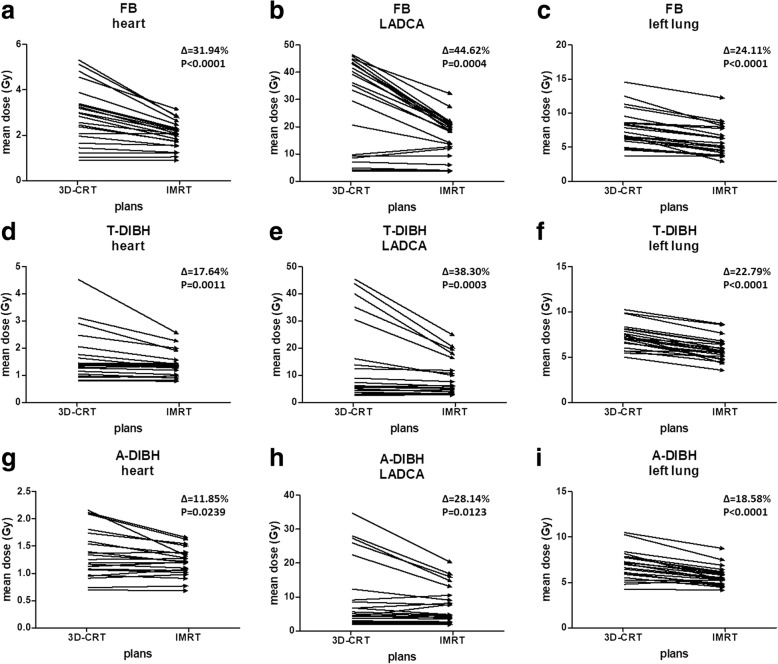
Results: The mean doses to the heart, LADCA and ipsilateral lung in 3D-CRT plans generated from 3D-CRT with FB, T-DIBH and A-DIBH were (2.89 ± 1.30), (1.67 ± 0.90) and (1.34 ± 0.43) Gy (all P < 0.05), respectively, with FB; (29.08 ± 16.72), (13.94 ± 14.74) and (10.22 ± 10.30) Gy (all P < 0.05), respectively, with T-DIBH; and (7.77 ± 2.71), (7.32 ± 1.42) and (6.90 ± 1.60) Gy (all P < 0.05), respectively, with A-DIBH. The mean doses to the heart, LADCA and ipsilateral lung in IMRT plans were generated from IMRT with FB, T-DIBH and A-DIBH were (1.96 ± 2.25), (1.37 ± 0.44) and (1.18 ± 0.26) Gy (all P < 0.05), respectively, with FB; (16.10 ± 7.45), (8.6 ± 6.60) and (7.35 ± 5.42) Gy (all P < 0.05), respectively, with T-DIBH; and (5.90 ± 2.24), (5.65 ± 1.58) and (5.62 ± 1.05) Gy (all P > 0.05), respectively, with A-DIBH.
Conclusions: This study indicates that both 3D-CRT and IMRT plans with A-DIBH achieved lower cardiac and LADCA doses than plans with FB and T-DIBH; 3D-CRT plans with A-DIBH achieved lower ipsilateral lung doses than plans with FB and T-DIBH; and IMRT plans with A-DIBH had better outcomes than 3D-CRT plans with A-DIBH with respect to the mean dose to the heart, LADCA and ipsilateral lung. IMRT plans with A-DIBH should be incorporated into the daily routine for left-sided breast RT.
Keywords: 3-dimensional conformal radiation therapy (3D-CRT); Breast cancer; Breath holding; Intensity-modulated radiation therapy (IMRT); Organs at risk; Radiotherapy dosage.
Conflict of interest statement
Ethics approval and consent to participate
This prospective study was conducted in compliance with the ethical principles of the Declaration of Helsinki and was approved by the Research Ethics Committee of the First Affiliated Hospital, College of Medicine, Zhejiang University. Informed consent was obtained from all individual participants included in the study.
Consent for publication
Not applicable.
Competing interests
The authors declare that they have no competing interests.
Publisher’s Note
Springer Nature remains neutral with regard to jurisdictional claims in published maps and institutional affiliations.
Figures
References
-
- Early Breast Cancer Trialists' Collaborative Group (EBCTCG) Darby S, McGale P, et al. Effect of radiotherapy after breast-conserving surgery on 10-year recurrence and 15-year breast cancer death: meta-analysis of individual patient data for 10,801 women in 17 randomised trials. Lancet. 2011;378(9804):1707–1716. doi: 10.1016/S0140-6736(11)61629-2. - DOI - PMC - PubMed
-
- Rong Y, Walston S, Welliver MX, Chakravarti A, Quick AM. Improving intra-fractional target position accuracy using a 3D surface surrogate for left breast irradiation using the respiratory-gated deep-inspiration breath-hold technique. PLoS One. 2014;9(5):e97933. doi: 10.1371/journal.pone.0097933. - DOI - PMC - PubMed
MeSH terms
Grants and funding
LinkOut - more resources
Full Text Sources
Other Literature Sources
Research Materials
