


Idiopathic Scoliosis Families Highlight Actin-Based and Microtubule-Based Cellular Projections and Extracellular Matrix in Disease Etiology
- PMID: 29930198
- PMCID: PMC6071588
- DOI: 10.1534/g3.118.200290
Idiopathic Scoliosis Families Highlight Actin-Based and Microtubule-Based Cellular Projections and Extracellular Matrix in Disease Etiology
Abstract
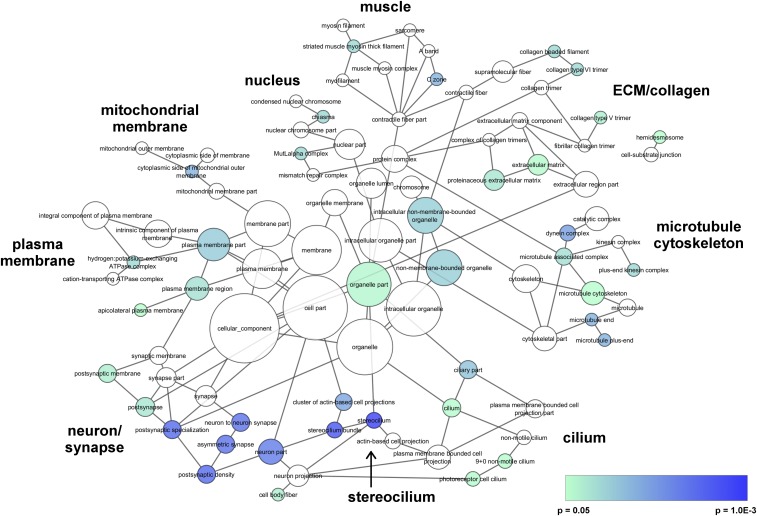
Idiopathic scoliosis (IS) is a structural lateral spinal curvature of ≥10° that affects up to 3% of otherwise healthy children and can lead to life-long problems in severe cases. It is well-established that IS is a genetic disorder. Previous studies have identified genes that may contribute to the IS phenotype, but the overall genetic etiology of IS is not well understood. We used exome sequencing to study five multigenerational families with IS. Bioinformatic analyses identified unique and low frequency variants (minor allele frequency ≤5%) that were present in all sequenced members of the family. Across the five families, we identified a total of 270 variants with predicted functional consequences in 246 genes, and found that eight genes were shared by two families. We performed GO term enrichment analyses, with the hypothesis that certain functional annotations or pathways would be enriched in the 246 genes identified in our IS families. Using three complementary programs to complete these analyses, we identified enriched categories that include stereocilia and other actin-based cellular projections, cilia and other microtubule-based cellular projections, and the extracellular matrix (ECM). Our results suggest that there are multiple paths to IS and provide a foundation for future studies of IS pathogenesis.
Keywords: actin cytoskeleton; cilia; exome sequencing; extracellular matrix; idiopathic scoliosis; microtubules.
Copyright © 2018 Baschal et al.
Figures
References
-
- Aksenovich T. I., Zaidman A. M., Zorkol’tseva I. V., Tregubova I. L., Borodin P. M., 1999. [New models of inheritance of complex characteristics and their use in segregation analysis of idiopathic scoliosis] Genetika 35: 255–262. - PubMed
Publication types
MeSH terms
Grants and funding
LinkOut - more resources
Full Text Sources
Other Literature Sources
Medical
Molecular Biology Databases