. 2018 Jun 21;8(1):9445.
doi: 10.1038/s41598-018-27711-8.

Krüppel-Like Factor 10 participates in cervical cancer immunoediting through transcriptional regulation of Pregnancy-Specific Beta-1 Glycoproteins

Affiliations

Krüppel-Like Factor 10 participates in cervical cancer immunoediting through transcriptional regulation of Pregnancy-Specific Beta-1 Glycoproteins

Daniel Marrero-Rodríguez et al. Sci Rep. .

Abstract

Cervical cancer (CC) is associated with alterations in immune system balance, which is primarily due to a shift from Th1 to Th2 and the unbalance of Th17/Treg cells. Using in silico DNA copy number analysis, we have demonstrated that ~20% of CC samples exhibit gain of 8q22.3 and 19q13.31; the regions of the genome that encodes the KLF10 and PSG genes, respectively. Gene expression studies demonstrated that there were no alterations in KLF10 mRNA expression, whilst the PSG2 and -5 genes were up-regulated by 1.76 and 3.97-fold respectively in CC compared to normal tissue controls. siRNA and ChIP experiments in SiHa cells have demonstrated that KLF10 participates in immune response through regulation of IL6, IL25 and PSG2 and PSG5 genes. Using cervical tissues from KLF10-/- mice, we have identified down-regulation of PSG17, -21 and -23 and IL11. These results suggest that KLF10 may regulate immune system response genes in cervical cancer among other functions. KLF10 and PSG copy number variations and alterations in mRNA expression levels could represent novel molecular markers in CC.


Conflict of interest statement

The authors declare no competing interests.

Figures
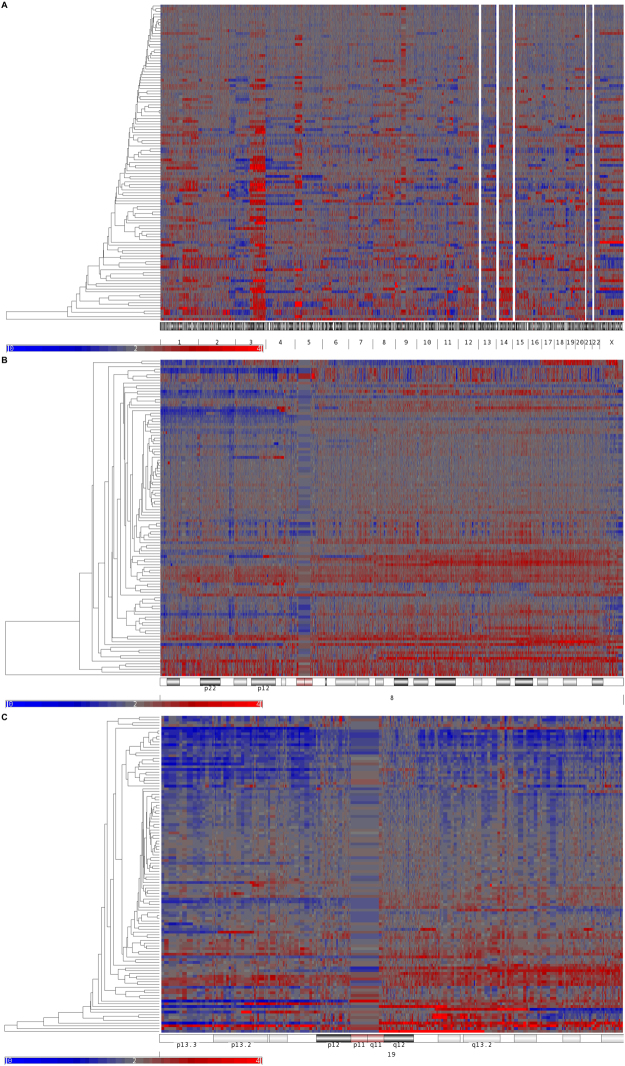
Figure 1
Figure 1
Chromosomal imbalances in CC. Panel (A) hierarchical clustering indicating genomic DNA gains in red and losses in blue in the 22 somatic chromosomes and the X chromosome in 115 CC samples. Cervical cancer genomes show gains in 1p, 3q, 5p, 20, and 8q22.3 and 19q13.31 cytogenetic regions. Panel (B) and Panel (C) indicate the hierarchical clustering of the 8 and 19 chromosomes across the CC samples analyzed. In panel (A) white stripes in the acrocentric chromosomes 13, 14, 15, 21 and 22 corresponds to nucleolar organizer regions and stripes observed in chromosome 8 and 19 correspond to centromere on panel B and C.
Figure 2
Figure 2
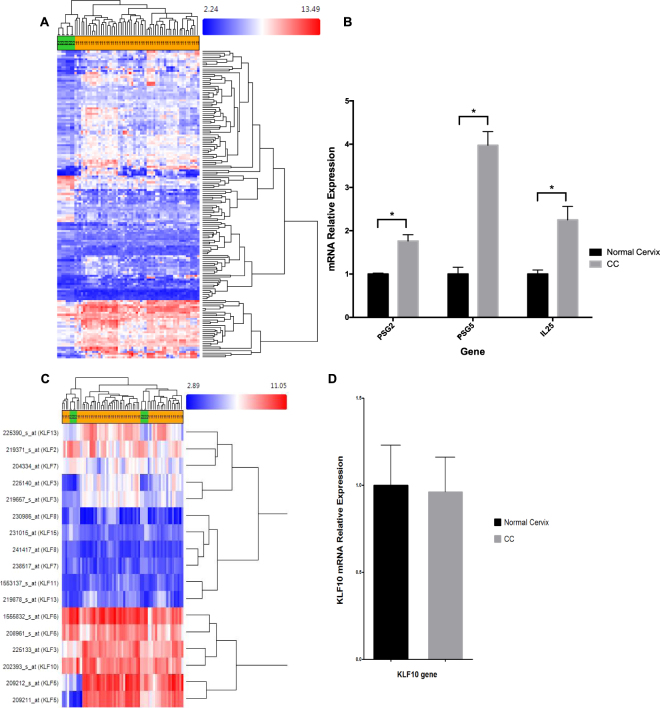
Transcriptome analysis of cervical tissue. (A) Heat map indicating differentially expressed immune related genes between normal and CC samples as detected by in silico analysis of the array datasets. (B) RT-qPCR validation of PSG2, PSG5 and IL25 in cervical cancer samples collected by our laboratory. Black bars represent basal expression in normal cervical tissue while grey bars represent expression in cervical cancer. (C) Hierarchical clustering indicating the expression levels of KLF family members in normal tissue and CC. (D) RT-qPCR analysis demonstrating no significant differences in the expression levels of KLF10 between normal (black bar) and CC (grey bar) tissue.
Figure 3
Figure 3
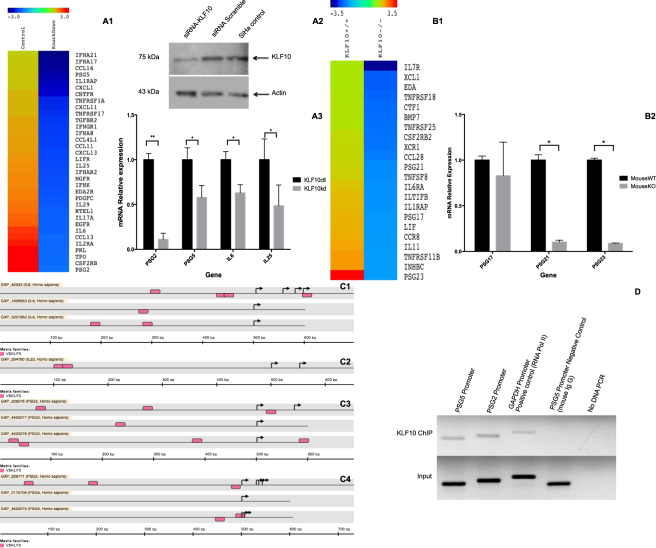
Relative expression analyses of IL25, PSG2 and PSG5 genes. Panel (A1) Heatmap depicting expression levels of indicated immune system response genes that are down regulated in SiHa cells following siRNA-mediated suppression of KLF10. Panel (A2) Western blot depicting KLF10 protein levels in the knocked down cells compared to scrambled siRNA and untreated control cells. Panel (A3) show RT-qPCR validation of the down-regulated genes in microarray data: IL6 with 38%, IL25 with 52% PSG5 with 43% and PSG2 with 89% down regulation in KLF10 siRNA treated cells in comparison with the control cells without any treatment. Panel (B1) presents heatmap corresponding to immune system response related genes dowregulated in KLF10 KO mouse compared to KLF10 WT mouse. Panel (B2) show RT-qPCR validation of PSG17 down regulation of 18%, PSG21 90% and PSG23 92% down-regulation in KO mouse cervical tissue compared to WT mouse tissue. Black bars represent the control cells (KLF10ct) or the WT mouse (KLF10wt), while grey bars represent the KLF10 knock down cells (KLF10kd) and knock out mouse (KLF10ko) in each panel respectively. Panel (C1–C4) shows the in silico results for the analysis of promoter regions from IL6, IL25, PSG2 and PSG5 genes respectively, MatInspector module from Genomatix Software was used. Pink rectangles represent the putative region were KLF10 responsive sequence could be located. Panel (D) show the KLF10-immunoprecipitated DNA. The first two lanes present PSG promoter region associated to KLF10. Whereas lanes three and four present GAPDH promoter in RNA Pol II immunoprecipitated DNA as positive control, and PSG5 promoter in mouse-IgG immunoprecipitated DNA as negative control. All ChIP lanes present Input DNA control. Agarose gel was cropped; all reactions were electrophoresed in the same gel.

References

    1. Woodman C, Collins S, Young L. The natural history of cervical HPV infection: unresolved issues. Nat Rev Cancer. 2007;7:11–22. doi: 10.1038/nrc2050. - DOI - PubMed
    1. Hanahan D, Weinberg R. Hallmarks of Cancer: The Next Generation. Cell. 2011;144:646–674. doi: 10.1016/j.cell.2011.02.013. - DOI - PubMed
    1. Kanodia S, Fahey L, Kast M. Mechanisms Used by Human Papillomaviruses to Escape the Host Immune Response. Current Cancer Drug Targets. 2007;7:79–89. doi: 10.2174/156800907780006869. - DOI - PubMed
    1. Tindle W. Immune evasion in human papillomavirus-associated cervical cancer. Nat Rev Cancer. 2002;2:59–65. doi: 10.1038/nrc700. - DOI - PubMed
    1. Boccardo E, Lepique A, Villa L. The role of inflammation in HPV carcinogenesis. Carcinogenesis. 2010;31:1905–1912. doi: 10.1093/carcin/bgq176. - DOI - PubMed

Publication types

MeSH terms

Substances