Review
. 2018 Jun 7:9:1306.
doi: 10.3389/fimmu.2018.01306. eCollection 2018.

Integrated Stress Responses to Bacterial Pathogenesis Patterns

Affiliations
Review

Integrated Stress Responses to Bacterial Pathogenesis Patterns

Larissa O C P Rodrigues et al. Front Immunol. .

Abstract

Activation of an appropriate innate immune response to bacterial infection is critical to limit microbial spread and generate cytokines and chemokines to instruct appropriate adaptive immune responses. Recognition of bacteria or bacterial products by pattern recognition molecules is crucial to initiate this response. However, it is increasingly clear that the context in which this recognition occurs can dictate the quality of the response and determine the outcome of an infection. The cross talk established between host and pathogen results in profound alterations on cellular homeostasis triggering specific cellular stress responses. In particular, the highly conserved integrated stress response (ISR) has been shown to shape the host response to bacterial pathogens by sensing cellular insults resulting from infection and modulating transcription of key genes, translation of new proteins and cell autonomous antimicrobial mechanisms such as autophagy. Here, we review the growing body of evidence demonstrating a role for the ISR as an integral part of the innate immune response to bacterial pathogens.

Keywords: PKR; PKR-like ER kinase; bacterial pathogens; cellular stress; eukaryotic translation initiation factor 2 alpha; general control non-derepressible 2; heme-regulated eIF2α kinase.


Figures
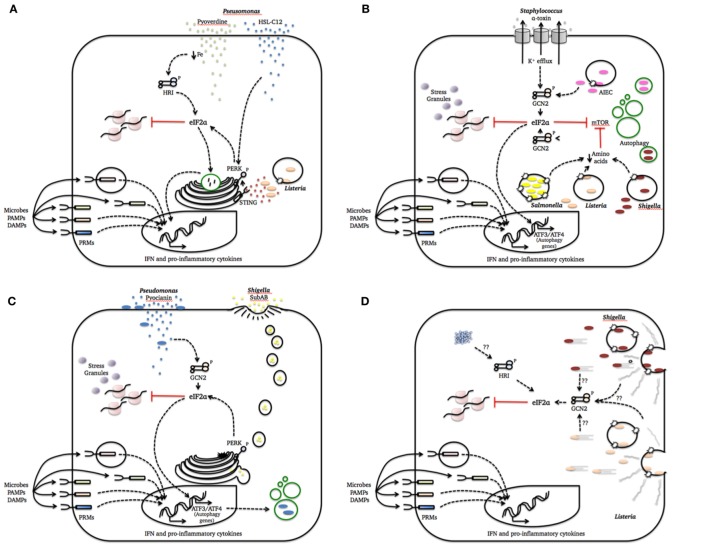
Figure 1
Figure 1
Integrated stress response (ISR) activation by bacterial pathogenesis patterns. This figure summarizes how cellular damage induced by different bacterial species is sensed by one or more eukaryotic translation initiation factor 2 alpha (eIF2α) kinases to activate defense mechanisms and homeostatic programs. We intentionally included a simplified representation of pattern recognition molecules (PRMs) recognition of microbes, PAMPs, and danger-associated molecular patterns (DAMPs) in all cartoons to strengthen the notion that these system act together to refine the cell response to the infection. (A) Pathogenesis pattern: bacterial growth; (B) pathogenesis pattern: membrane damage; (C) pathogenesis pattern: access to cytosol; (D) pathogenesis pattern: cytoskeleton disruption and protein aggregation.

References

    1. Medzhitov R. Recognition of microorganisms and activation of the immune response. Nature (2007) 449:819–26.10.1038/nature06246 - DOI - PubMed
    1. Carneiro LA, Magalhaes JG, Tattoli I, Philpott DJ, Travassos LH. Nod-like proteins in inflammation and disease. J Pathol (2008) 214:136–48.10.1002/path.2271 - DOI - PubMed
    1. Iwasaki A, Medzhitov R. Control of adaptive immunity by the innate immune system. Nat Immunol (2015) 16:343–53.10.1038/ni.3123 - DOI - PMC - PubMed
    1. Kumar S, Ingle H, Prasad DV, Kumar H. Recognition of bacterial infection by innate immune sensors. Crit Rev Microbiol (2013) 39:229–46.10.3109/1040841X.2012.706249 - DOI - PubMed
    1. Vance RE, Isberg RR, Portnoy DA. Patterns of pathogenesis: discrimination of pathogenic and nonpathogenic microbes by the innate immune system. Cell Host Microbe (2009) 6:10–21.10.1016/j.chom.2009.06.007 - DOI - PMC - PubMed

LinkOut - more resources
