


A incidência regional do tromboembolismo venoso no Brasil
- PMID: 29930651
- PMCID: PMC5868939
- DOI: 10.1590/1677-5449.000517
A incidência regional do tromboembolismo venoso no Brasil
Abstract
Background: Several studies conducted in areas with temperate climates have suggested that the incidence of venous thromboembolism (VTE) varies depending on seasonal climatic fluctuations. However, no studies have been conducted comparing areas with semi-arid climate with areas with temperate climates.
Objectives: To analyze whether there is a correlation between the incidence of VTE in areas with semi-arid climates and areas with temperate climates in Brazil.
Methods: Retrospective data were acquired for patients diagnosed with VTE from January 2011 to December 2014 from the Brazilian National Health Service for the following Brazilian states that have semi-arid climates: Alagoas, Ceará, Maranhão, Paraíba, Pernambuco, Piauí, and Rio Grande do Norte (all located in the Northeast Region of Brazil); and the following states with temperate climates: Paraná, Santa Catarina, and Rio Grande do Sul (all located in the South Region of Brazil). Data on climatic variation were obtained from the National Meteorological Institute and population data were obtained from the Brazilian Institute of Geography and Statistics.
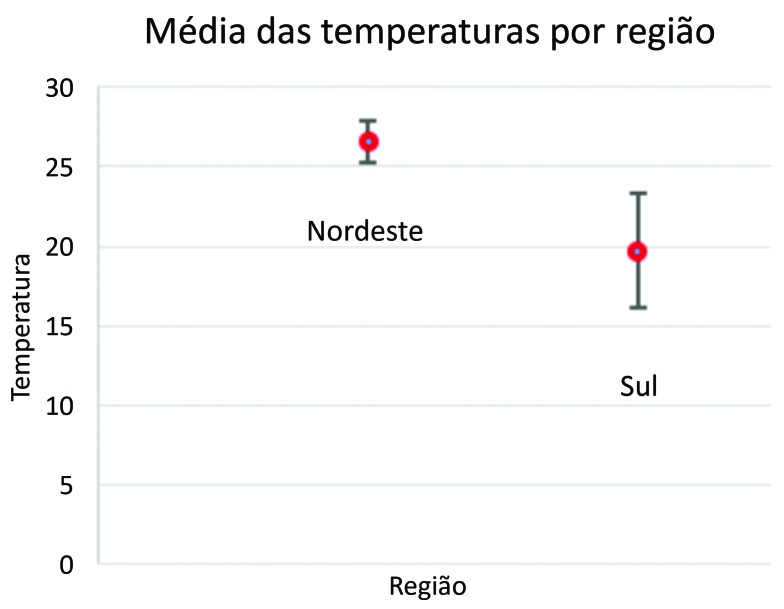
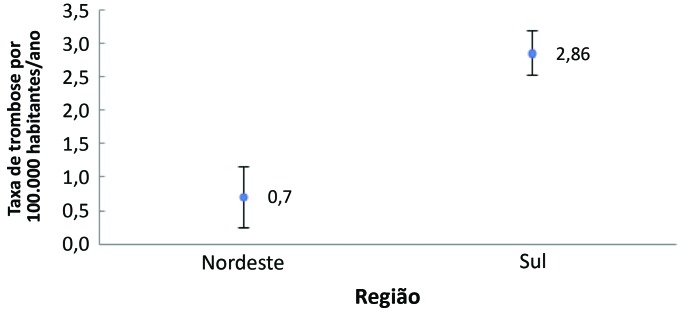
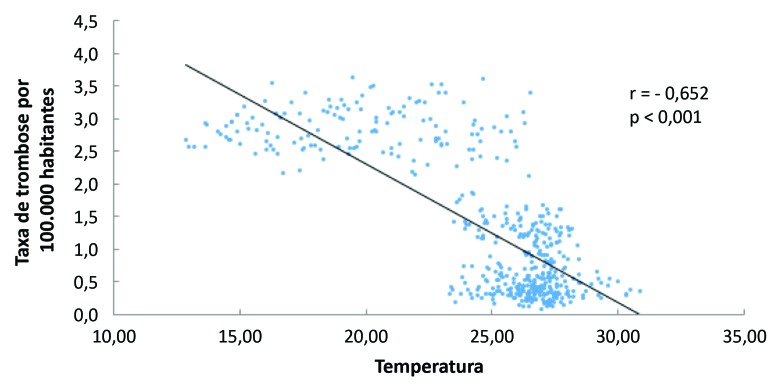
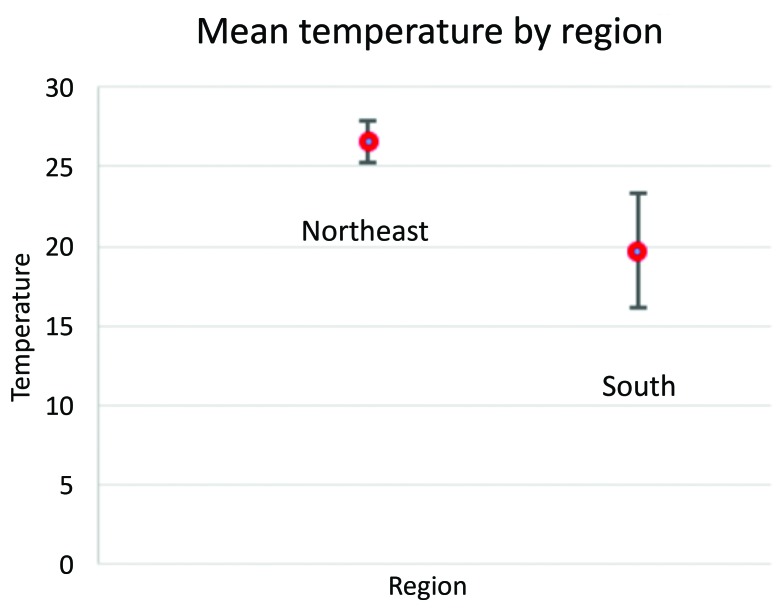
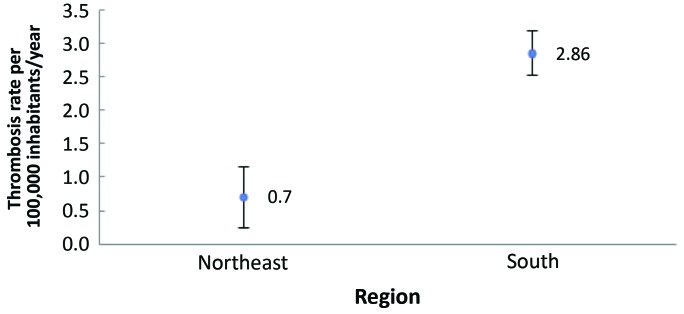
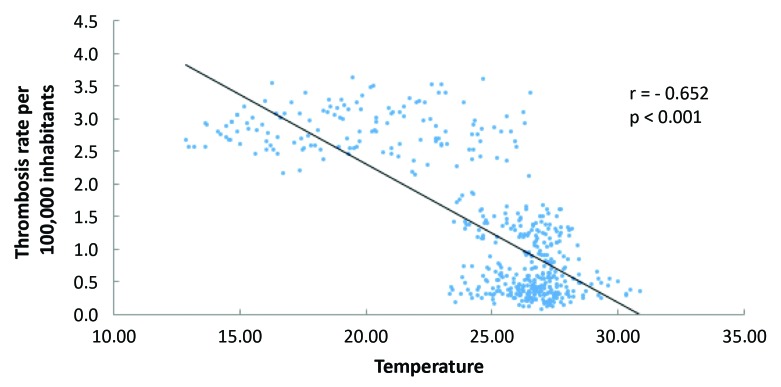
Results: There was a significant correlation in the incidence of VTE cases in areas with lower temperatures (p < 0.001). The South Region exhibited significantly lower temperatures than the Northeast Region (p < 0.001) and had a significantly higher number of cases of VTE than the Northeast Region (p < 0.001).
Conclusions: There are more cases of VTE in areas with temperate climates, where temperatures are lower. However, there is still little information in the literature on seasonal fluctuations and incidence of VTE. More studies of this subject are needed.
Contexto: Vários estudos realizados em climas temperados sugerem que há uma variação na incidência de tromboembolismo venoso (TEV) de acordo com as estações climáticas. Entretanto, nenhum estudo foi feito comparando áreas de clima semiárido com áreas de clima temperado.
Objetivos: Analisar se existe correlação entre a incidência do TEV em áreas de clima semiárido e de clima temperado no Brasil.
Métodos: Foi feito um levantamento de dados retrospectivos de pacientes com diagnóstico de TEV no Sistema Único de Saúde de janeiro de 2011 a dezembro de 2014 provenientes dos seguintes estados com clima semiáridos: Alagoas, Ceará, Maranhão, Paraíba, Pernambuco, Piauí e Rio Grande do Norte, localizados na Região Nordeste do Brasil; e dos seguintes estados com clima temperado: Paraná, Santa Catarina e Rio Grande do Sul, localizados na Região Sul do Brasil. Os dados de variação climática foram obtidos do Instituto Nacional de Meteorologia e os dados populacionais do Instituto Brasileiro de Geografia e Estatística.
Resultados: Houve correlação significativa na incidência de casos de TEV em regiões de temperaturas mais baixas (p < 0,001). A Região Sul apresentou temperaturas significativamente menores que as da Região Nordeste (p < 0,001) e apresentou número significativamente maior de casos de TEV do que a Região Nordeste (p < 0,001).
Conclusão: Há mais casos de TEV em regiões de clima temperado, onde as temperaturas são mais baixas. No entanto, pouco ainda é conhecido na literatura sobre a flutuação sazonal e a incidência de TEV. Sendo assim, mais estudos são necessários nessa área.
Conflict of interest statement
Conflito de interesse: Os autores declararam não haver conflitos de interesse que precisam ser informados.
Figures
References
-
- Silverstein MD, Heit JA, Mohr DN, Petterson TM, O’Fallon WM, Melton LJ., 3rd Trends in the incidence of deep vein thrombosis and pulmonary embolism: a 25-year population-based study. Arch Intern Med. 1998;158(6):585–593. http://dx.doi.org/10.1001/archinte.158.6.585 - DOI - PubMed
-
- Maffei FH. Epidemiologia da trombose venosa profunda e de suas complicações no Brasil. Cir Vasc Angiol. 1998;14:5–8.
-
- Fowkes FJ, Price JF, Fowkes FG. Incidence of diagnosed deep vein thrombosis in the general population: systematic review. Eur J Vasc Endovasc Surg. 2003;25(1):1–5. http://dx.doi.org/10.1053/ejvs.2002.1778 - DOI - PubMed
-
- Naess IA, Christiansen SC, Romundstad P, Cannegieter SC, Rosendaal FR, Hammerstrøm J. Incidence and mortality of venous thrombosis: a population-based study. J Thromb Haemost. 2007;5(4):692–699. http://dx.doi.org/10.1111/j.1538-7836.2007.02450.x - DOI - PubMed
-
- Stein PD, Kayali F, Olson RE. Analysis of occurrence of venous thromboembolic disease in the four seasons. Am J Cardiol. 2004;93(4):511–513. http://dx.doi.org/10.1016/j.amjcard.2003.10.061 - DOI - PubMed
LinkOut - more resources
Full Text Sources
Other Literature Sources