


Objective cognitive functioning in self-reported habitual short sleepers not reporting daytime dysfunction: examination of impulsivity via delay discounting
- PMID: 29931335
- PMCID: PMC6132621
- DOI: 10.1093/sleep/zsy115
Objective cognitive functioning in self-reported habitual short sleepers not reporting daytime dysfunction: examination of impulsivity via delay discounting
Abstract
Study objectives: (1) Examine performance on an objective measure of reward-related cognitive impulsivity (delay discounting) among self-reported habitual short sleepers and medium (i.e. recommended 7-9 hours) length sleepers either reporting or not reporting daytime dysfunction; (2) Inform the debate regarding what type and duration of short sleep (e.g. 21 to 24 hours of total sleep deprivation, self-reported habitual short sleep duration) meaningfully influences cognitive impulsivity; (3) Compare the predictive utility of sleep duration and perceived dysfunction to other factors previously shown to influence cognitive impulsivity via delay discounting performance (age, income, education, and fluid intelligence).
Methods: We analyzed data from 1190 adults from the Human Connectome Project database. Participants were grouped on whether they reported habitual short (≤6 hours) vs. medium length (7-9 hours) sleep duration and whether they perceived daytime dysfunction using the Pittsburgh Sleep Quality Index.
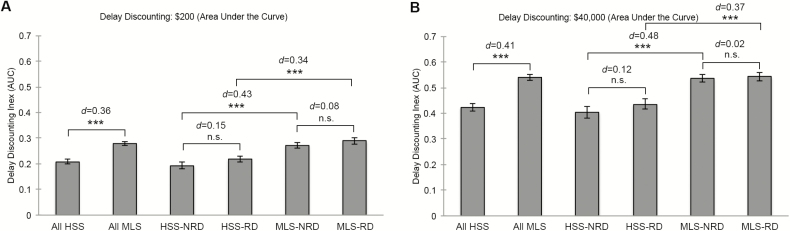
Results: All short sleepers exhibited increased delay discounting compared to all medium length sleepers, regardless of perceived dysfunction. Of the variables examined, self-reported sleep duration was the strongest predictor of delay discounting behavior between groups and across all 1190 participants.
Conclusions: Individuals who report habitual short sleep are likely to exhibit increased reward-related cognitive impulsivity regardless of perceived sleep-related daytime impairment. Therefore, there is a reason to suspect that these individuals exhibit more daytime dysfunction, in the form of reward-related cognitive impulsivity, than they may assume. Current findings suggest that assessment of sleep duration over the prior month has meaningful predictive utility for human reward-related impulsivity.
Figures
Comment in
-
Sleep and delay discounting: is insufficient sleep a cause or a manifestation of short-sighted choice?Sleep. 2019 Apr 1;42(4):zsz005. doi: 10.1093/sleep/zsz005. Sleep. 2019. PMID: 30946469 No abstract available.
-
Toward an individual differences approach to habitual short sleep duration: a reply to Massar and Chee.Sleep. 2019 Apr 1;42(4):zsz035. doi: 10.1093/sleep/zsz035. Sleep. 2019. PMID: 30946470 No abstract available.
References
-
- Waters F, et al. Neuropsychological effects of sleep loss: implication for neuropsychologists. J Int Neuropsychol Soc. 2011;17(4):571–586. - PubMed
-
- van de Laar M, et al. The role of personality traits in insomnia. Sleep Med Rev. 2010;14(1):61–68. - PubMed
-
- American Academy of Sleep Medicine. International Classification of Sleep Disorders: Diagnostic and Coding Manual. 3rd ed Darien, IL: American Academy of Sleep Medicine, 2014.
Publication types
MeSH terms
Grants and funding
LinkOut - more resources
Full Text Sources
Other Literature Sources
