


Recent Advancements in Treating Sleep Disorders in Co-Occurring PTSD
- PMID: 29931537
- PMCID: PMC6645398
- DOI: 10.1007/s11920-018-0916-9
Recent Advancements in Treating Sleep Disorders in Co-Occurring PTSD
Abstract
Purpose of review: Comorbidity of posttraumatic stress disorder (PTSD) and insomnia, nightmares, and obstructive sleep apnea (OSA) is high. We review recent research on psychotherapeutic and pharmacological interventions for sleep disorders in PTSD.
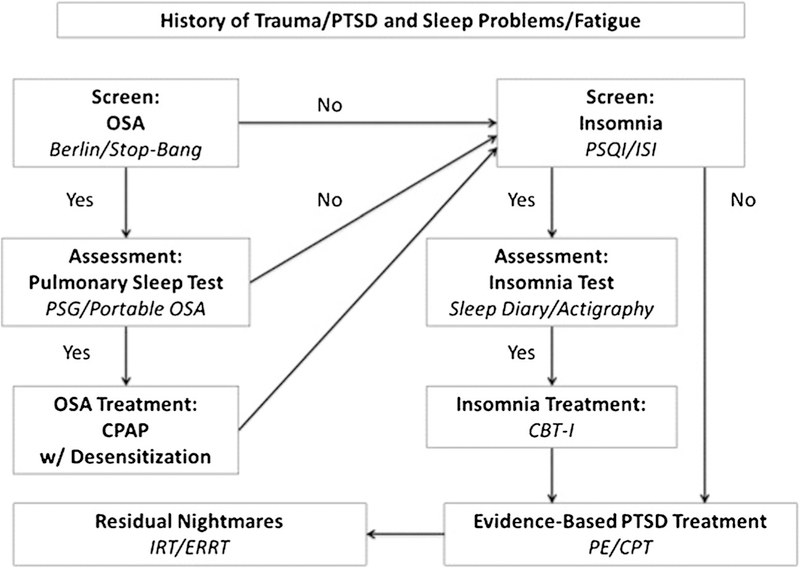
Recent findings: PTSD treatments decrease PTSD severity and nightmare frequency, but do not resolve OSA or insomnia. Research on whether insomnia hinders PTSD treatment shows mixed results; untreated OSA does interfere with PTSD treatment. Cognitive behavioral therapy for insomnia is the recommended treatment for insomnia; however, optimal ordering with PTSD treatment is unclear. PTSD treatment may be most useful for PTSD-related nightmares. CPAP therapy is recommended for OSA but adherence can be low. Targeted treatment of sleep disorders in the context of PTSD offers a unique and underutilized opportunity to advance clinical care and research. Research is needed to create screening protocols, determine optimal order of treatment, and elucidate mechanisms between sleep and PTSD treatments.
Keywords: Insomnia; Obstructive sleep apnea; PTSD; Sleep disorders; Treatment.
Figures
References
-
- Ohayon MM, Shapiro CM. Sleep disturbances and psychiatric disorders associated with posttraumatic stress disorder in the general population. Compr Psychiatry 2000;41(6):469–78. - PubMed
-
- Plumb TR, Peachey JT, Zelman DC. Sleep disturbance is common among servicemembers and veterans of Operations Enduring Freedom and Iraqi Freedom. Psychol Serv 2014;11(2):209–19. - PubMed
-
- Neylan TC, Marmar CR, Metzler TJ, Weiss DS, Zatzick DF, Delucchi KL, et al. Sleep disturbances in the Vietnam generation: findings from a nationally representative sample of male Vietnam veterans. Sleep 1998;155(7):929–33. - PubMed
-
- Krakow B, Melendrez D, Johnston L, Warner TD, Clark JO, Pacheco M, et al. Sleep-disordered breathing, psychiatric distress, and quality of life impairment in sexual assault survivors. J Nerv Ment Dis 2002;190(7):442–52. - PubMed
Publication types
MeSH terms
Grants and funding
LinkOut - more resources
Full Text Sources
Other Literature Sources
Medical
Research Materials
