


Meditation or exercise for preventing acute respiratory infection (MEPARI-2): A randomized controlled trial
- PMID: 29933369
- PMCID: PMC6014660
- DOI: 10.1371/journal.pone.0197778
Meditation or exercise for preventing acute respiratory infection (MEPARI-2): A randomized controlled trial
Abstract
Background: Practice of meditation or exercise may enhance health to protect against acute infectious illness.
Objective: To assess preventive effects of meditation and exercise on acute respiratory infection (ARI) illness.
Design: Randomized controlled prevention trial with three parallel groups.
Setting: Madison, Wisconsin, USA.
Participants: Community-recruited adults who did not regularly exercise or meditate.
Methods: 1) 8-week behavioral training in mindfulness-based stress reduction (MBSR); 2) matched 8-week training in moderate intensity sustained exercise (EX); or 3) observational waitlist control. Training classes occurred in September and October, with weekly ARI surveillance through May. Incidence, duration, and area-under-curve ARI global severity were measured using daily reports on the WURSS-24 during ARI illness. Viruses were identified multiplex PCR. Absenteeism, health care utilization, and psychosocial health self-report assessments were also employed.
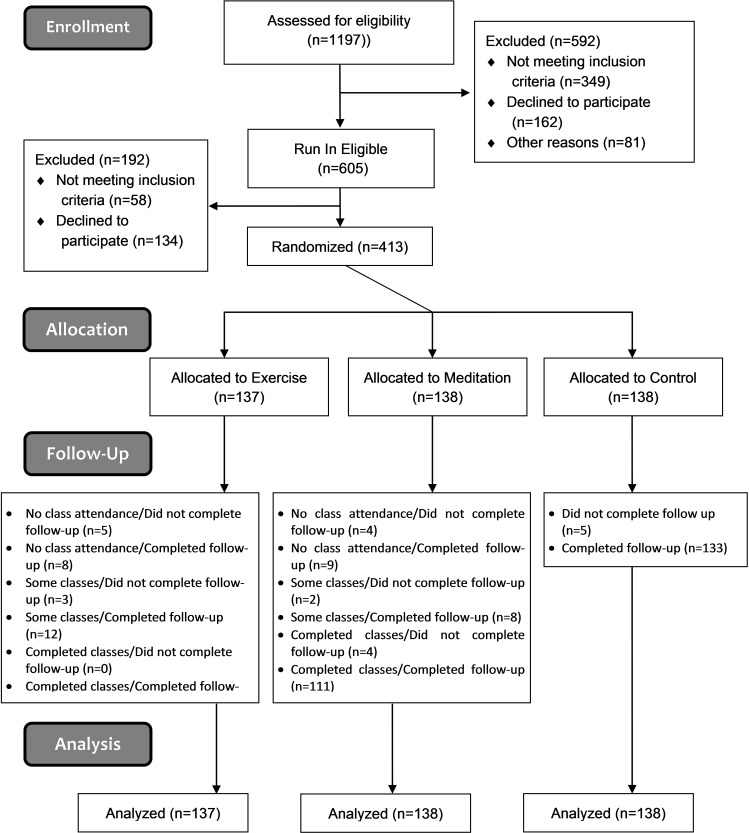
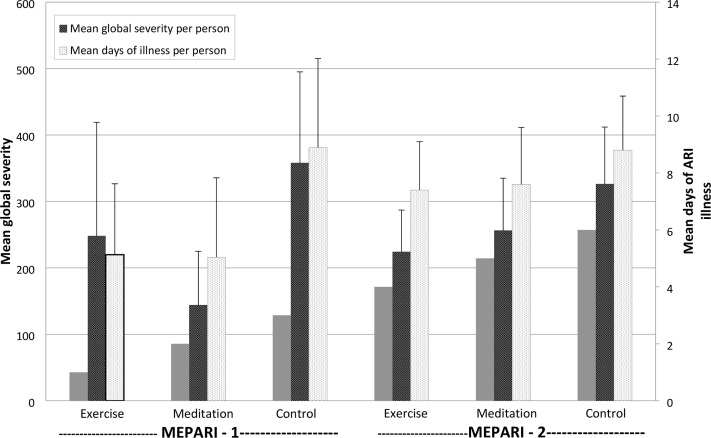
Results: Of 413 participants randomized, 390 completed the trial. In the MBSR group, 74 experienced 112 ARI episodes with 1045 days of ARI illness. Among exercisers, 84 had 120 episodes totaling 1010 illness days. Eighty-two of the controls had 134 episodes with 1210 days of ARI illness. Mean global severity was 315 for MBSR (95% confidence interval 244, 386), 256 (193, 318) for EX, and 336 (268, 403) for controls. A prespecified multivariate zero-inflated regression model suggested reduced incidence for MBSR (p = 0.036) and lower global severity for EX (p = 0.042), compared to control, not quite attaining the p<0.025 prespecified cut-off for null hypothesis rejection. There were 73 ARI-related missed-work days and 22 ARI-related health care visits in the MBSR group, 82 days and 21 visits for exercisers, and 105 days and 24 visits among controls. Viruses were identified in 63 ARI episodes in the MBSR group, compared to 64 for EX and 72 for control. Statistically significant (p<0.05) improvements in general mental health, self-efficacy, mindful attention, sleep quality, perceived stress, and depressive symptoms were observed in the MBSR and/or EX groups, compared to control.
Conclusions: Training in mindfulness meditation or exercise may help protect against ARI illness.
Limitations: This trial was likely underpowered.
Trial registration: Clinicaltrials.gov NCT01654289.
Conflict of interest statement
The authors have declared that no competing interests exist.
Figures
References
-
- Adam Y, Meinlschmidt G, Lieb R (2013) Associations between mental disorders and the common cold in adults: a population-based cross-sectional study. J Psychosom Res 74: 69–73. doi: 10.1016/j.jpsychores.2012.08.013 - DOI - PubMed
-
- Smith AP (2013) Twenty-five years of research on the behavioural malaise associated with influenza and the common cold. Psychoneuroendocrinology 38: 744–751. doi: 10.1016/j.psyneuen.2012.09.002 - DOI - PMC - PubMed
-
- Cohen S, Tyrell DAJ, Smith AP (1991) Psychological stress and susceptibility to the common cold. NEJM 325: 606–612. doi: 10.1056/NEJM199108293250903 - DOI - PubMed
-
- Cobb JM, Steptoe A (1996) Psychosocial stress and susceptibility to upper respiratory tract illness in an adult population sample. Psychosomatic Medicine 58: 404–412. - PubMed
Publication types
MeSH terms
Substances
Associated data
Grants and funding
LinkOut - more resources
Full Text Sources
Other Literature Sources
Medical
