


Global Diabetes Prevention Interventions: A Systematic Review and Network Meta-analysis of the Real-World Impact on Incidence, Weight, and Glucose
- PMID: 29934481
- PMCID: PMC6463613
- DOI: 10.2337/dc17-2222
Global Diabetes Prevention Interventions: A Systematic Review and Network Meta-analysis of the Real-World Impact on Incidence, Weight, and Glucose
Abstract
Objective: Understanding the real-world impacts of lifestyle modification (LSM) for diabetes prevention is imperative to inform resource allocation. The purpose of this study was to synthetize global evidence on the impact of LSM strategies on diabetes incidence and risk factors in one parsimonious model.
Research design and methods: PubMed, Embase, Cochrane Library, and ClinicalTrials.gov were searched for studies published between January 1990 and April 2015. Effectiveness/translation studies of any design testing LSM strategies, targeting high-risk populations (with prediabetes or diabetes risk factors), and reporting diabetes incidence, weight, or glucose outcomes were included. We extracted number of diabetes cases/incidence rates and mean changes in weight (kg), fasting blood glucose (FBG, mmol/L), 2-h postload glucose (mmol/L), and hemoglobin A1c (%). Pairwise random-effects and frequentist random-effects network meta-analyses were used to obtain pooled effects.
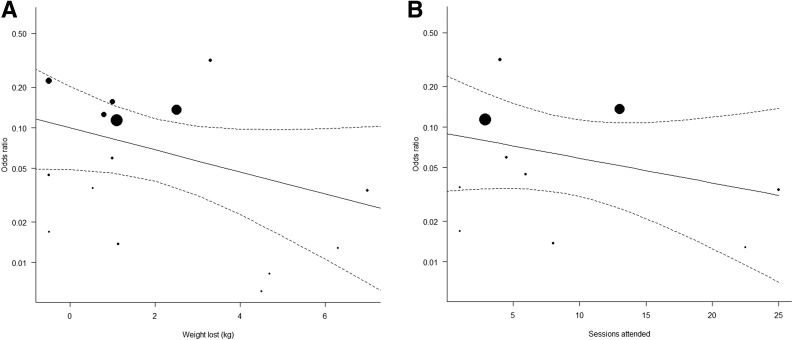
Results: Sixty-three studies were pooled in the meta-analysis (n = 17,272, mean age 49.7 years, 28.8% male, 60.8% white/European). In analyses restricted to controlled studies (n = 7), diabetes cumulative incidence was 9% among intervention participants and 12% among control participants (absolute risk reduction 3%; relative risk 0.71 [95% CI 0.58, 0.88]). In analyses combining controlled and uncontrolled studies (n = 14), participants receiving group education by health care professionals had 33% lower diabetes odds than control participants (odds ratio 0.67 [0.49, 0.92]). Intervention participants lost 1.5 kg more weight [-2.2, -0.8] and achieved a 0.09 mmol/L greater FBG decrease [-0.15, -0.03] than control participants. Every additional kilogram lost by participants was associated with 43% lower diabetes odds (β = 0.57 [0.41, 0.78]).
Conclusions: Real-world LSM strategies can reduce diabetes risk, even with small weight reductions.
© 2018 by the American Diabetes Association.
Figures
References
-
- International Diabetes Federation. IDF Diabetes Atlas, 8th edition [Internet], 2017. Brussels, Belgium, International Diabetes Federation. Available at http://www.diabetesatlas.org/. Accessed 15 February 2018
-
- Ramachandran A, Snehalatha C, Mary S, et al.; Indian Diabetes Prevention Programme (IDPP) . The Indian Diabetes Prevention Programme shows that lifestyle modification and metformin prevent type 2 diabetes in Asian Indian subjects with impaired glucose tolerance (IDPP-1). Diabetologia 2006;49:289–297 - PubMed
-
- Lindström J, Ilanne-Parikka P, Peltonen M, et al.; Finnish Diabetes Prevention Study Group . Sustained reduction in the incidence of type 2 diabetes by lifestyle intervention: follow-up of the Finnish Diabetes Prevention Study. Lancet 2006;368:1673–1679 - PubMed
Publication types
MeSH terms
Substances
Grants and funding
LinkOut - more resources
Full Text Sources
Other Literature Sources
Medical
Miscellaneous
