. 2018 Jun 22;8(1):9562.
doi: 10.1038/s41598-018-27875-3.

Pyruvate dehydrogenase complex plays a central role in brown adipocyte energy expenditure and fuel utilization during short-term beta-adrenergic activation

Affiliations

Pyruvate dehydrogenase complex plays a central role in brown adipocyte energy expenditure and fuel utilization during short-term beta-adrenergic activation

Ntsiki M Held et al. Sci Rep. .

Abstract

Activation of brown adipose tissue (BAT) contributes to total body energy expenditure through energy dissipation as heat. Activated BAT increases the clearance of lipids and glucose from the circulation, but how BAT accommodates large influx of multiple substrates is not well defined. The purpose of this work was to assess the metabolic fluxes in brown adipocytes during β3-adrenergic receptor (β3-AR) activation.T37i murine preadipocytes were differentiated into brown adipocytes and we used Seahorse respirometry employing a set of specific substrate inhibitors in the presence or absence of β3-AR agonist CL316,243. The main substrate used by these brown adipocytes were fatty acids, which were oxidized equally during activation as well as during resting condition. [U-13C]-glucose tracer-based metabolomics revealed that the flux through the TCA cycle was enhanced and regulated by pyruvate dehydrogenase (PDH) activity. Based on 13C-tracer incorporation in lipids, it appeared that most glucose was oxidized via TCA cycle activity, while some was utilized for glycerol-3-phosphate synthesis to replenish the triglyceride pool. Collectively, we show that while fatty acids are the main substrates for oxidation, glucose is also oxidized to meet the increased energy demand during short term β3-AR activation. PDH plays an important role in directing glucose carbons towards oxidation.


Conflict of interest statement

The authors declare no competing interests.

Figures
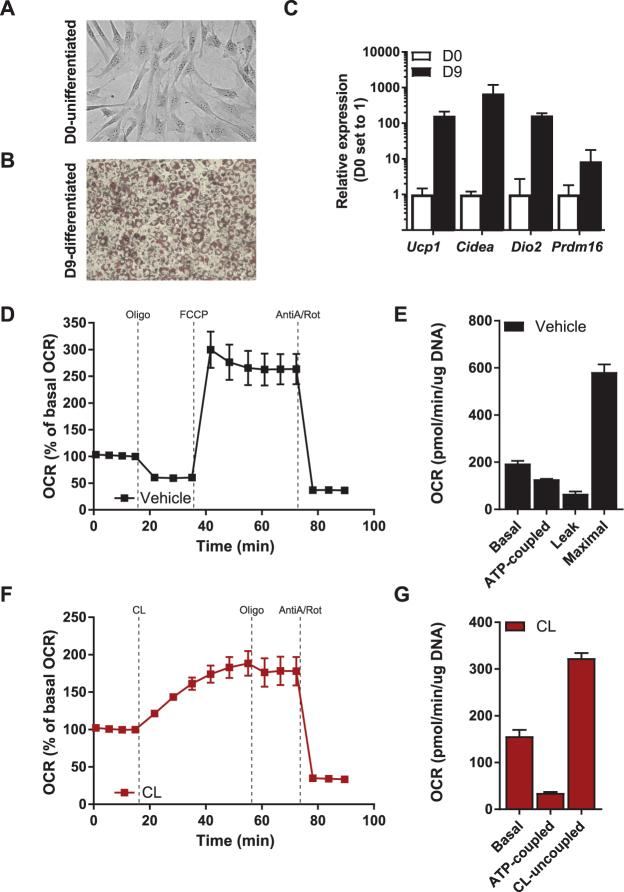
Figure 1
Figure 1
T37i bioenergetic profile during differentiation and β3-AR stimulation. (A,B) Oil-Red-O stained phase contrast images of undifferentiated (A) and differentiated (B) T37i cells. (C) Induction of mRNA expression of brown adipocyte genes after differentiation at day 9 relative to expression at day 0. (D) Oxygen consumption rate (OCR) of differentiated cells and (E) quantification of basal respiration, ATP-coupled and leak respiration after successive addition of 1.5 µM oligomycin, maximum respiration induced by 2 µM FCCP, corrected for non-mitochondrial respiration calculated after addition of 1.25 µM rotenone and 2.5 µM antimycin A. (F) OCR after CL316,243 and oligomycin addition and (G) quantification of basal, ATP coupled and CL-uncoupled respiration. Data is presented as average of three experiments ± SEM.
Figure 2
Figure 2
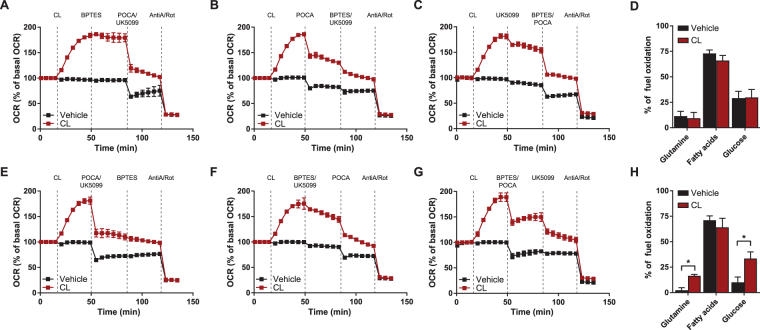
β3-AR activation improves metabolic flexibility in brown adipocytes. Representative OCR trace showing substrate dependence for maintaining respiration based on individual inhibitor addition strategies. Substrate oxidation dependence was determined for (A) glutamine with BPTES, (B) fatty acids with POCA and (C) glucose with UK5099. (D) Quantification of substrate dependence highlights that both resting and activated T37i adipocytes predominantly rely on fatty acid utilization to sustain OCR. Representative OCR trace showing (E) glutamine, (F) fatty acid and (G) glucose reserve capacity for maintenance of respiration after simultaneous addition of two inhibitors. (H) Quantification of substrate reserve capacity in resting and activated T37i cells. Glutamine and glucose oxidation reserved capacity is induced in CL316,243 stimulated cells. Line graphs show mean ± SD of 6 wells of one representative experiment. Data in bar graphs are presented as mean ± SEM of four experiments; *P < 0.05 (unpaired Student’s t-test).
Figure 3
Figure 3
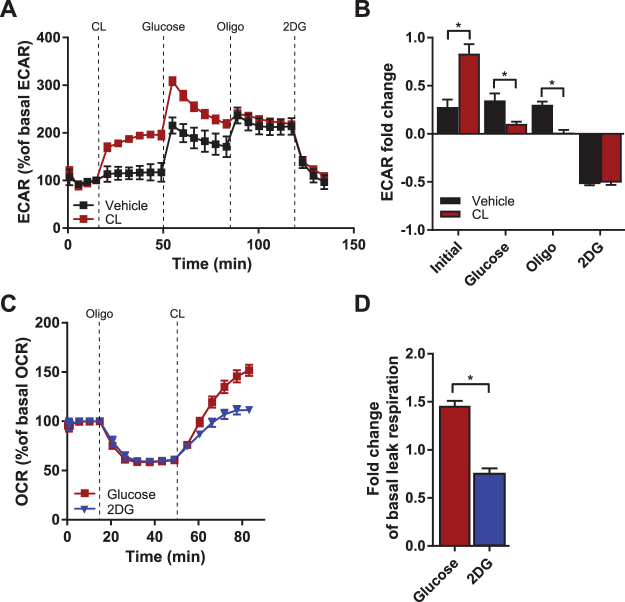
Increased glycolytic flux contributes to uncoupled respiration in activated brown adipocytes. (A) Extracellular acidification rate (ECAR) of vehicle and CL316,243-stimulated cells in response to 10 mM glucose, 1.5 µM oligomycin and 100 mM 2-deoxy-D-glucose (2DG). (B) ECAR fold change compared to basal ECAR shows increased initial glycolytic flux but unchanged glycolytic capacity. (C) Oxygen consumption rate (OCR) of cells under basal conditions, after addition of 1.5 µM oligomycin and 10 µM CL316,243 combined with 10 mM D-glucose (in red) or with 100 mM 2DG (in blue). (D) 2DG significantly reduces uncoupled respiration in activated brown adipocytes. Line graphs show a representative experiment with mean ± SD of 12 wells. Data in bar graphs are presented as mean ± SEM of three experiments; *P < 0.05 (unpaired Student’s t-test).
Figure 4
Figure 4
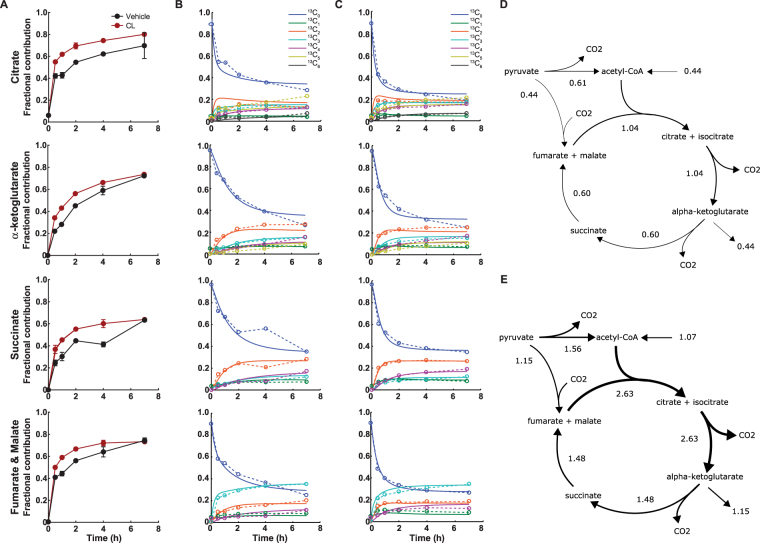
Increased glucose oxidation through TCA cycle activity after β3-AR activation. (A) Time course incubation with [U-13C]-glucose results in increased labelling of tricarboxylic acid (TCA) cycle intermediates at early time points after CL316,243 activation, suggesting increased TCA flux. (B) The measured MID data in dotted lines and predicted MID data in solid lines of vehicle-treated cells and (C) CL316,243-treated cells. (D) Results of non-stationary metabolic flux analysis of cells after vehicle and (E) β3-AR stimulation. The flux values have unit [/h] and are normalized to the alpha-ketoglutarate/glutamate concentration. Data represent mean ± SD of two separate experiments.
Figure 5
Figure 5
β3-AR stimulation increases glucose flux through PDH. (A) Increased ratio of 13C-labeled citrate over 13C-labeled phosphoenolpyruvate (PEP) after 30 min CL316,243 activation suggests increased flux through pyruvate dehydrogenase (PDH). (B) Western blot showing reduced PDH phosphorylation at serine-293, which is indicative for PDH activation. (C) The ratio of the quantified phosphorylated PDH E1-α serine-293 over the total PDH E1-α. (D) Upon 1 h CL316,243 stimulation pyruvate oxidation (using [1-14C]-pyruvate as substrate) is increased to a level that is similar as 1 h stimulation with the established PDH activator dichloroacetate (DCA). Data in (A) is mean ± SD of duplicate experiments, and (B,C) represent mean ± SEM of triplicates; *P < 0.05 (one-way ANOVA, Bonferroni corrected).
Figure 6
Figure 6
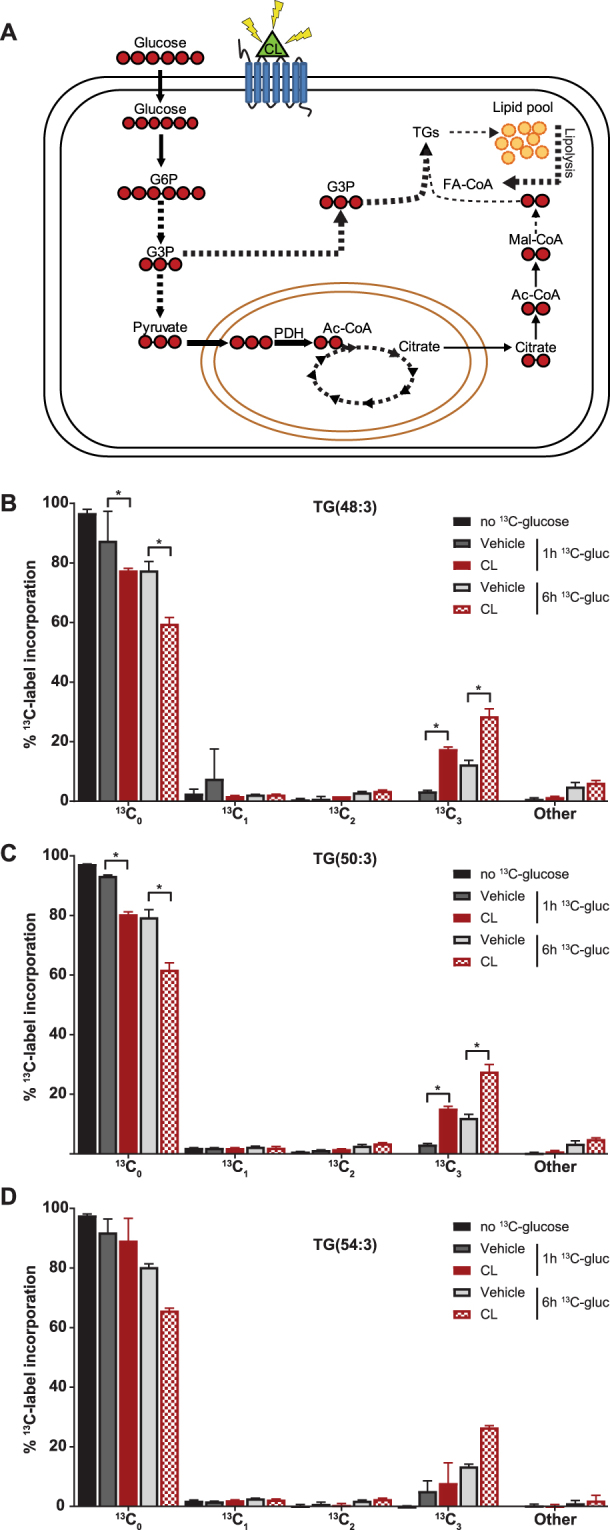
Short-term β3-AR stimulation increases fatty acid re-esterification. (A) Schematic illustration of label incorporation scenarios in lipids. Ac-CoA, acetyl-CoA; G6P, glucose-6-phosphate; G3P, glycerol-3-phosphate;FA-CoA, fatty acyl-CoA; mal-CoA, malonyl-CoA; PDH, pyruvate dehydrogenase. Solid lines and dashed lines indicate direct and indirect fluxes. Isotope profile of the three most abundant triglycerides (B) TG(48:3), (C) TG(50:3) and (D) TG(54:3) after 0, 1 and 6 hours of CL316,243 or vehicle stimulation. Incorporation of even carbons (13C[n×2]) is relatively low, while the 13C3 is increased over time suggesting glycerol incorporation in TG. CL316,243 induces glycerol incorporation significantly after 1 and especially after 6 hours. Bars represent mean ± SD of three biological replicates samples; *P < 0.05 (one-way ANOVA, Bonferroni corrected).

References

    1. Bray GA, Bellanger T. Epidemiology, Trends, and Morbidities of Obesity and the Metabolic Syndrome. Endocrine. 2006;29:109–118. doi: 10.1385/ENDO:29:1:109. - DOI - PubMed
    1. van Marken Lichtenbelt WD, et al. Cold-Activated Brown Adipose Tissue in Healthy Men. N. Engl. J. Med. 2009;360:1500–1508. doi: 10.1056/NEJMoa0808718. - DOI - PubMed
    1. Saito M, et al. High Incidence of Metabolically Active Brown Adipose Effects of Cold Exposure and Adiposity. Diabetes. 2009;58:1526–1531. doi: 10.2337/db09-0530. - DOI - PMC - PubMed
    1. Virtanen KA, et al. Functional Brown Adipose Tissue in Healthy Adults. N. Engl. J. Med. 2009;360:1518–1525. doi: 10.1056/NEJMoa0808949. - DOI - PubMed
    1. Zingaretti MC, et al. The presence of UCP1 demonstrates that metabolically active adipose tissue in the neck of adult humans truly represents brown adipose tissue. FASEB J. 2009;23:3113–20. doi: 10.1096/fj.09-133546. - DOI - PubMed

Publication types