


The contribution of common genetic risk variants for ADHD to a general factor of childhood psychopathology
- PMID: 29934545
- PMCID: PMC6169728
- DOI: 10.1038/s41380-018-0109-2
The contribution of common genetic risk variants for ADHD to a general factor of childhood psychopathology
Abstract
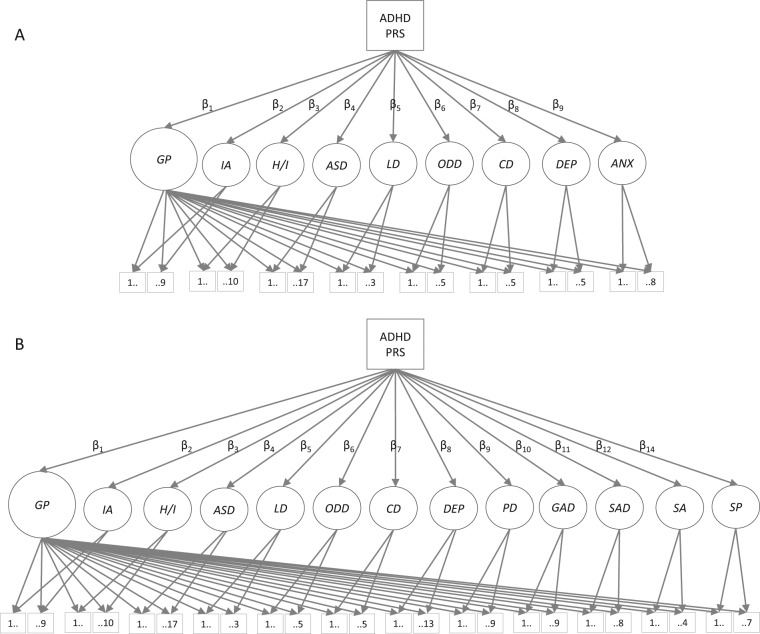
Common genetic risk variants have been implicated in the etiology of clinical attention-deficit/hyperactivity disorder (ADHD) diagnoses and symptoms in the general population. However, given the extensive comorbidity across ADHD and other psychiatric conditions, the extent to which genetic variants associated with ADHD also influence broader psychopathology dimensions remains unclear. The aim of this study was to evaluate the associations between ADHD polygenic risk scores (PRS) and a broad range of childhood psychiatric symptoms, and to quantify the extent to which such associations can be attributed to a general factor of childhood psychopathology. We derived ADHD PRS for 13,457 children aged 9 or 12 from the Child and Adolescent Twin Study in Sweden, using results from an independent meta-analysis of genome-wide association studies of ADHD diagnosis and symptoms. We estimated associations between ADHD PRS, a general psychopathology factor, and several dimensions of neurodevelopmental, externalizing, and internalizing symptoms, using structural equation modeling. Higher ADHD PRS were statistically significantly associated with elevated neurodevelopmental, externalizing, and depressive symptoms (R2 = 0.26-1.69%), but not with anxiety. After accounting for a general psychopathology factor, on which all symptoms loaded positively (mean loading = 0.50, range = 0.09-0.91), an association with specific hyperactivity/impulsivity remained significant. ADHD PRS explained ~ 1% (p value < 0.0001) of the variance in the general psychopathology factor and ~ 0.50% (p value < 0.0001) in specific hyperactivity/impulsivity. Our results suggest that common genetic risk variants associated with ADHD, and captured by PRS, also influence a general genetic liability towards broad childhood psychopathology in the general population, in addition to a specific association with hyperactivity/impulsivity symptoms.
Conflict of interest statement
Drs Brikell, Lu, Petterson, Chen, Kuja-Halkola, Karlsson, Lahey, and Martin declare no potential conflicts of interest. Dr. Larsson has served as a speaker for Eli-Lilly and Shire and has received research grants from Shire. Dr. Lichtenstein has served as a speaker for Medice. All outside the submitted work.
Figures
References
-
- Brikell, I, Kuja-Halkola, R & Larsson, H. Heritability of attention-deficit hyperactivity disorder in adults. Am J Med Genet B Neuropsychiatr Genet. 2015;168:406–13. - PubMed
-
- Nikolas MA, Burt SA. Genetic and environmental influences on ADHD symptom dimensions of inattention and hyperactivity: a meta-analysis. J Abnorm Psychol. 2010;119:1–17. - PubMed
-
- Faraone, SV et al. Attention-deficit/hyperactivity disorder. Nat Rev Dis Primers. 2015;1:15020. - PubMed
Publication types
MeSH terms
Grants and funding
LinkOut - more resources
Full Text Sources
Other Literature Sources
Medical
