. 2018 Oct 20:674:127-133.
doi: 10.1016/j.gene.2018.06.060. Epub 2018 Jun 20.

Characterization of expression and alternative splicing of the gene cadherin-like and PC esterase domain containing 1 (Cped1)

Affiliations

Characterization of expression and alternative splicing of the gene cadherin-like and PC esterase domain containing 1 (Cped1)

Robert D Maynard et al. Gene. .

Abstract

Cadherin-like and PC-esterase domain containing 1 (CPED1) is an uncharacterized gene with no known function. Human genome wide association studies (GWAS) for bone mineral density (BMD) have repeatedly identified a significant locus on Chromosome 7 that contains the gene CPED1, but it remains unclear if this gene could be causative. While an open reading frame for this gene has been predicted, there has been no systematic exploration of expression or alternate splicing for CPED1 in humans or mice.Using mouse models, we demonstrate that Cped1 is alternately spliced whereby transcripts are generated with exon 3 or exons 16 and 17 removed. In calvarial-derived pre-osteoblasts, Cped1 utilizes the predicted promoter upstream of exon 1 as well as alternate promoters upstream of exon 3 and exon 12.Lastly, we have determined that some transcripts terminate at the end of exon 10 and therefore do not contain the cadherin like and the PC esterase domains.Together, these data suggest that multiple protein products may be produced by this gene, with some products either lacking or containing both the predicted functional domains. Our data provide a framework upon which future functional studies will be built to understand the role of this gene in bone biology.

Keywords: Alternative splicing; Tissue expression profile; Uncharacterized gene.


Conflict of interest statement

Declarations of interest (all authors): None

Figures

Figure 1:
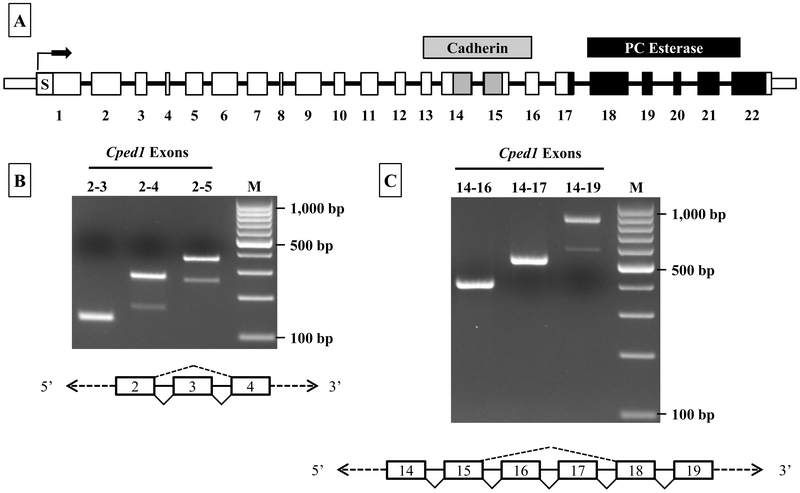
Figure 1:. Cped1 is alternatively spliced leading to the generation of multiple mRNA isoforms.
A) Diagrammatic view of Cped1 mRNA (boxes represent exons) detailing the predicted exons and putative functional domains (S = signal peptide, Cadherin = cadherin-like domain, and PC esterase domain). B & C) Total RNA from male, 12 week old C57BL/6J mouse calvaria was analyzed via RT-PCR for the presence or absence of splice variants. Diagrams depict the splicing events (exon skipping) for exons 3, 16, or 16 and 17.
Figure 2:
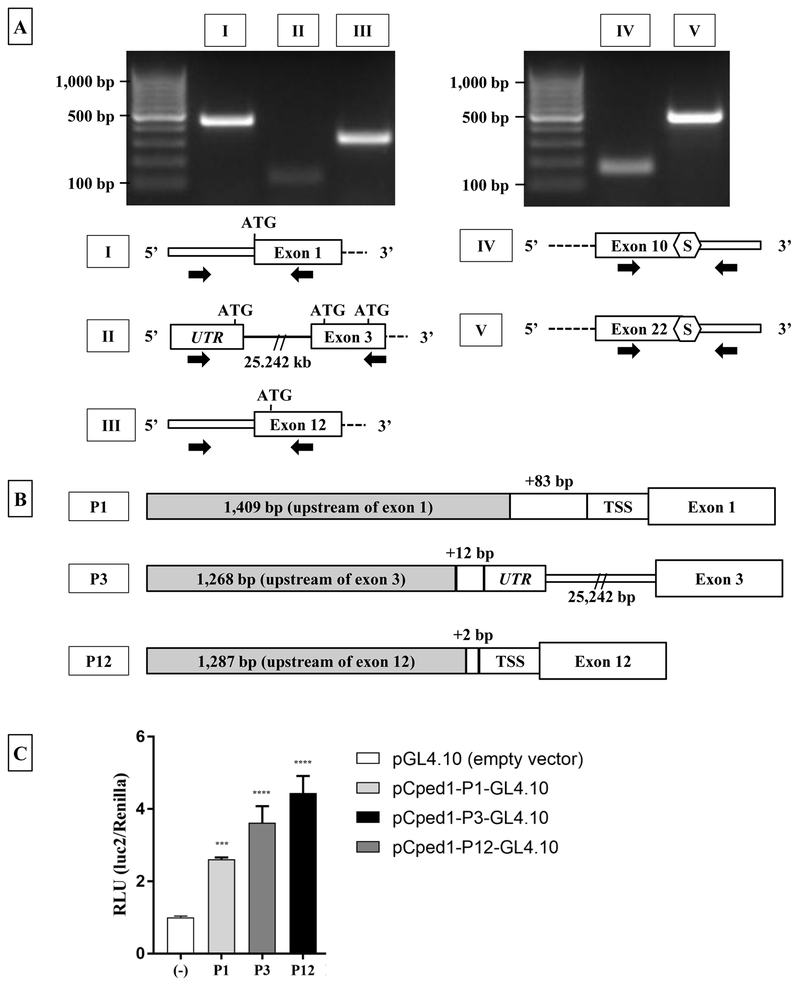
Figure 2:. Calvaria express multiple Cped1 transcripts with alternate 5’- and 3’-UTR, and utilize alternate promoters for transcription.
A) RT-PCR of Cped1 transcripts demonstrates the expression of alternate 5’- and 3’-UTRs. Thick and thin rectangles represent exon and UTRs, respectively, and solid lines represent introns. White hexagons labeled ‘S’ represent predicted stop codons as identified by analysis of nucleotide sequence. Black arrows represent the approximate target location of forward and reverse primers for PCR of Cped1 transcripts. B) Predicted promoter regions upstream of exon 1 (P1), exon 3 (P3), and exon 12 (P12) are transcriptionally active in MC3T3-E1 pre-osteoblasts during osteogenic differentiation. Fold change between luciferase constructs P1, P3, and P12 vs. empty vector (pGL4.10) was detected. Data is represented as change in relative light units (RLU) of firefly luciferase normalized to renilla luciferase 24 hours post-transfection. Results are expressed as mean +/− SD, N=3. TSS: translational start site. Statistical differences were detected via one-way ANOVA and Dunnett’s multiple comparisons test. ***P < 0.001, ****P < 0.0001
Figure 3:
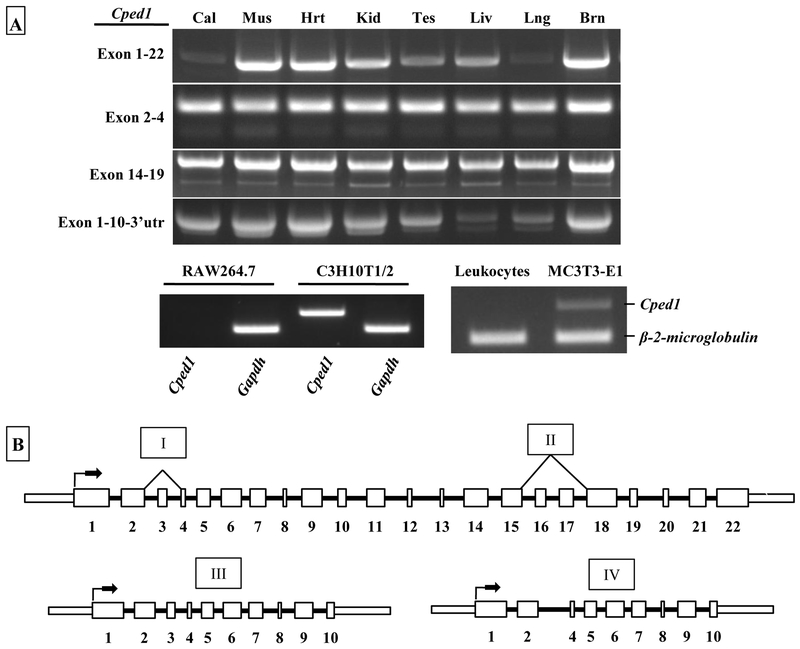
Figure 3:. Cped1 isoforms are widely expressed in whole mouse organs but absent in RAW264.7 cells and circulating leukocytes.
A) RT-PCR for Cped1 transcripts was performed in eight C57BL/6J mouse tissues (Cal: calvaria, Mus: skeletal muscle [rectus femoris], Hrt: heart, Kid: kidney, Tes: testis, Liv: liver, Lng: lung, Brn: brain). Expression of a segment of exons 1 and 2 of Cped1 was tested in RAW264.7 monocytes/macrophases, multipotent C3H10T1/2 cells, MC3T3-E1 calvaria-derived pre-osteoblasts, and whole blood leukocytes. B) Summary schematic of alternative splicing suggests a diverse expression pattern for Cped1. Each of the identified and confirmed Cped1 transcripts including the splicing events (depicted above with roman numerals) is listed. Thick and thin rectangles represent exon and UTRs, respectively, and solid lines represent introns. Arrows indicate putative start sites for initiation of translation.
Figure 4:
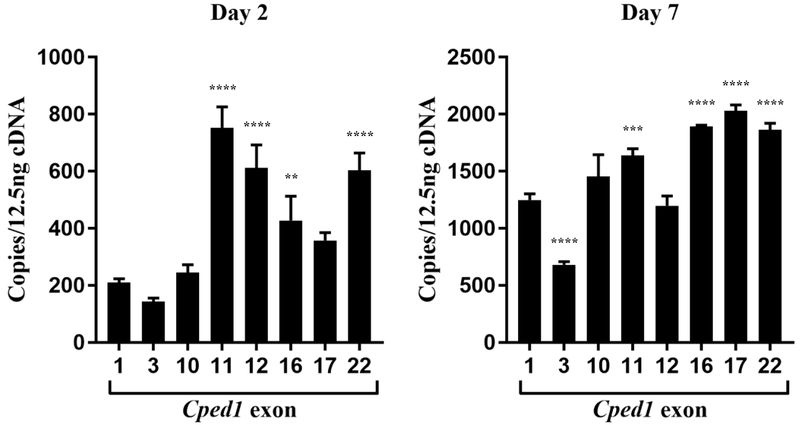
Figure 4:. Cped1 exon expression varies due to alternative splicing and time of differentiation.
The number of copies of Cped1 exons 1, 3, 10, 11, 12, 16, 17, and 22 were determined in MC3T3-E1 cells (N=3) by qRT-PCR at days 2 and 7 of osteogenic differentiation. Values represent transcript copies per 12.5 ng of cDNA input. Error bars represent SEM of technical and biological replicates. **P < 0.01, ***P < 0.001, ****P < 0.0001.

References

    1. Raisz LG, Pathogenesis of osteoporosis: concepts, conflicts, and prospects. J Clin Invest, 2005. 115(12): p. 3318–25. - PMC - PubMed
    1. Bliuc D, et al. , Mortality risk associated with low-trauma osteoporotic fracture and subsequent fracture in men and women. JAMA, 2009. 301(5): p. 513–21. - PubMed
    1. Estrada K, et al. , Genome-wide meta-analysis identifies 56 bone mineral density loci and reveals 14 loci associated with risk of fracture. Nat Genet, 2012. 44(5): p. 491–501. - PMC - PubMed
    1. Zheng HF, et al. , Whole-genome sequencing identifies EN1 as a determinant of bone density and fracture. Nature, 2015. 526(7571): p. 112–7. - PMC - PubMed
    1. Zheng HF, et al. , WNT16 influences bone mineral density, cortical bone thickness, bone strength, and osteoporotic fracture risk. PLoS Genet, 2012. 8(7): p. e1002745. - PMC - PubMed

Substances