


The antipyretic efficacy and safety of propacetamol compared with dexibuprofen in febrile children: a multicenter, randomized, double-blind, comparative, phase 3 clinical trial
- PMID: 29935535
- PMCID: PMC6015655
- DOI: 10.1186/s12887-018-1166-z
The antipyretic efficacy and safety of propacetamol compared with dexibuprofen in febrile children: a multicenter, randomized, double-blind, comparative, phase 3 clinical trial
Abstract
Background: We aimed to compare the antipyretic efficacy, safety, and tolerability between oral dexibuprofen and intravenous propacetamol in children with upper respiratory tract infection (URTI) presenting with fever.
Methods: Patients aging from 6 months to 14 years admitted for URTI with axillary body temperature ≥ 38.0 °C were enrolled and randomized into the study or control group. Patients in the study group were intravenously infused with propacetamol and subsequently oral placebo medication was administered. Patients in the control group were intravenously infused with 100 mL of 0.9% sodium chloride solution without propacetamol and then oral dexibuprofen was administered. We checked the body temperature of all patients at 0.5 h (hr), 1 h, 1.5 h, 2 h, 3 h, 4 h, and 6 h after oral placebo or dexibuprofen had been applied.
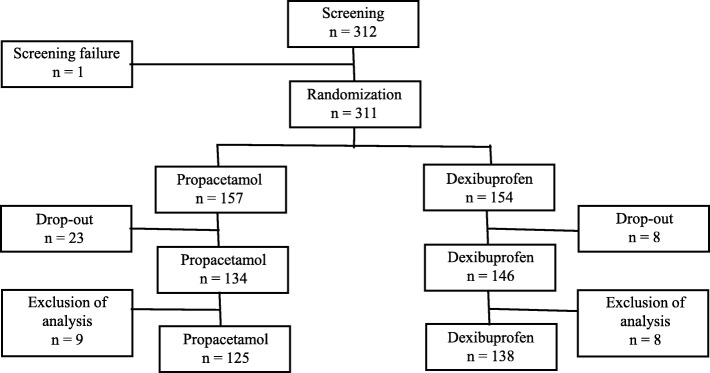
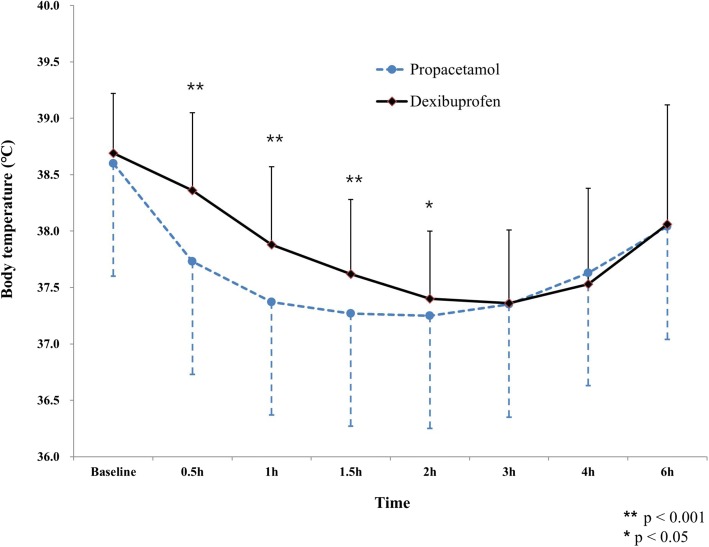
Results: A total of 263 patients (125 in the study group) were finally enrolled. The body temperatures of patients in the study group were significantly lower until 2 h after administration (37.73 ± 0.58 vs 38.36 ± 0.69 °C (p < 0.001), 37.37 ± 0.53 vs 37.88 ± 0.69 °C (p < 0.001), 37.27 ± 0.60 vs 37.62 ± 0.66 °C (p < 0.001), 37.25 ± 0.62 vs 37.40 ± 0.60 °C (p = 0.0452), at 0.5 h, 1 h, 1.5 h, and 2 h, respectively). The two groups showed no significant differences in terms of the range of body temperature decrease, the Area Under the Curve of body temperature change for antipyretic administration-and-time relationship, the maximum value of body temperature decrease during the 6 h test period, the number of patients whose body temperature normalized (< 37.0 °C), the mean time when first normalization of body temperature, and the development of adverse events including gastrointestinal problem, elevated liver enzyme, and thrombocytopenia.
Conclusions: Intravenous propacetamol may be a safe and effective choice for pediatric URTI patients presenting with fever who are not able to take oral medications or need faster fever control.
Trial registration: CRIS KCT0002888 . Date of registration: July 31st, 2013.
Keywords: Children; Dexibuprofen; Fever; Propacetamol; Upper respiratory tract infection.
Conflict of interest statement
Ethics approval and consent to participate
All procedures performed in studies involving human participants were in accordance with the ethical standards of the institutional and/or national research committee and with the 1964 Helsinki declaration and its later amendments or comparable ethical standards. The protocol was approved by the Institutional Research Board (IRB) of each institution. The IRB numbers of the participating hospitals are as follows: KC13MDMT0120 at Seoul St. Mary’s Hospital; VC13MDMT0024 at St. Vincent’s Hospital; KMC2015–009 at Hanjin General Hospital; DC14MDMT0006 at Daejeon St. Mary’s Hospital; PS13MDMT0015 at St. Paul’s Hospital; OC13MDMT0025 at Incheon St. Mary’s Hospital; and CR115093 at Yonsei Christian Hospital.
Written informed consent was obtained from parents or legal guardians and from the child, if possible.
Competing interests
The authors declare that they have no competing interests.
Publisher’s Note
Springer Nature remains neutral with regard to jurisdictional claims in published maps and institutional affiliations.
Figures
References
Publication types
MeSH terms
Substances
Associated data
LinkOut - more resources
Full Text Sources
Other Literature Sources
Medical
