Review
. 2019 Mar;56(3):1841-1851.
doi: 10.1007/s12035-018-1188-4. Epub 2018 Jun 23.

The Gut Microbiome Alterations and Inflammation-Driven Pathogenesis of Alzheimer's Disease-a Critical Review

Affiliations
Review

The Gut Microbiome Alterations and Inflammation-Driven Pathogenesis of Alzheimer's Disease-a Critical Review

Marta Sochocka et al. Mol Neurobiol. 2019 Mar.

Abstract

One of the most important scientific discoveries of recent years was the disclosure that the intestinal microflora takes part in bidirectional communication between the gut and the brain. Scientists suggest that human gut microflora may even act as the "second brain" and be responsible for neurodegenerative disorders like Alzheimer's disease (AD). Although human-associated microbial communities are generally stable, they can be altered by common human actions and experiences. Enteric bacteria, commensal, and pathogenic microorganisms, may have a major impact on immune system, brain development, and behavior, as they are able to produce several neurotransmitters and neuromodulators like serotonin, kynurenine, catecholamine, etc., as well as amyloids. However, brain destructive mechanisms, that can lead to dementia and AD, start with the intestinal microbiome dysbiosis, development of local and systemic inflammation, and dysregulation of the gut-brain axis. Increased permeability of the gut epithelial barrier results in invasion of different bacteria, viruses, and their neuroactive products that support neuroinflammatory reactions in the brain. It seems that, inflammatory-infectious hypothesis of AD, with the great role of the gut microbiome, starts to gently push into the shadow the amyloid cascade hypothesis that has dominated for decades. It is strongly postulated that AD may begin in the gut, and is closely related to the imbalance of gut microbiota. This is promising area for therapeutic intervention. Modulation of gut microbiota through personalized diet or beneficial microbiota intervention, alter microbial partners and their products including amyloid protein, will probably become a new treatment for AD.

Keywords: Alzheimer’s disease; Gut microbiome; Microbial amyloid; Neuroinflammation; Therapeutic intervention.


Figures

Fig. 1
Fig. 1
Age-related changes in the neuroinflmmatory response in the CNS—the role of local and peripheral infections. In healthy brain proper functioning of the brain innate immune response results in Aβ clearance and pathogen elimination [primary infection/reactivation]. Aging leads to the decline in immune surveillance and decrease of microglia fagocytic activity. Aβ overproduction/overdeposition with lose/limited antimicrobial capacity, as well as varied microbes and their products [LPS, amyloids] infecting or infiltrating into the brain from periphery, initiates the cascade of chronic neuroinflammatory reactions and neurodegenerative changes that can cause AD
Fig. 2
Fig. 2
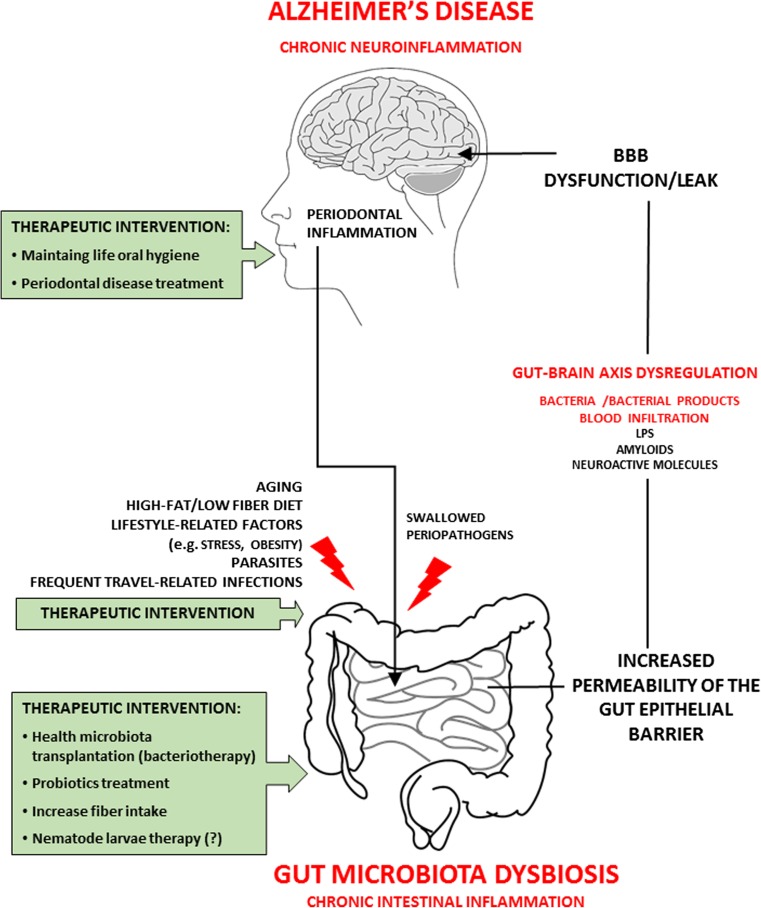
Gut microbiota dysbiosis and Alzheimer’s disease. Mechanism and potential therapeutic interventions. The gut-brain-axis—a pathway which gut microbiota can modulate host brain function and behavior. Aging, diverse lifestyle-related risk factors, as well as different infections can induce alterations of gut microbiota [dysbiosis] increasing risks of neurodegeneration disorders such as Alzheimer’s disease. Pathogenic bacteria and their products [LPS, amyloids, nueroactive molecules] may induce increased permeability of intestine epithelial barrier and blood-brain barrier dysfunction/leak that may induce/support chronic inflmmatory reactions in the brain. From the times of Hippocrates, it is believed that there is an association between mental health and intestinal flora imballance. Possibly, modulation of gut microbiota as well as therapeutic intervention against gut microbiota dysbiosis will become a new approach to treatment for AD

References

    1. Hardy J, Allsop D. Amyloid deposition as the central event in the aetiology of Alzheimer’s disease. Trends Pharmacol Sci. 1991;12:383–388. - PubMed
    1. Penke B, Bogár F, Fülöp L (2017) β-Amyloid and the pathomechanisms of Alzheimer’s disease: a comprehensive view. Molecules (Basel Switz) 22(10):1692 - PMC - PubMed
    1. Fuster-Matanzo A, Llorens-Martín M, Hernández F, et al. Role of neuroinflammation in adult neurogenesis and Alzheimer disease: Therapeutic approaches. Mediat Inflamm. 2013;2013:260925. - PMC - PubMed
    1. Pawelec G (2017) Age and immunity: what is ‘immunosenescence’? Exp Gerontol 105:4–9 - PubMed
    1. Sochocka M, Diniz BS, Leszek J. Inflammatory response in the CNS: friend or foe? Mol Neurobiol. 2017;54:8071–8089. - PMC - PubMed