


AGTR2 absence or antagonism prevents cystic fibrosis pulmonary manifestations
- PMID: 29937318
- PMCID: PMC6830504
- DOI: 10.1016/j.jcf.2018.05.013
AGTR2 absence or antagonism prevents cystic fibrosis pulmonary manifestations
Abstract
Background: Pulmonary disease remains the primary cause of morbidity and mortality for individuals with cystic fibrosis (CF). Variants at a locus on the X-chromosome containing the type 2 angiotensin II receptor gene (AGTR2) were identified by a large GWAS as significantly associating with lung function in CF patients. We hypothesized that manipulating the angiotensin-signaling pathway may yield clinical benefit in CF.
Methods: Genetic subset analysis was conducted on a local CF cohort to extend the GWAS findings. Next, we evaluated pulmonary function in CF mice with a deleted AGTR2 gene, and in those who were given subcutaneous injections of PD123,319, a selective AGTR2 antagonist for 12 weeks beginning at weaning.
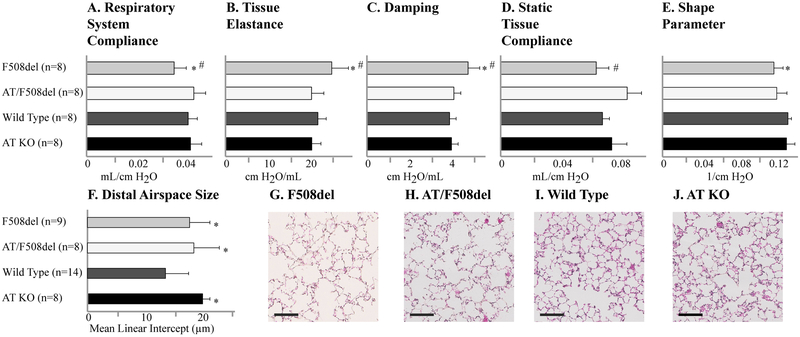
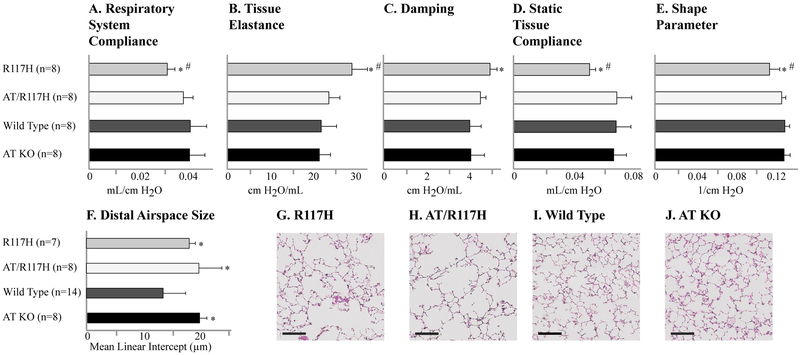
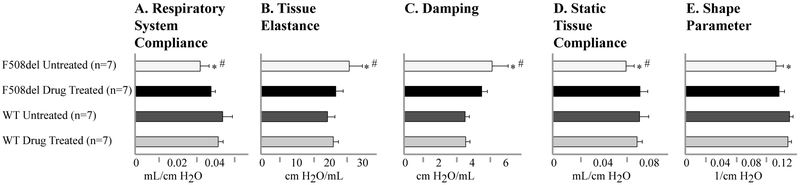
Results: The genetic subset analysis replicated the initial GWAS identified association, and confirmed the association of this locus with additional lung function parameters. Studies in genetically modified mice established that absence of the AGTR2 gene normalized pulmonary function indices in two independent CF mouse models. Further, we determined that pharmacologic antagonism of AGTR2 improved overall pulmonary function in CF mice to near wild-type levels.
Conclusions: These results identify that reduced AGTR2 signaling is beneficial to CF lung function, and suggest the potential of manipulating the angiotensin-signaling pathway for treatment and/or prevention of CF pulmonary disease. Importantly, the beneficial effects were not CF gene mutation dependent, and were able to be reproduced with pharmacologic antagonism. As there are clinically approved drugs available to target the renin-angiotensin signaling system, these findings may be quickly translated to human clinical trials.
Keywords: Angiotensin signaling; GWAS follow up; Mouse models of airway disease; Pulmonary function.
Copyright © 2018 The Author(s). Published by Elsevier B.V. All rights reserved.
Conflict of interest statement
Conflicts of Interest
Authors Darrah, Jacono, Mitchell and Drumm are named on a patent application for the use of AGTR2 inhibition as a therapy for CF lung disease. The authors declare no other relevant conflicts of interest.
Figures
References
-
- Ong T and Ramsey BW, Update in Cystic Fibrosis 2014. American journal of respiratory and critical care medicine, 2015. 192(6): p. 669–75. - PubMed
-
- Legris GJ, et al., Sodium space and intravascular volume: dietary sodium effects in cystic fibrosis and healthy adolescent subjects. Pediatrics, 1998. 101(1 Pt 1): p. 48–56. - PubMed
-
- Arkwright PD, et al., End-organ dysfunction in cystic fibrosis: association with angiotensin I converting enzyme and cytokine gene polymorphisms. American journal of respiratory and critical care medicine, 2003. 167(3): p. 384–9. - PubMed
Publication types
MeSH terms
Substances
Grants and funding
LinkOut - more resources
Full Text Sources
Other Literature Sources
Medical
Research Materials
