. 2018 May 26;9(6):563-568.
doi: 10.1021/acsmedchemlett.8b00191. eCollection 2018 Jun 14.

Selective Irreversible Inhibitors of the Wnt-Deacylating Enzyme NOTUM Developed by Activity-Based Protein Profiling

Affiliations

Selective Irreversible Inhibitors of the Wnt-Deacylating Enzyme NOTUM Developed by Activity-Based Protein Profiling

Radu M Suciu et al. ACS Med Chem Lett. .

Abstract

Wnt proteins are secreted morphogens that play critical roles in embryonic development and tissue remodeling in adult organisms. Aberrant Wnt signaling contributes to diseases such as cancer. Wnts are modified by an unusual O-fatty acylation event (O-linked palmitoleoylation of a conserved serine) that is required for binding to Frizzled receptors. O-Palmitoleoylation of Wnts is introduced by the porcupine (PORCN) acyltransferase and removed by the serine hydrolase NOTUM. PORCN inhibitors are under development for oncology, while NOTUM inhibitors have potential for treating degenerative diseases. Here, we describe the use of activity-based protein profiling (ABPP) to discover and advance a class of N-hydroxyhydantoin (NHH) carbamates that potently and selectively inhibit NOTUM. An optimized NHH carbamate inhibitor, ABC99, preserves Wnt-mediated cell signaling in the presence of NOTUM and was also converted into an ABPP probe for visualizing NOTUM in native biological systems.


Conflict of interest statement

The authors declare the following competing financial interest(s): B.F.C. is a cofounder and scientific advisor to Abide Therapeutics, a biotechnology company interested in developing SH inhibitors as therapeutics.

Figures
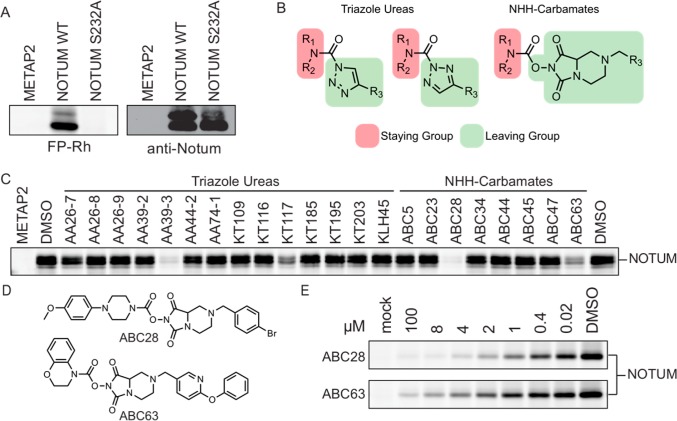
Figure 1
Figure 1
Discovery of NOTUM inhibitors from a set of activated ureas and carbamates by competitive ABPP. (A) Gel-based ABPP and Western blot analysis of conditioned media (CM) from HEK293T cells transiently transfected with cDNAs encoding WT-NOTUM, a catalytically inactive S232A-NOTUM, or control protein (METAP2). Gel-based ABPP was performed by incubating CM proteome with the FP-Rh probe (1 μM, 30 min, room temperature). Western blotting was performed with an anti-NOTUM antibody (Sigma-Aldrich HPA023041). (B) General structures of the triazole urea and NHH carbamate classes of SH-directed inhibitors. (C) Gel-based ABPP of a collection of triazole urea and NHH carbamate compounds against the CM of WT-NOTUM-transfected HEK293T cells. CM samples were pretreated with 10 μM compound (30 min, 37 °C) followed by FP-Rh (1 μM, 30 min, room temperature), prior to SDS-PAGE analysis and in-gel fluorescence scanning. (D,E) Structures (D) and concentration-dependent inhibition profiles (E) for two NHH carbamate inhibitors of NOTUM: ABC28 and ABC63.
Figure 2
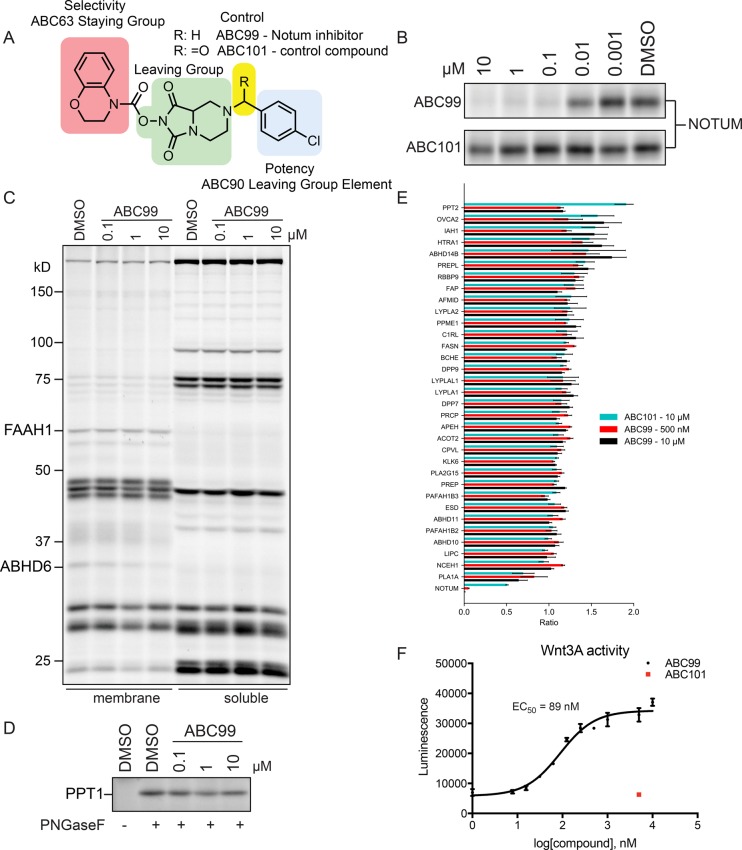
Figure 2
Generation and characterization of ABC99, a potent and selective NOTUM inhibitor. (A) Structure of ABC99 and inactive control compound ABC101. (B) Concentration-dependent inhibition of NOTUM by ABC99 and ABC101 as measured by competitive ABPP using SW620 CM. (C,D) Competitive ABPP of SW620 cells treated in situ with ABC99 (indicated concentrations, 2 h, 37 °C) followed by exposure to the general serine hydrolase probe FP-Rh (C) or the PPT1-directed probe ABC45 (D). (E) Quantitative MS-based ABPP of SW620 CM treated with ABC99 (0.5 or 10 μM, 1 h, 37 °C), ABC101 (10 μM, 1 h, 37 °C), or DMSO. Serine hydrolases were enriched with FP-biotin (4 μM, 1 h, room temperature) and streptavidin chromatography. After on-bead trypsin digestion, peptides were isotopically labeled with heavy (DMSO) or light (compound) formaldehyde, then combined and processed for MS-based analysis. Ratios are displayed as light/heavy; therefore, low values indicate inhibition. Data for each experimental group represent median aggregate peptide ratios across two independent experiments +/− SEM. (F) ABC99, but not ABC101, preserves Wnt-3A activity in the presence of NOTUM in a concentration-dependent manner as measured using a Super TOPflash assay. Media from Wnt-3A expressing L-cells were incubated with inhibitor treated media from SW620 cells and then added to HEK293T-STF cells, which express luciferase in response to activation of the canonical Wnt pathway. Data represent average values with confidence intervals (CI) provided for four independent experiments.
Figure 3
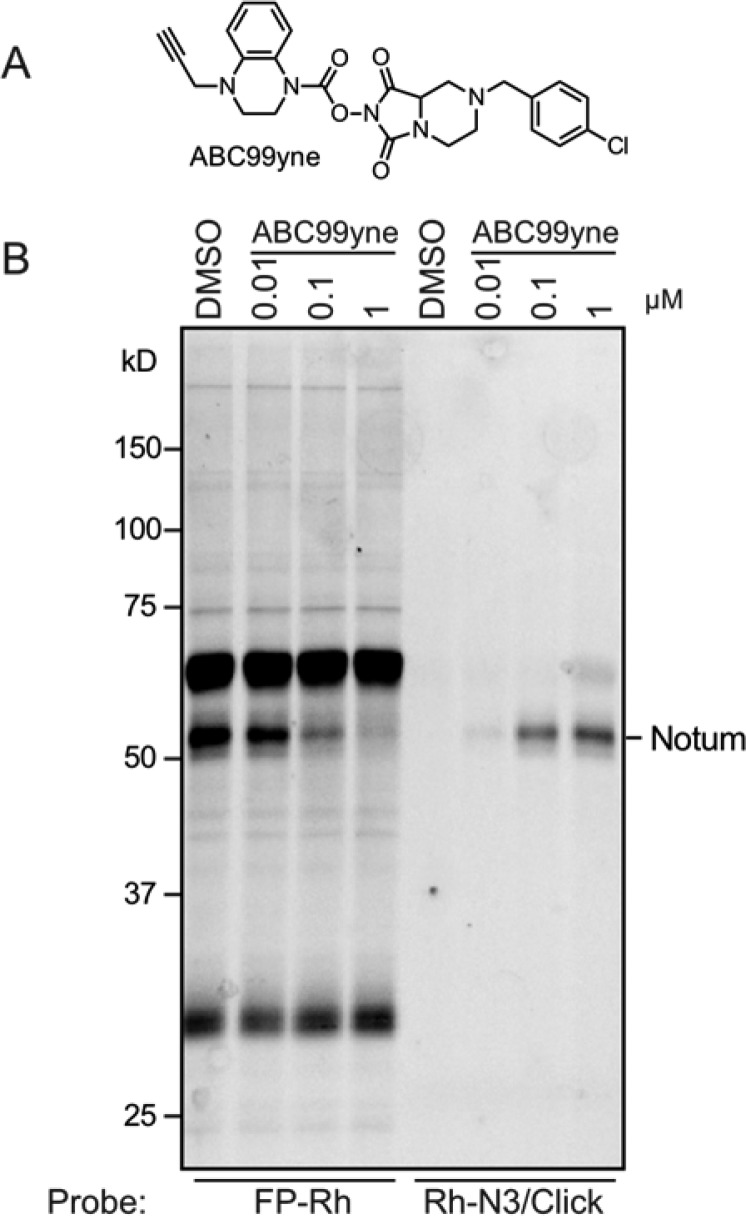
Figure 3
Development of ABC99yne, a clickable analogue of ABC99 for visualizing NOTUM activity in biological samples. (A) Structure of ABC99yne. (B) ABPP gel showing competitive blockade of FP-Rh labeling (left lanes) and direct labeling (right lanes) of NOTUM by ABC99yne in SW620 CM. Samples were pretreated with ABC99yne at the indicated concentrations (30 min, 37 °C) and then treated with FP-Rh (1 μM, 30 min, room temperature) or subjected to CuAAC conditions with a Rh–N3 tag prior to SDS-PAGE analysis.

References

    1. Gordon M. D.; Nusse R. Wnt signaling: multiple pathways, multiple receptors, and multiple transcription factors. J. Biol. Chem. 2006, 281 (32), 22429–33. 10.1074/jbc.R600015200. - DOI - PubMed
    1. Logan C. Y.; Nusse R. The Wnt signaling pathway in development and disease. Annu. Rev. Cell Dev. Biol. 2004, 20, 781–810. 10.1146/annurev.cellbio.20.010403.113126. - DOI - PubMed
    1. Zeng Y. A.; Nusse R. Wnt proteins are self-renewal factors for mammary stem cells and promote their long-term expansion in culture. Cell Stem Cell 2010, 6 (6), 568–77. 10.1016/j.stem.2010.03.020. - DOI - PMC - PubMed
    1. Niehrs C. Function and biological roles of the Dickkopf family of Wnt modulators. Oncogene 2006, 25 (57), 7469–81. 10.1038/sj.onc.1210054. - DOI - PubMed
    1. Janda C. Y.; Garcia K. C. Wnt acylation and its functional implication in Wnt signalling regulation. Biochem. Soc. Trans. 2015, 43 (2), 211–6. 10.1042/BST20140249. - DOI - PMC - PubMed