


The combination of arbuscular mycorrhizal fungi inoculation (Glomus versiforme) and 28-homobrassinolide spraying intervals improves growth by enhancing photosynthesis, nutrient absorption, and antioxidant system in cucumber (Cucumis sativus L.) under salinity
- PMID: 29938088
- PMCID: PMC6010694
- DOI: 10.1002/ece3.4112
The combination of arbuscular mycorrhizal fungi inoculation (Glomus versiforme) and 28-homobrassinolide spraying intervals improves growth by enhancing photosynthesis, nutrient absorption, and antioxidant system in cucumber (Cucumis sativus L.) under salinity
Abstract
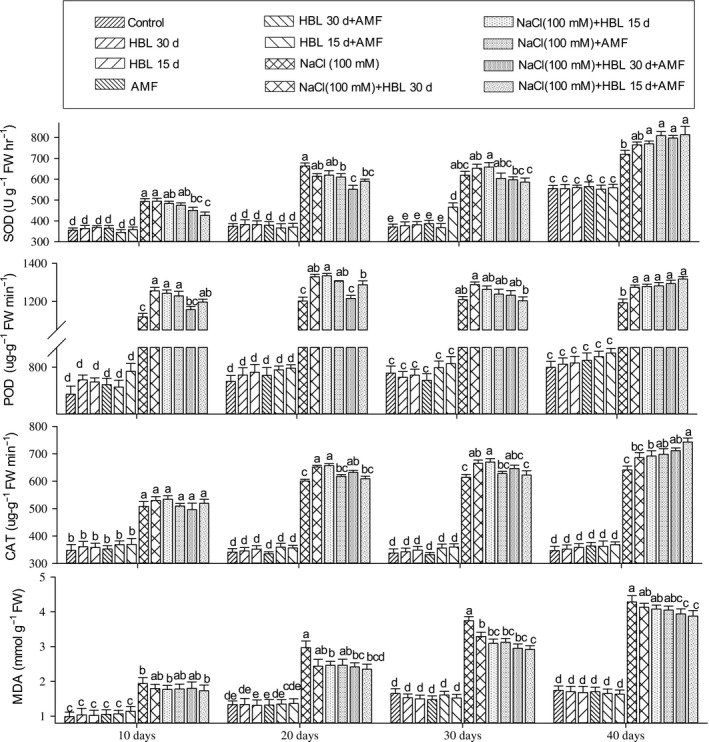
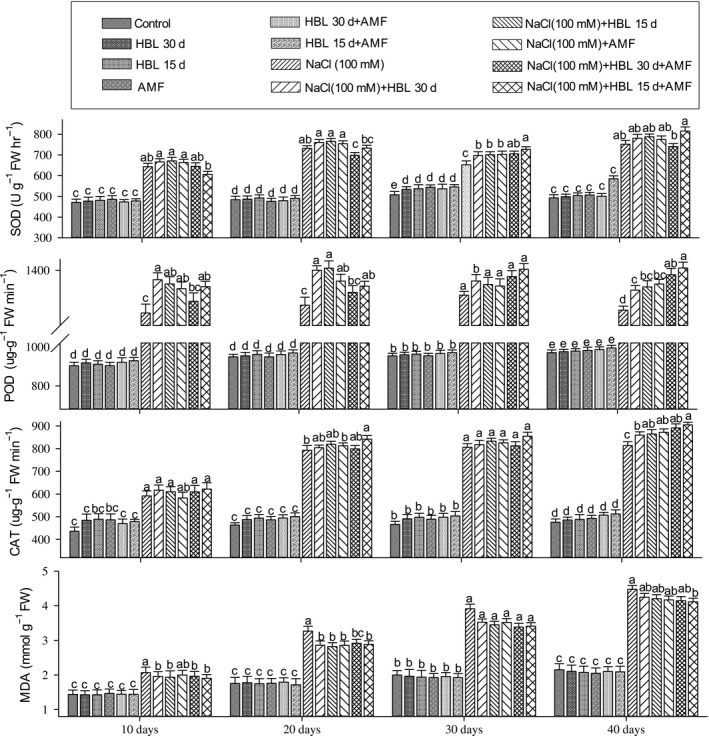
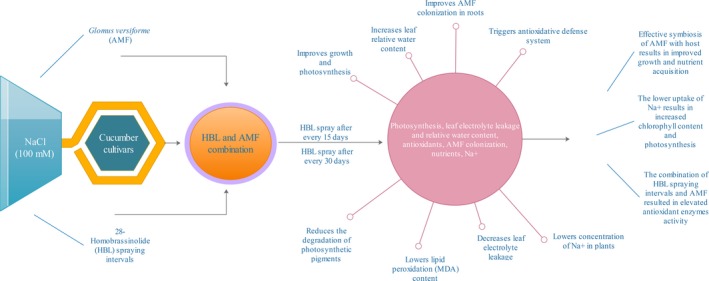
Salinity is one of the major obstacles in the agriculture industry causing huge losses in productivity. Several strategies such as plant growth regulators with arbuscular mycorrhizal fungi (AMF) have been used to decrease the negative effects of salt stress. In our experiment, 28-homobrassinolide (HBL) with spraying intervals was combined with AMF (Glomus versiforme) in cucumber cultivars Jinyou 1# (salt sensitive) and (Changchun mici, in short, CCMC, salt tolerant) under NaCl (100 mmol/L). Studies have documented that the foliar application of HBL and AMF colonization can enhance tolerance to plants under stress conditions. However, the mechanism of the HBL spraying intervals after 15 and 30 days in combination with AMF in cucumber under salt stress is still unknown. Our results revealed that the HBL spraying interval after 15 days in combination with AMF resulted in improved growth, photosynthesis, and decreased sodium toxicity under NaCl. Moreover, the antioxidant enzymes SOD (superoxide dismutase; EC 1.15.1.1) and POD activity (peroxidase; EC 1.11.1.7) showed a gradual increase after every 10 days, while the CAT (catalase; EC 1.11.1.6) increased after 30 days of salt treatments in both cultivars. This research suggests that the enhanced tolerance to salinity was mainly related to elevated levels of antioxidant enzymes and lower uptake of Na+, which lowers the risk of ion toxicity and decreases cell membrane damage.
Keywords: 28‐homobrassinolide; NaCl stress; antioxidants; arbuscular mycorrhizal fungi; cucumber.
Figures
References
-
- Aghdam, M. S. , & Mohammadkhani, N. (2014). Enhancement of chilling stress tolerance of tomato fruit by postharvest brassinolide treatment. Food and Bioprocess Technology, 7(3), 909–914. https://doi.org/10.1007/s11947-013-1165-x - DOI
-
- Ahmad, P. , Ashraf, M. , Hakeem, K. R. , Azooz, M. M. , Rasool, S. , Chandna, R. , … Akram, N. A. (2014). Potassium starvation‐induced oxidative stress and antioxidant defense responses in Brassica juncea . Journal of Plant Interactions, 9(1), 1–9. https://doi.org/10.1080/17429145.2012.747629 - DOI
-
- Ahmad, P. , Azooz, M. M. , & Prasad, M. N. V. (2013). Ecophysiology and responses of plants under salt stress (pp. 1–510). New York, NY: Springer; https://doi.org/10.1007/978-1-4614-4747-4 - DOI
-
- Ahmad, H. , Hayat, S. , Ali, M. , Imran Ghani, M. , & Zhihui, C. (2017). Regulation of growth and physiological traits of cucumber (Cucumis sativus L.) through various levels of 28‐Homobrassinolide under salt stress conditions. Canadian Journal of Plant Science, 98(1): 132–140. https://doi.org/10.1139/cjps-2016-0404 - DOI
-
- Ali, B. , Hayat, S. , & Ahmad, A. (2007). 28‐Homobrassinolide ameliorates the saline stress in chickpea (Cicer arietinum L.). Environmental and Experimental Botany, 59(2), 217–223. https://doi.org/10.1016/j.envexpbot.2005.12.002 - DOI
LinkOut - more resources
Full Text Sources
Other Literature Sources
Research Materials
Miscellaneous
