. 2018 Nov 22;218(suppl_5):S574-S581.
doi: 10.1093/infdis/jiy302.

Broad Neutralizing Activity Against Ebolaviruses Lacking the Mucin-Like Domain in Convalescent Plasma Specimens From Patients With Ebola Virus Disease

Affiliations

Broad Neutralizing Activity Against Ebolaviruses Lacking the Mucin-Like Domain in Convalescent Plasma Specimens From Patients With Ebola Virus Disease

Joanna Luczkowiak et al. J Infect Dis. .

Abstract

Background: In Ebola virus (EBOV) infection, the specific neutralizing activity of convalescent plasma against other members of the Ebolavirus genus has not been extensively analyzed.

Methods: We measured the neutralizing activity in plasma from 3 survivors of the recent outbreak due to the Makona variant of EBOV and tested its neutralizing potency against other variants of EBOV (ie, Mayinga and Kikwit) and against Sudan virus (SUDV), Bundibugyo virus (BDBV), and Reston virus (RESTV), using a glycoprotein (GP)-pseudotyped lentiviral system both with full-length GP and in vitro-cleaved GP (GPCL).

Results: Convalescent plasma specimens from survivors of EBOV infection showed low neutralizing activity against full-length GPs of SUDV, BDBV, RESTV, and EBOV variants Mayinga and Kikwit. However, broad and potent neutralizing activity was observed against the GPCL forms of SUDV, BDBV, and RESTV.

Discussion: Removal of the mucin-like domain and glycan cap from the GP of members of the Ebolavirus genus presumably exposes conserved epitopes in or in the vicinity of the receptor binding site and internal fusion loop that are readily amenable to neutralization. These types of broad neutralizing antibodies could be induced by using immunogens mimicking GPCL.


Figures
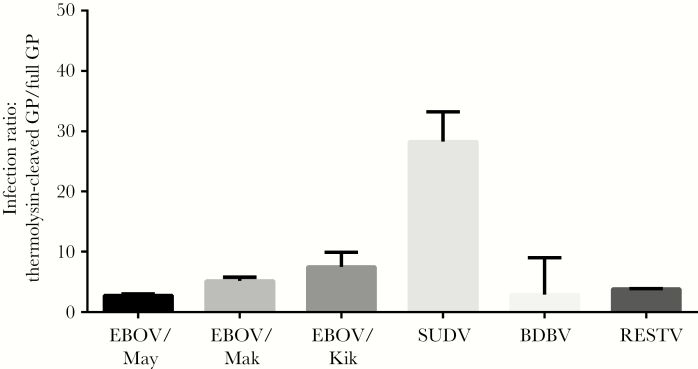
Figure 1.
Figure 1.
Increased infectivity of filovirus glycoprotein (GP)–pseudotyped particles after thermolysin treatment. Bars represent infection ratios, expressed as relative infection for cleaved filovirus GP in relation to the native form (GPCL/GP). Data are mean values from triplicate analyses in 3 independent experiments. Error bars correspond to standard errors of the mean. Abbreviations: BDBV, Bundibugyo virus; EBOV/Kik, Ebola virus Kikwit; EBOV/Mak, Ebola virus Makona; EBOV/May, Ebola virus Mayinga; RESTV, Reston virus; SUDV, Sudan virus.
Figure 2.
Figure 2.
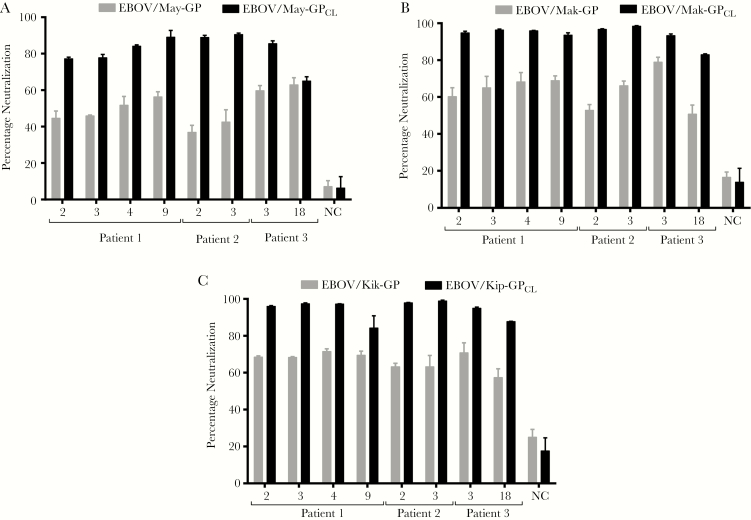
Neutralizing activity against full-length glycoprotein (GP)– and cleaved GP (GPCL)–pseudotyped Ebola virus particles in convalescent plasma specimens from patients with Ebola virus disease. Bars represent neutralization activity of plasma in an infection assay, expressed as the percentage neutralization (expressed as mean values [±standard errors of the mean] from triplicate analyses) as compared to the infectivity obtained without addition of any plasma sample (y-axis). Convalescent plasma samples from 3 patients were heat inactivated and tested at a dilution of 1:200. Abbreviations: EBOV/Kik, Ebola virus Kikwit; EBOV/Mak, Ebola virus Makona; EBOV/May, Ebola virus Mayinga; NC, noninfected control.
Figure 3.
Figure 3.
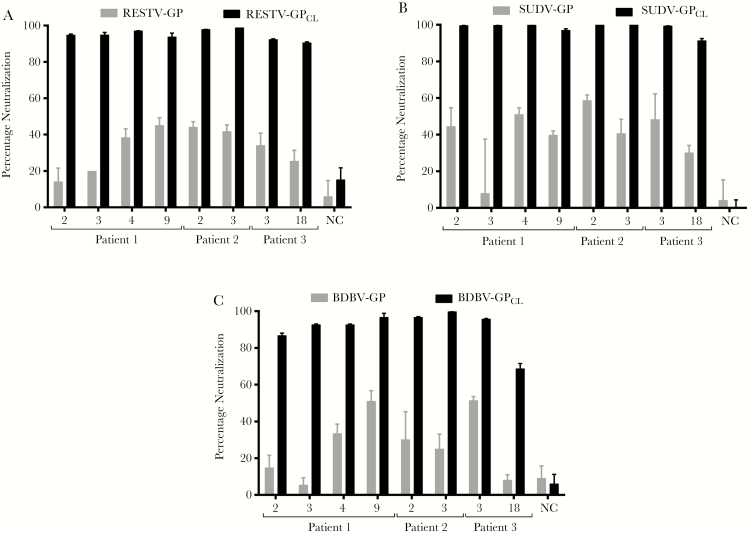
Neutralizing activity against full-length glycoprotein (GP)– and cleaved GP (GPCL)–pseudotyped Reston virus (RESTV), Sudan virus (SUDV), and Bundibugyo virus (BDBV) particles in convalescent plasma specimens from patients with Ebola virus disease. Bars represent the percentage neutralization (expressed as mean values [±standard errors of the mean] from duplicate analyses) in an infection assay as compared to the infectivity obtained in the absence of any plasma sample (y-axis). Plasma samples from 3 convalescent patients were heat inactivated and tested at a dilution of 1:200. Abbreviation: NC, noninfected control.
Figure 4.
Figure 4.
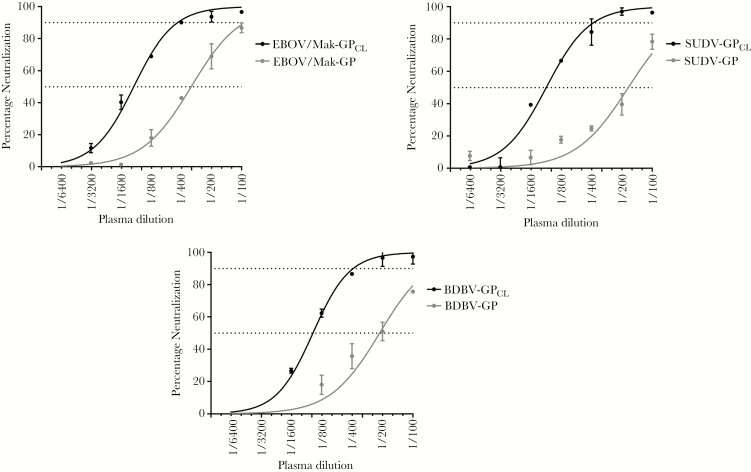
Neutralizing activity against full-length glycoprotein (GP)– and cleaved GP (GPCL)–pseudotyped Ebola virus Makona (EBOV/Mak), Sudan virus (SUDV), and Bundibugyo virus (BDBV) in a convalescent plasma specimen from patient 1. Values represent mean values (±standard errors of the mean) of triplicate analyses. Curves were obtained using a nonlinear regression model fit with settings for log inhibitor versus normalized response curves, in GraphPad Prism, version 6.

References

    1. Muñoz-Fontela C, McElroy AK. Ebola virus disease in humans: pathophysiology and immunity. Curr Top Microbiol Immunol 2017; 411:141–69. - PMC - PubMed
    1. Team WER. After Ebola in West Africa — unpredictable risks, preventable epidemics. N Engl J Med 2016; 375:587–96. - PubMed
    1. Côté M, Misasi J, Ren T, et al. Small molecule inhibitors reveal Niemann-Pick C1 is essential for Ebola virus infection. Nature 2011; 477:344–8. - PMC - PubMed
    1. Carette JE, Raaben M, Wong AC, et al. Ebola virus entry requires the cholesterol transporter Niemann-Pick C1. Nature 2011; 477:340–3. - PMC - PubMed
    1. Chandran K, Sullivan NJ, Felbor U, Whelan SP, Cunningham JM. Endosomal proteolysis of the Ebola virus glycoprotein is necessary for infection. Science 2005; 308:1643–5. - PMC - PubMed

Publication types