


Amiloride resolves resistant edema and hypertension in a patient with nephrotic syndrome; a case report
- PMID: 29939487
- PMCID: PMC6016639
- DOI: 10.14814/phy2.13743
Amiloride resolves resistant edema and hypertension in a patient with nephrotic syndrome; a case report
Abstract
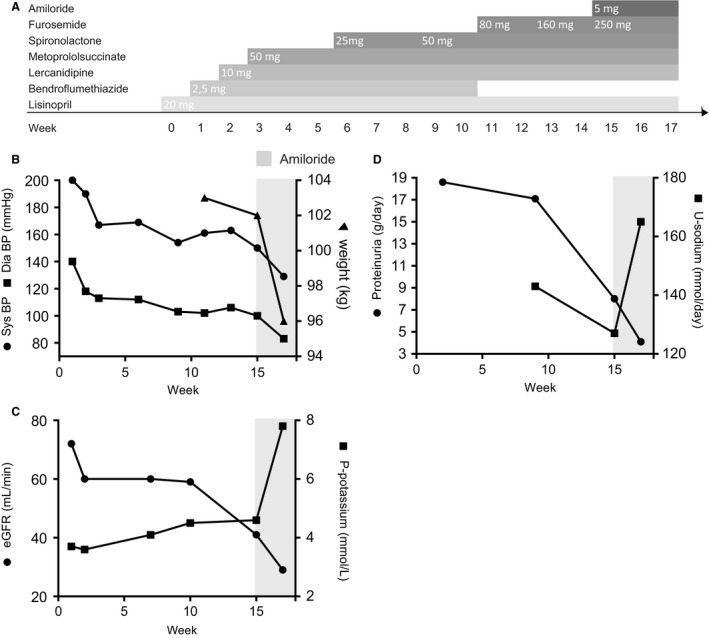
Sodium and fluid retention is a hallmark and a therapeutic challenge of the nephrotic syndrome (NS). Studies support the "overfill" theory of NS with pathophysiological proteolytic activation of the epithelial sodium channel (ENaC) which explains the common observation of suppressed renin -angiotensin system and poor therapeutic response to ACE inhibitors. Blockade of ENaC by the diuretic amiloride would be a rational intervention compared to the traditionally used loop diuretics. We describe a 38-year-old male patient with type1 diabetes who developed severe hypertension (200/140 mmHg), progressive edema (of at least 10 L), and overt proteinuria (18.5 g/24 h), despite combined administration of five antihypertensive drugs. Addition of amiloride (5 mg/day) to treatment resulted in resolution of edema, weight loss of 7 kg, reduction in blood pressure (150/100-125/81 mmHg), increased 24 h urinary sodium excretion (127-165 mmol/day), decreased eGFR (41-29 mL/min), and increased plasma potassium concentration (4.6-7.8 mmol/L). Blocking of ENaC mobilizes nephrotic edema and lowers blood pressure in NS. However, acute kidney injury and dangerous hyperkalemia is a potential risk if amiloride is added to multiple other antihypertensive medications as ACEi and spironolactone. The findings support that ENaC is active in NS and is a relevant target in adult NS patients.
Keywords: ENaC; plasmin; protease; proteinuria.
© 2018 The Authors. Physiological Reports published by Wiley Periodicals, Inc. on behalf of The Physiological Society and the American Physiological Society.
Figures
Comment in
-
ENaC blockade in proteinuria-associated extracellular fluid volume overload - effective but risky.Physiol Rep. 2018 Sep;6(17):e13835. doi: 10.14814/phy2.13835. Physiol Rep. 2018. PMID: 30178569 Free PMC article. No abstract available.
References
-
- Andersen, H. , Hansen P. B., Bistrup C., Nielsen F., Henriksen J. E., and Jensen B. L.. 2016. Significant natriuretic and antihypertensive action of the epithelial sodium channel blocker amiloride in diabetic patients with and without nephropathy. J. Hypertens. 34:1621–1629. - PubMed
-
- Bobrie, G. , Frank M., Azizi M., Peyrard S., Boutouyrie P., Chatellier G., et al. 2012. Sequential nephron blockade versus sequential renin‐angiotensin system blockade in resistant hypertension: a prospective, randomized, open blinded endpoint study. J. Hypertens. 30:1656–1664. - PubMed
-
- Bohnert, B. N. , Menacher M., Janessa A., Worn M., Schork A., Daiminger S., et al. 2017. Aprotinin prevents proteolytic epithelial sodium channel (ENaC) activation and volume retention in nephrotic syndrome. Kidney Int. 000:00. - PubMed
-
- Brown, E. A. , Markandu N. D., Roulston J. E., Jones B. E., Squires M., and MacGregor G. A.. 1982a. Is the renin‐angiotensin‐aldosterone system involved in the sodium retention in the nephrotic syndrome? Nephron 32:102–107. - PubMed
-
- Brown, E. A. , Markandu N. D., Sagnella G. A., Squires M., Jones B. E., and MacGregor G. A.. 1982b. Evidence that some mechanism other than the renin system causes sodium retention in nephrotic syndrome. Lancet (London, England) 2: 1237–1240. - PubMed
Publication types
MeSH terms
Substances
LinkOut - more resources
Full Text Sources
Other Literature Sources
Medical
Research Materials
Miscellaneous
