The association between physician trust and prostate-specific antigen screening: Implications for shared decision-making
- PMID: 29940136
- PMCID: PMC6261724
- DOI: 10.5489/cuaj.5351
The association between physician trust and prostate-specific antigen screening: Implications for shared decision-making
Abstract
Introduction: Shared decision-making is widely recommended when men are considering prostate cancer screening with prostate-specific antigen (PSA). The role of patients' trust in cancer information from their physician in such decisions is unknown.
Methods: We identified male respondents ≥18 years of age from the Health Information National Trends Survey, a population-based survey of people living in the U.S. (2011-014). We assessed the association between degree of trust in cancer information from respondent's physician with patient-reported receipt of PSA-screening and patient-reported discussion of PSA screening with their physician.
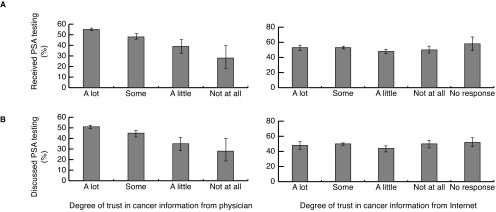
Results: Among 5069 eligible respondents, 3606 (71.1%) men reported trusting cancer information from their physician "a lot," 1186 (23.4%) "somewhat," 219 (4.3%) "a little," and 58 (1.1%) "not at all." A total of 2655 (52.4%) men reported receiving PSA screening. The degree of trust an individual had in his physician for cancer information was strongly associated with his likelihood of having received PSA screening (ptrend<0.0001) (54.9% "a lot" vs. 27.6% "not at all"). These findings persisted after multivariable regression. Similarly, men who had high levels of trust in their physician were more likely to have discussed PSA screening with a strong trend across strata (ptrend<0.0001).
Conclusions: The level of trust an individual has in cancer information from his physician is strongly associated with his likelihood of discussing and undergoing PSA screening. As rationale, implementation of PSA screening requires shared decision-making, and the level of trust an individual has in his physician has important implications for dissemination of PSA screening guidelines.
Conflict of interest statement
Figures
References
-
- Schroder FH, Hugosson J, Roobol MJ, et al. Screening and prostate-cancer mortality in a randomized European study. N Engl J Med. 2009;360:1320–8. https://doi.org/10.1056/NEJMoa0810084 - DOI - PubMed
-
- Moyer VA Force USPST. Screening for prostate cancer: U.S. Preventive Services Task Force recommendation statement. Ann Intern Med. 2012;157:120–34. https://doi.org/10.7326/0003-4819-157-2-201207170-00459 - DOI - PubMed
-
- Charles C, Gafni A, Whelan T. Shared decision-making in the medical encounter: What does it mean? (or it takes at least two to tango) Soc Sci Med. 1997;44:681–92. https://doi.org/10.1016/S0277-9536(96)00221-3 - DOI - PubMed
-
- Peek ME, Gorawara-Bhat R, Quinn MT, et al. Patient trust in physicians and shared decision-making among African-Americans with diabetes. Health Commun. 2013;28:616–23. https://doi.org/10.1080/10410236.2012.710873 - DOI - PMC - PubMed
-
- Kraetschmer N, Sharpe N, Urowitz S, et al. How does trust affect patient preferences for participation in decision-making? Health Expect. 2004;7:317–26. https://doi.org/10.1111/j.1369-7625.2004.00296.x - DOI - PMC - PubMed
LinkOut - more resources
Full Text Sources
Other Literature Sources
Research Materials
Miscellaneous