


Urinary tungsten and incident cardiovascular disease in the Strong Heart Study: An interaction with urinary molybdenum
- PMID: 29940477
- PMCID: PMC6347476
- DOI: 10.1016/j.envres.2018.06.015
Urinary tungsten and incident cardiovascular disease in the Strong Heart Study: An interaction with urinary molybdenum
Abstract
Background: Tungsten (W) interferes with molybdenum (Mo) binding sites and has been associated with prevalent cardiovascular disease (CVD). We evaluated if (1) W exposure is prospectively associated with incident CVD and (2) the association between urinary W levels and incident CVD is modified by urinary Mo levels.
Methods: We estimated multi-adjusted hazard ratios (HRs) for incident CVD outcomes by increasing W levels for 2726 American Indian participants in the Strong Heart Study with urinary metal levels measured at baseline (1989-1991) and CVD events ascertained through 2008.
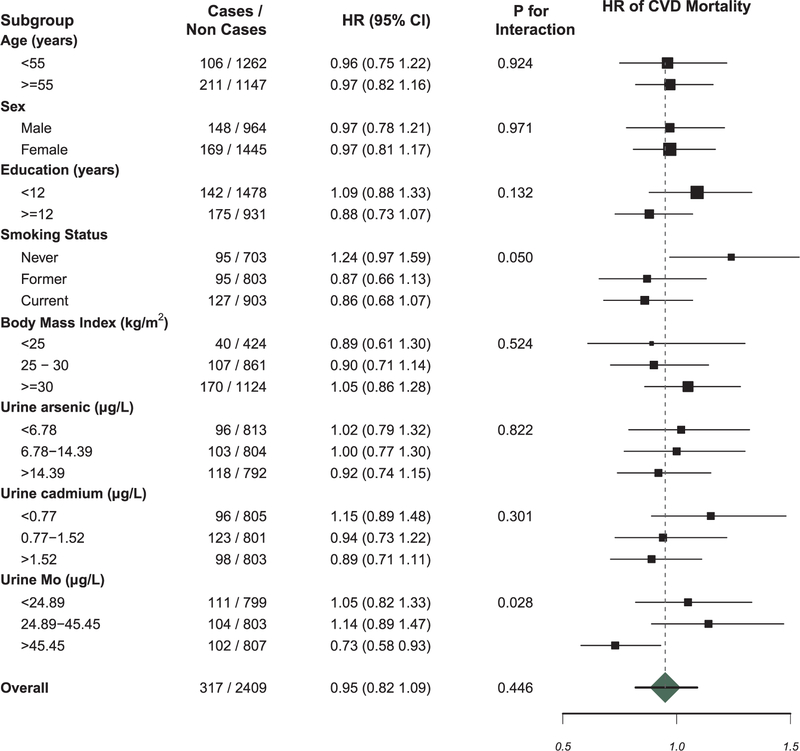
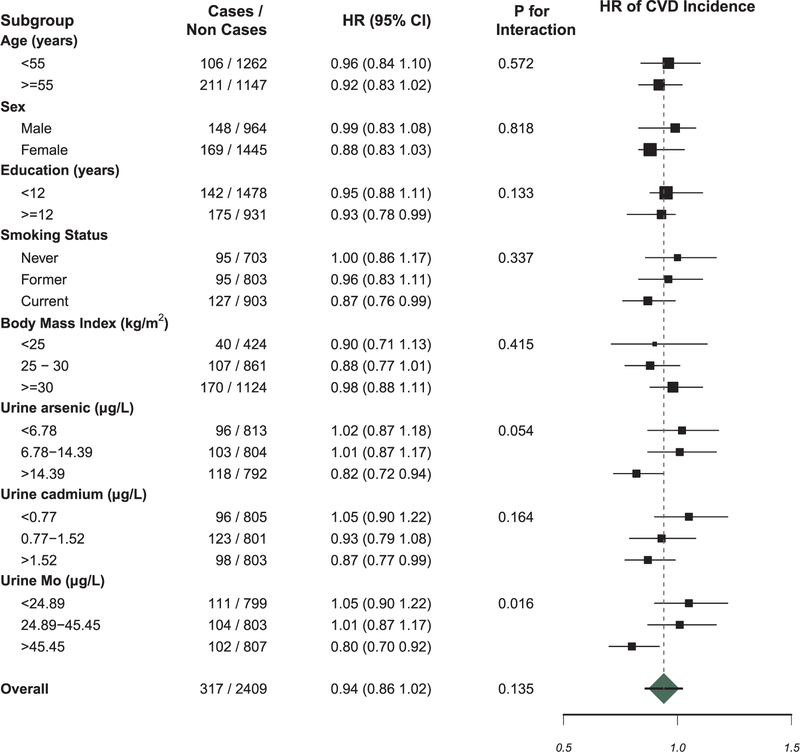
Results: Increasing levels of baseline urinary W were not associated with incident CVD. Fully-adjusted HRs (95% CIs) of incident CVD comparing a change in the IQR of W levels for those in the lowest and highest tertile of urinary Mo were 1.05 (0.90, 1.22) and 0.80 (0.70, 0.92), respectively (p-interaction = 0.02); for CVD mortality, the corresponding HRs were 1.05 (0.82, 1.33) and 0.73 (0.58, 0.93), respectively (p-interaction = 0.03).
Conclusions: The association between W and CVD incidence and mortality was positive although non-significant at lower urinary Mo levels and significant and inverse at higher urinary Mo levels. Although prior cross-sectional epidemiologic studies in the general US population found positive associations between urinary tungsten and prevalent cardiovascular disease, our prospective analysis in the Strong Heart Study indicates this association may be modified by molybdenum exposure.
Keywords: American Indians; Cardiovascular disease; Molybdenum; Strong Heart Study; Tungsten.
Copyright © 2018. Published by Elsevier Inc.
Conflict of interest statement
Competing interests
The authors declare that they have no actual or potential competing financial interests.
Figures
References
-
- Agarwal S, Zaman T, Tuzcu EM, Kapadia SR, 2011. Heavy metals and cardiovascular disease: results from the National Health and Nutrition Examination Survey (NHANES) 1999–2006. Angiology 62 (5), 422–429. - PubMed
-
- Agency for Toxic Substances and Disease Registry, 2005. Toxicological profile for tungsten - PubMed
-
- Bolt AM, Mann KK, 2016. Tungsten: an emerging toxicant, alone or in combination. Curr. Environ. Health Rep 3 (4), 405–415. - PubMed
-
- Brondino CD, Romao MJ, Moura I, Moura JJ, 2006. Molybdenum and tungsten enzymes: the xanthine oxidase family. Curr. Opin. Chem. Biol 10 (2), 109–114. - PubMed
Publication types
MeSH terms
Substances
Grants and funding
- U01 HL041642/HL/NHLBI NIH HHS/United States
- U01 HL041654/HL/NHLBI NIH HHS/United States
- R01 ES025216/ES/NIEHS NIH HHS/United States
- U01 HL041652/HL/NHLBI NIH HHS/United States
- F31 ES029799/ES/NIEHS NIH HHS/United States
- R01 HL109315/HL/NHLBI NIH HHS/United States
- T32 ES007322/ES/NIEHS NIH HHS/United States
- R01 HL109319/HL/NHLBI NIH HHS/United States
- R01 HL109284/HL/NHLBI NIH HHS/United States
- U01 HL065521/HL/NHLBI NIH HHS/United States
- R01 HL109301/HL/NHLBI NIH HHS/United States
- R01 HL109282/HL/NHLBI NIH HHS/United States
- U01 HL065520/HL/NHLBI NIH HHS/United States
- R01 ES021367/ES/NIEHS NIH HHS/United States
- P30 ES009089/ES/NIEHS NIH HHS/United States
LinkOut - more resources
Full Text Sources
Other Literature Sources
