


Replacing sedentary time with physical activity or sleep: effects on cancer-related cognitive impairment in breast cancer survivors
- PMID: 29940894
- PMCID: PMC6019533
- DOI: 10.1186/s12885-018-4603-3
Replacing sedentary time with physical activity or sleep: effects on cancer-related cognitive impairment in breast cancer survivors
Abstract
Background: Evidence suggests reallocating daily sedentary time to physical activity or sleep confers important health benefits in cancer survivors. Despite emerging research suggesting physical activity as a treatment for cancer-related cognitive impairment (CRCI), little is known about the interactive effects of behaviors across the 24-h period. The present purpose was to examine the cognitive effects of reallocating sedentary time to light-intensity physical activity, moderate-to-vigorous physical activity (MVPA), or sleep in breast cancer survivors.
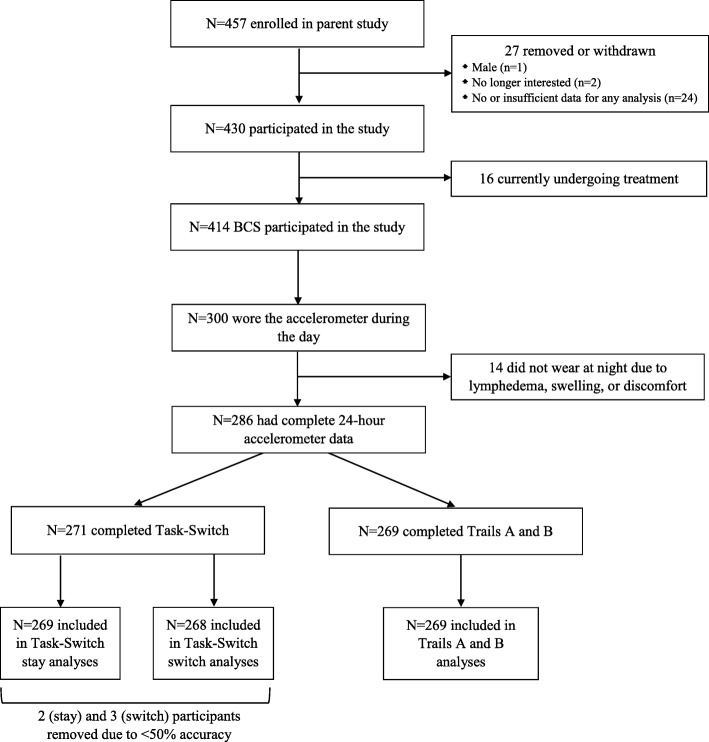
Methods: Breast cancer survivors (N = 271, Mage = 57.81 ± 9.50 years) completed iPad-based questionnaires and cognitive tasks assessing demographics, health history, executive function, and processing speed (Task-Switch, Trail Making). Participants wore an accelerometer for seven consecutive days to measure their sedentary, physical activity, and sleep behaviors. Single effects (each behavior individually) and partition (controlling for other behaviors) models were used to examine associations among behaviors and cognitive performance. Isotemporal substitution models were used to test the cognitive effects of substituting 30 min of sedentary time with 30 min of light-intensity activity, MVPA, and sleep.
Results: MVPA was associated with faster Task-switch reaction time in the partition models (stay: B = - 35.31, p = 0.02; switch: B = - 48.24, p = 0.004). Replacing 30 min of sedentary time with 30 min of MVPA yielded faster reaction times on Task-Switch stay (B = - 29.37, p = 0.04) and switch (B = - 39.49, p = 0.02) trials. In Trails A single effects models, sedentary behavior was associated with faster completion (B = - 0.97, p = 0.03) and light-intensity activity with slower completion (B = 1.25, p = 0.006). No single effects were observed relative to Trails B completion (all p > 0.05). Only the effect of MVPA was significant in the partition models (Trails A: B = - 3.55, p = 0.03; Trails B: B = - 4.46, p = 0.049). Replacing sedentary time with light-intensity activity was associated with slower Trails A (B = 1.55 p = 0.002) and Trails B (B = 1.69, p = 0.02) completion. Replacing light activity with MVPA yielded faster Trails A (B = - 4.35, p = 0.02) and Trails B (B = - 5.23, p = 0.03) completion.
Conclusions: Findings support previous research suggesting MVPA may be needed to improve cognitive function in breast cancer survivors. Trails findings underscore the need to dissect sedentary contexts to better understand the impact of daily behavioral patterns on CRCI. Additional research investigating the cognitive impacts of behaviors across the 24-h period is warranted.
Trial registration: This study is registered with United States ClinicalTrials.gov ( NCT02523677 ; 8/14/2015).
Conflict of interest statement
Ethics approval and consent to participate
This study was approved by the Institutional Review Board at the University of Illinois at Urbana-Champaign. All participants digitally signed the iPad-based consent form prior to enrollment in the study.
Consent for publication
This section is not applicable to the present study.
Competing interests
The authors declare that they have no competing interests.
Publisher’s Note
Springer Nature remains neutral with regard to jurisdictional claims in published maps and institutional affiliations.
Figures
References
-
- Ehlers D, Trinh L, McAuley E. The intersection of cancer and aging: implications for physical activity and cardiorespiratory fitness effects on cognition. Expert Rev Qual Life Cancer Care. 2016;1:347–350. doi: 10.1080/23809000.2016.1241661. - DOI
MeSH terms
Associated data
Grants and funding
LinkOut - more resources
Full Text Sources
Other Literature Sources
Medical
