


Effects of an exercise program on hepatic metabolism, hepatic fat, and cardiovascular health in overweight/obese adolescents from Bogotá, Colombia (the HEPAFIT study): study protocol for a randomized controlled trial
- PMID: 29941024
- PMCID: PMC6019229
- DOI: 10.1186/s13063-018-2721-5
Effects of an exercise program on hepatic metabolism, hepatic fat, and cardiovascular health in overweight/obese adolescents from Bogotá, Colombia (the HEPAFIT study): study protocol for a randomized controlled trial
Abstract
Background: A considerable proportion of contemporary youth have a high risk of obesity-related disorders such as cardiovascular disease, metabolic syndrome, or non-alcoholic fatty liver disease (NAFLD). Although there is consistent evidence for the positive effects of physical activity on several health aspects, most adolescents in Colombia are sedentary. It is, therefore, important to implement strategies that generate changes in lifestyle. The HEPAFIT study aims to examine whether a 6-month exercise program has benefits for hepatic fat content and cardiovascular health outcomes among overweight/obese adolescents from Bogotá, Colombia.
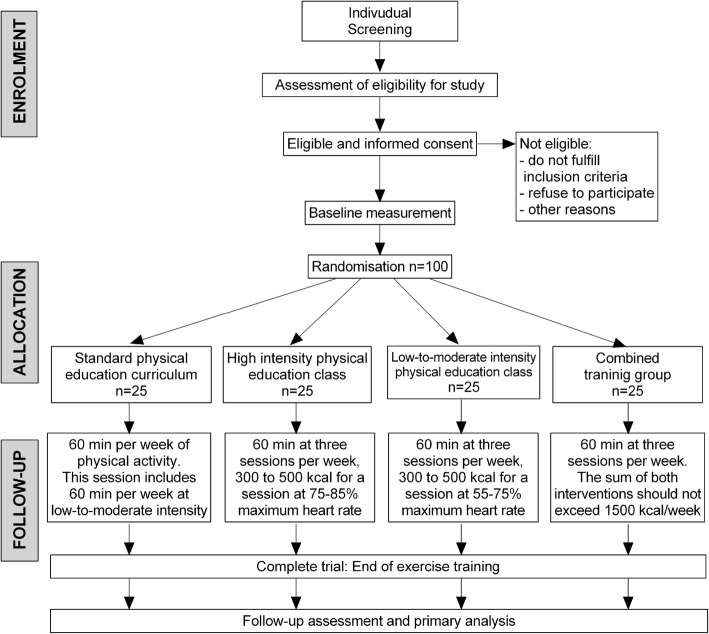
Methods/design: Altogether, 100 hundred overweight/obese, sedentary adolescents (aged 11-17 years) attending two public schools in Bogotá, Colombia, will be included in a parallel-group randomized controlled trial. Adolescents will be randomly assigned to an intervention group following one of four curricula: (1) the standard physical education curriculum (60 min per week of physical activity, n = 25) at low-to-moderate intensity; (2) a high-intensity physical education curriculum (HIPE, n = 25), consisting of endurance and resistance games and non-competitive activities, such as running, gymkhanas, lifting, pushing, wrestling, or hauling, for 60-min sessions, three times per week, with an energy expenditure goal of 300 to 500 kcal/session at 75-85% maximum heart rate (HRmax); (3) a low-to-moderate intensity physical education curriculum (LIPE, n = 25) consisting of endurance and resistance games and non-competitive activities (e.g., chasing, sprinting, dribbling, or hopping) for 60-min sessions, three times per week with an energy expenditure goal of 300 kcal/session at 55-75% HRmax; and (4) a combined HIPE and LIPE curriculum (n = 25). The HIPE, LIPE, and combined interventions were performed in addition to the standard physical education curriculum. The primary outcome for effectiveness is liver fat content, as measured by the controlled attenuation parameter 1 week after the end of the intervention program.
Discussion: The translational focus may be suitable for collecting new information in a school setting on the possible effects of physical activity interventions to reduce liver fat content and to improve metabolic profiles and the cardiometabolic health of overweight/obese adolescents. This may lead to the more efficient use of school physical education resources.
Trial registration: ClinicalTrials.gov, NCT02753231 . Registered on 21 April 2016.
Keywords: Exercise; Fatty liver; Metabolic syndrome; Obesity; Overweight; Risk factor.
Conflict of interest statement
Ethics approval and consent to participate
The study received ethical approval from the Medical Research Ethics Committee of the University of Rosario (act no ABN026–000140, 17 May 2016). All parents or guardians will sign a written informed consent form and all adolescents must give their assent before being enrolled in the study according to the International Council for Harmonization of Technical Requirements for Pharmaceuticals for Human Use and Good Clinical Practice, and national and local regulations.
Consent for publication
I have obtained consent from the participants to publish individual patient data.
Competing interests
The authors declare that they have no competing interest.
Publisher’s Note
Springer Nature remains neutral with regard to jurisdictional claims in published maps and institutional affiliations.
Figures
References
-
- Organization WHO . Obesity: preventing and managing the global epidemic: World Health Organization. 2000. - PubMed
-
- González SA, Castiblanco MA, Arias-Gómez LF, Martinez-Ospina A, Cohen DD, Holguin GA, Almanza A, Lemos DM, Correa-Bautista JE, Escobar ID, García J, Gámez R, Garzon M, Beltrán YH, Hurtado H, Lozano O, Páez DC, Ramírez-Vélez R, Ruiz N, Tovar G, Sarmiento OL. Results from Colombia's 2016 report card on physical activity for children and youth. J Phys Act Health. 2016;13(11 Suppl 2):S129–S126. doi: 10.1123/jpah.2016-0369. - DOI - PubMed
Publication types
MeSH terms
Substances
Associated data
Grants and funding
LinkOut - more resources
Full Text Sources
Other Literature Sources
Medical
Miscellaneous
