Review
. 2018 Aug 28;38(18):e00263-18.
doi: 10.1128/MCB.00263-18. Print 2018 Sep 15.

Centromere Biology: Transcription Goes on Stage

Affiliations
Review

Centromere Biology: Transcription Goes on Stage

Carlos Perea-Resa et al. Mol Cell Biol. .

Abstract

Accurate chromosome segregation is a fundamental process in cell biology. During mitosis, chromosomes are segregated into daughter cells through interactions between centromeres and microtubules in the mitotic spindle. Centromere domains have evolved to nucleate formation of the kinetochore, which is essential for establishing connections between chromosomal DNA and microtubules during mitosis. Centromeres are typically formed on highly repetitive DNA that is not conserved in sequence or size among organisms and can differ substantially between individuals within the same organism. However, transcription of repetitive DNA has emerged as a highly conserved property of the centromere. Recent work has shown that both the topological effect of transcription on chromatin and the nascent noncoding RNAs contribute to multiple aspects of centromere function. In this review, we discuss the fundamental aspects of centromere transcription, i.e., its dual role in chromatin remodeling/CENP-A deposition and kinetochore assembly during mitosis, from a cell cycle perspective.

Keywords: Aurora-B; CENP-A; CENP-C; CPC; R-loop; RNA Pol II; cenRNA; centromere; centromere transcription; chromosome segregation; mitosis; ncRNA.


Figures

FIG 1
FIG 1
Comparative analysis of centromere DNA organization in S. cerevisiae, S. pombe, D. melanogaster, and Homo sapiens. Schemes representing the main components of centromere regions in the different organisms are indicated. Despite the lack of conservation in size, with lengths ranging from 125 bp in S. cerevisiae to megabases in humans, or in sequence, the epigenetic loading of CENP-A/Cse4/Cnp1/Cid nucleosomes is a common feature of centromere definition.
FIG 2
FIG 2
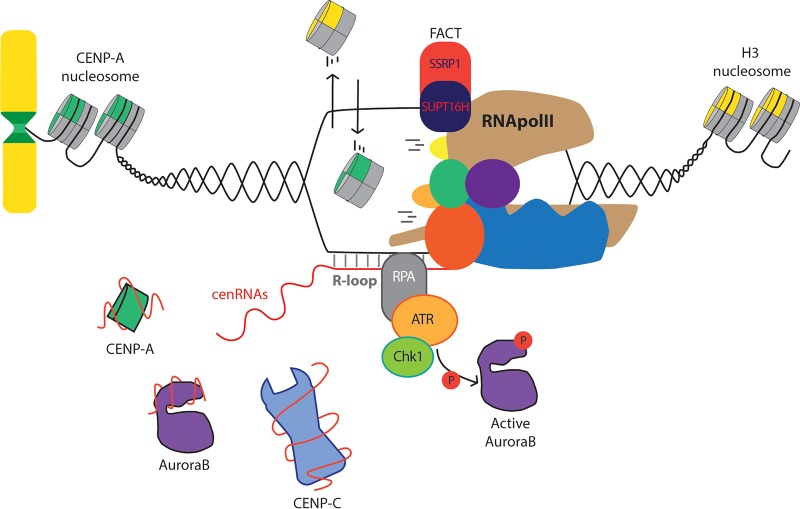
The process and product of centromeric transcription regulate key aspects of centromere biology. (Top) The topological effect generated by RNA Pol II passage favors the incorporation of CENP-A nucleosomes at centromere regions. (Bottom) As a consequence of transcription, nascent centromeric RNAs (cenRNAs) and DNA/RNA hybrids (R-loops) modulate distinct fundamental aspects of a plethora of centromere proteins.
FIG 3
FIG 3
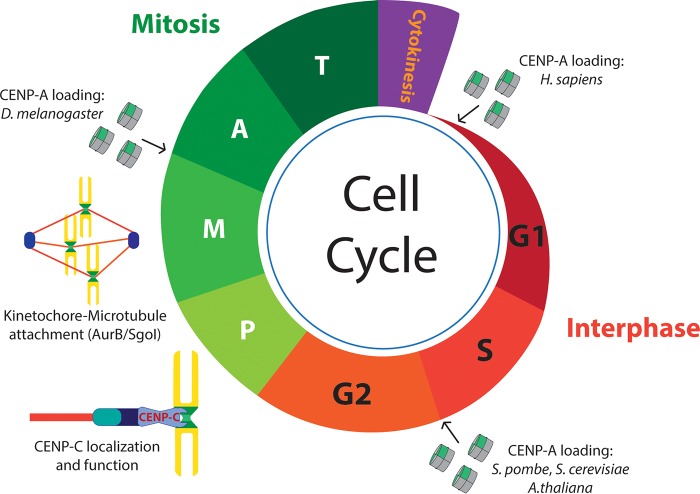
Cell cycle perspective on centromere transcription. CENP-A loading occurs only once during the cell cycle, but at different stages depending on the species, i.e., in early G1 in humans, in the S/G2 transition in yeast or Arabidopsis, and in metaphase-anaphase (M/A) in Drosophila. The existence of centromere transcription during these stages facilitates the incorporation of CENP-A at these chromosome regions. Centromere transcription uncoupled from CENP-A loading also guarantees other centromere aspects, such as sensing the kinetochore-microtubule attachment tension status in metaphase by regulating the localization and function of Aurora-B (AurB) or shugoshin I (SgoI). In addition, transcription ensures the proper localization and function of CENP-C, a key RNA-binding factor linking CENP-A nucleosomes to the Mis12 complex during mitosis.
None
None

References

    1. Gordon DJ, Resio B, Pellman D. 2012. Causes and consequences of aneuploidy in cancer. Nat Rev Genet 13:189–203. doi: 10.1038/nrg3123. - DOI - PubMed
    1. Santaguida S, Amon A. 2015. Short- and long-term effects of chromosome mis-segregation and aneuploidy. Nat Rev Cell Biol 16:473–485. doi: 10.1038/nrm4025. - DOI - PubMed
    1. Aldrup-McDonald ME, Sullivan BA. 2014. The past, present, and future of human centromere genomics. Genes (Basel) 5:33–50. doi: 10.3390/genes5010033. - DOI - PMC - PubMed
    1. Miga KH. 2015. Completing the human genome: the progress and challenge of satellite DNA assembly. Chromosome Res 23:421–426. doi: 10.1007/s10577-015-9488-2. - DOI - PubMed
    1. Jain M, Olsen HE, Turner DJ, Stoddart D, Bulazei KV, Paten B, Haussier D, Willard HF, Akeson M, Miga KH. 2018. Linear assembly of a human centromere on the Y chromosome. Nat Biotechnol 36:321–323. doi: 10.1038/nbt.4109. - DOI - PMC - PubMed

Publication types