


Unconditional probability of dying and age-specific mortality rate because of major non-communicable diseases in India: Time trends from 2001 to 2013
- PMID: 29943745
- PMCID: PMC6380139
- DOI: 10.4103/jpgm.JPGM_529_17
Unconditional probability of dying and age-specific mortality rate because of major non-communicable diseases in India: Time trends from 2001 to 2013
Abstract
Background: Unconditional probability of dying because of four major non-communicable diseases (NCDs) between 30 and 70 years of age is the selected global indicator to measure the impact of NCD prevention and control programs.
Objective: To calculate the unconditional probability of dying and age-specific mortality rate because of major NCDs in India from 2001 to 2013.
Methods: This study used multiple data sources that are available in the public domain-Census 2001 and 2011, Sample Registration System, causes of death reports in 2001-03, 2004-06, and 2010-13. Unconditional probability of dying between ages 30 and 70 years during 2001, 2006, and 2013 was calculated by the formula suggested by the World Health Organization. Line graphs were used to depict time trends in age-specific mortality rates over the years in four major NCDs (cardiovascular diseases, cancer, diabetes, and chronic respiratory diseases).
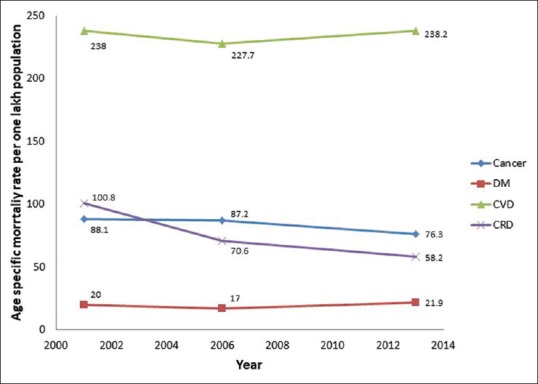
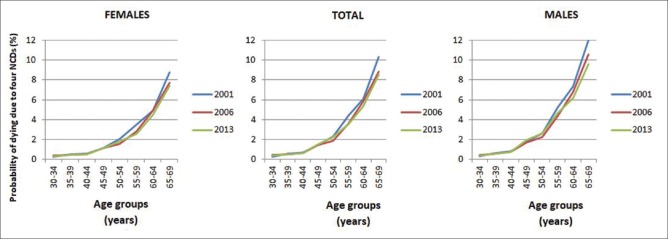
Results: The age-specific mortality rate because of four NCDs showed a decrease of 51 deaths per 100,000 population from 2001 to 2013. Of the four NCDs, age-specific mortality rate was highest in cardiovascular diseases (238.2/100,000 population) and least in diabetes mellitus (21.9/100,000 population); it was 76.3 and 58.2/100,000 population for cancer and chronic respiratory diseases, respectively. The probability of dying was very less and was almost the same from 30 to 44 years of life and increased steeply after that till 70 years of life; and it was more in males (24%) compared with females (17.4%).
Conclusion: Although India has shown a decreasing trend in premature mortality because of NCDs in the past decade, the rate of decrease is not on par to achieve the global "25 × 25" target.
Keywords: Age-specific mortality rate; non-communicable disease; probability of dying.
Conflict of interest statement
None
Figures
Comment in
-
Noncommunicable diseases in India: Challenges and the way forward.J Postgrad Med. 2019 Jan-Mar;65(1):5-6. doi: 10.4103/jpgm.JPGM_157_18. J Postgrad Med. 2019. PMID: 30693870 Free PMC article. No abstract available.
References
-
- World Health Organization. Global status report on noncommunicable diseases. Geneva: WHO; 2010. [Last accessed on 2018 Mar 17]. Available from: http:// apps.who.int/iris/bitstream/10665/44579/1/9789240686458_eng. pdf . 2011. Internet.
-
- World Hea lth Organiza t ion. NCD global monit o r ing framework [Internet] Geneva: WHO; 2013. [Last accessed on 2018 Mar 17]. cited 2018 Mar 17. Available from: http://www.who.int/nmh/global_monitoring_ framework/2013-11-06-who-dc-c2... .
-
- Bloom DE, Cafiero-Fonseca ET, Candeias V, Adashi E, Bloom L, Gurfein L, et al. Economics of non-communicable diseases in India: The costs and returns on investment of interventions to promote healthy living and prevent, treat, and manage NCDs [Internet] World Economic Forum. 2014. [Last accessed on 2018 Mar 17]. Available from: http://www3.weforum. org/docs/WEF_EconomicNonCommunicableDiseasesIndia_ ... .
-
- Kontis V, Mathers CD, Bonita R, Stevens GA, Rehm J, Shield KD, et al. Regional contributions of six preventable risk factors to achieving the 25 × 25 non-communicable disease mortality reduction target: A modelling study. Lancet Glob Health. 2015;3:e746–57. - PubMed
-
- World Health Organization. Noncommunicable diseases country profiles 2014 [Internet] Geneva: WHO; 2014. [Last accessed on 2018 Mar 17]. Available from: http:// apps.who.int/iris/bitstream/10665/128038/1/9789241507509_eng. pdf .
MeSH terms
LinkOut - more resources
Full Text Sources
Other Literature Sources
Miscellaneous