. 2018 Aug;99(8):1001-1011.
doi: 10.1099/jgv.0.001101. Epub 2018 Jun 26.

Characterization of neutralizing epitopes in antigenic site B of recently circulating influenza A(H3N2) viruses

Affiliations

Characterization of neutralizing epitopes in antigenic site B of recently circulating influenza A(H3N2) viruses

Kerstin Beer et al. J Gen Virol. 2018 Aug.

Abstract

Influenza A(H3N2) viruses are associated with outbreaks worldwide and can cause disease with severe complications. The impact can be reduced by vaccination, which induces neutralizing antibodies that mainly target the haemagglutinin glycoprotein (HA). In this study we generated neutralizing mouse monoclonal antibodies (mAbs) against A/Victoria/361/2011 and identified their epitopes by generating and sequencing escape viruses. The epitopes are located in antigenic site B, which is near the receptor-binding site and is immunodominant in humans. Amino acid (aa) substitutions at positions 156, 158, 159, 189, 190 and 193 in antigenic site B led to reduced ability of mAbs to block receptor-binding. The majority of A(H3N2) viruses that have been circulating since 2014 are antigenically distinct from previous A(H3N2) viruses. The neutralization-sensitive epitopes in antigenic site B of currently circulating viruses were examined with these mAbs. We found that clade 3C.2a viruses, possessing an additional potential glycosylation site at HA1 position N158, were poorly recognized by some of the mAbs, but other residues, notably at position 159, also affected antibody binding. Through a mass spectrometric (MS) analysis of HA, the glycosylated sites of HA1 were established and we determined that residue 158 of HA1 was glycosylated and so modified a neutralization-sensitive epitope. Understanding and monitoring individual epitopes is likely to improve vaccine strain selection.

Keywords: Influenza; antigenic drift; monoclonal antibodies.


Conflict of interest statement

The authors declare that there are no conflicts of interest.

Figures

Fig. 1.
Fig. 1.
Critical residues in antigenic site B neutralization-sensitive epitopes of Vic361 HA. The adapted RCSB PDB file 4WEA [41] shows HA monomers in black, white and grey. Critical aa positions are highlighted. Positions 156, 158, 159 (red), 190 (purple) and 193 (orange) are critical for mAbs 11-2-6, 17-1-1 and 24-3-5; positions 189 (yellow) and 193 (orange) are critical for mAbs 7-1-3 and 16-3-5; positions 156, 158, 159 (red) and 193 (orange) are critical for 100-1-1; positions 156, 159 (red) and 193 (orange) are critical for 101-1-1. Blue, sialic acid (6′SLN) in the receptor-binding site. The figures were generated with PyMOL.
Fig. 2.
Fig. 2.
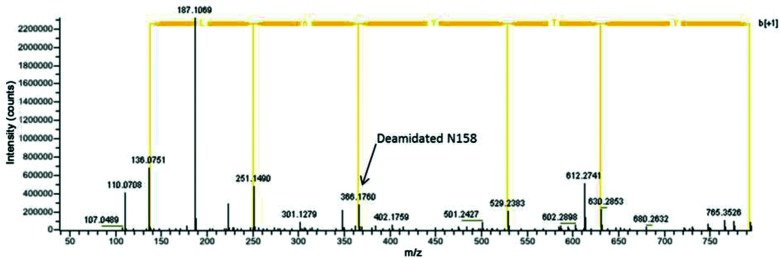
MS/MS spectrum for deamidated peptides containing glycosylation site NYT at positions 158–160 of HA1. The aa sequence is shown for the b ion series. The y series is not shown for simplicity. Peak 187.1069 equals the y2 ion. The position of the deamidated N158 is indicated.
Fig. 3.
Fig. 3.
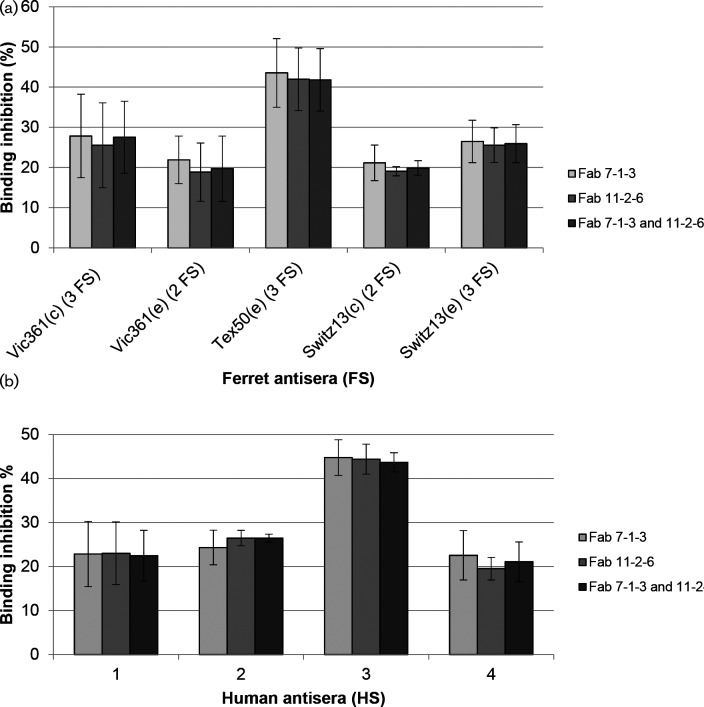
Competition ELISA with post-infection ferret antisera (FS) and human antisera (HS). Ferret antisera obtained after infection with the viruses shown (a) and human antisera collected 7–8 days after vaccination with Vic361-like vaccine virus (b) were tested in competition with Fabs using recombinant HA of Vic361(c) as the antigen. The percentages of binding inhibition by Fabs are shown. The bars show standard deviation.

References

    1. Skehel JJ, Wiley DC. Receptor binding and membrane fusion in virus entry: the influenza hemagglutinin. Annu Rev Biochem. 2000;69:531–569. doi: 10.1146/annurev.biochem.69.1.531. - DOI - PubMed
    1. Gerhard W, Yewdell J, Frankel ME, Webster R. Antigenic structure of influenza virus haemagglutinin defined by hybridoma antibodies. Nature. 1981;290:713–717. doi: 10.1038/290713a0. - DOI - PubMed
    1. Knossow M, Daniels RS, Douglas AR, Skehel JJ, Wiley DC. Three-dimensional structure of an antigenic mutant of the influenza virus haemagglutinin. Nature. 1984;311:678–680. doi: 10.1038/311678a0. - DOI - PubMed
    1. Whittle JR, Zhang R, Khurana S, King LR, Manischewitz J, et al. Broadly neutralizing human antibody that recognizes the receptor-binding pocket of influenza virus hemagglutinin. Proc Natl Acad Sci USA. 2011;108:14216–14221. doi: 10.1073/pnas.1111497108. - DOI - PMC - PubMed
    1. Brandenburg B, Koudstaal W, Goudsmit J, Klaren V, Tang C, et al. Mechanisms of hemagglutinin targeted influenza virus neutralization. PLoS One. 2013;8:e80034. doi: 10.1371/journal.pone.0080034. - DOI - PMC - PubMed

Publication types