


Tuberculosis in people newly diagnosed with HIV at a large HIV care and treatment center in Northwest Cameroon: Burden, comparative screening and diagnostic yields, and patient outcomes
- PMID: 29944701
- PMCID: PMC6019259
- DOI: 10.1371/journal.pone.0199634
Tuberculosis in people newly diagnosed with HIV at a large HIV care and treatment center in Northwest Cameroon: Burden, comparative screening and diagnostic yields, and patient outcomes
Abstract
Background: Diagnosis of tuberculosis in people living with HIV is challenging due to non-specific clinical presentations and inadequately sensitive diagnostic tests. The WHO recommends screening using a clinical algorithm followed by rapid diagnosis using the Xpert MTB/RIF assay, and more information is needed to evaluate these recommendations in different settings.
Methods: From August 2012 to September 2013, consecutive adults newly diagnosed with HIV in Bamenda, Cameroon, were screened for TB regardless of symptoms by smear microscopy and culture; the Xpert MTB/RIF assay was performed retrospectively. Time to treatment and patient outcomes were obtained from routine registers.
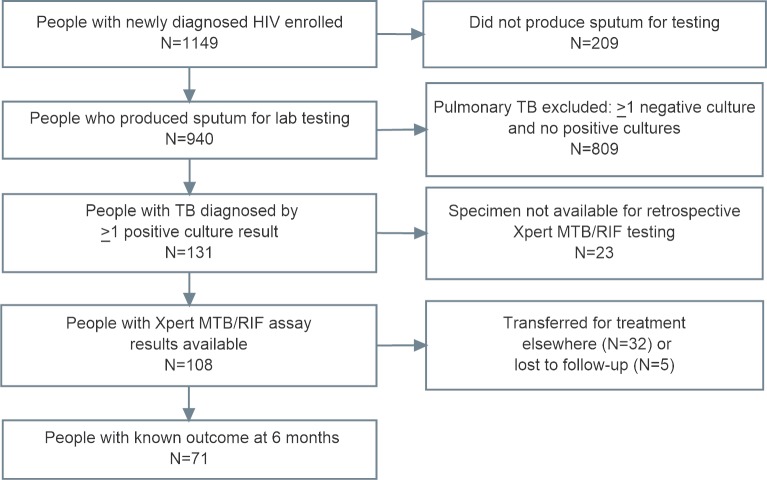
Results: Among 1,149 people enrolled, 940 (82%) produced sputum for lab testing; of these, 68% were women, the median age was 35 years (IQR, 28-42 years), the median CD4 count was 291cells/μL (IQR, 116-496 cells/μL), and 86% had one or more of current cough, fever, night sweats, or weight loss. In total, 131 people (14%, 95% CI, 12-16%) had sputum culture-positive TB. The WHO symptom screening algorithm had a sensitivity of 92% (95%CI, 86-96%) and specificity of 15% (95%CI, 12-17%) in this population. Compared to TB culture, the sensitivity of direct smear microscopy was 25% (95% CI, 18-34%), and the sensitivity of Xpert was 68% (95% CI, 58-76); the sensitivity of both was higher for people reporting more symptoms. Only one of 69 people with smear-negative/culture-positive TB was started on TB treatment prior to culture positivity. Of 71 people with bacteriologically-confirmed TB and known outcome after 6 months, 13 (17%) had died, including 11 people with smear-negative TB and 6 people with both smear and Xpert-negative TB.
Conclusions: Use of the most sensitive rapid diagnostic test available is critical in people newly diagnosed with HIV in this setting to maximize the detection of bacteriologically-confirmed TB. However, this intervention is not sufficient alone and should be combined with more comprehensive clinical diagnosis of TB to improve outcomes.
Conflict of interest statement
The authors have declared that no competing interests exist.
Figures
References
-
- Kranzer K, Houben RMGJ, Glynn JR, Bekker L, Wood R, Lawn SD. Yield of HIV-associated tuberculosis during intensifi ed case fi nding in resource-limited settings: a systematic review and meta-analysis. Lancet Infect Dis. 2010;10: 93–102. doi: 10.1016/S1473-3099(09)70326-3 - DOI - PMC - PubMed
-
- Getahun H, Harrington M, Brien RO, Nunn P. Diagnosis of smear-negative pulmonary tuberculosis in people with HIV infection or AIDS in resource-constrained settings: informing urgent policy changes. Lancet. 2007;369: 2042–2049. doi: 10.1016/S0140-6736(07)60284-0 - DOI - PubMed
-
- Getahun H, Gunneberg C, Granich R, Nunn P. HIV infection-associated tuberculosis: the epidemiology and the response. Clin Infect Dis. 2010;50 Suppl 3: S201–7. doi: 10.1086/651492 - DOI - PubMed
-
- Gupta RK, Lucas SB, Fielding KL, Lawn SD. Prevalence of tuberculosis in post-mortem studies of HIV-infected adults and children in resource-limited settings: a systematic review and meta-analysis. AIDS. 2015;29: 1987–2002. doi: 10.1097/QAD.0000000000000802 - DOI - PMC - PubMed
-
- World Health Organization. Guidelines for intensified tuberculosis case-finding and isoniazid preventive therapy for people living with HIV in resource- constrained settings. World Health; Geneva; 2011;1: 142. doi:ISBN 978 92 4 150070 8
Publication types
MeSH terms
Associated data
LinkOut - more resources
Full Text Sources
Other Literature Sources
Medical
Research Materials
Miscellaneous
