


Nonadherence to daily self-weighing and activity tracking is associated with weight fluctuations among African American breast cancer survivors
- PMID: 29944706
- PMCID: PMC6019092
- DOI: 10.1371/journal.pone.0199751
Nonadherence to daily self-weighing and activity tracking is associated with weight fluctuations among African American breast cancer survivors
Abstract
Introduction: Daily self-weighing (DSW) and daily activity tracking (DAT) are useful strategies for preventing weight gain among African American breast cancer survivors. However, self-monitoring behaviors vary over time, increasing risk of weight gain. This study explored the association of nonadherence to DSW and DAT with corresponding weight fluctuations among African American breast cancer survivors.
Methods: Using data from a 6-month randomized controlled trial, we conducted a secondary data analysis among women randomized into a DSW group (n = 13) and a DSW+DAT group (n = 11). DSW and DAT were captured from wireless scale and activity tracker data. Nonadherence to DSW was defined as one or more days without a weight measurement, and nonadherence to DAT was defined as one or more days without activity tracking. Generalized estimating equations were used to examine weight fluctuations in relation to nonadherence to DSW and DAT. Data analysis occurred from September 2016-April 2017.
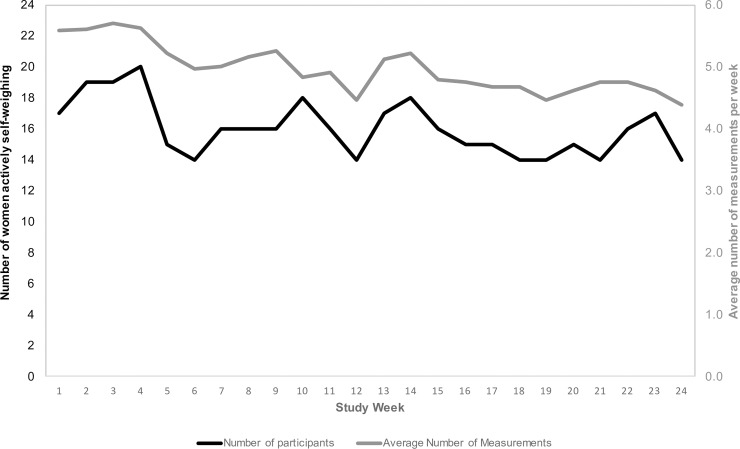
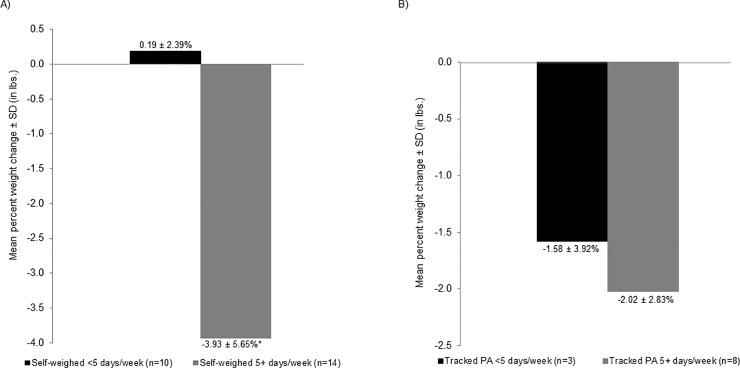
Results: Over the 6-month study period, women provided 119.2 ± 46.0 weight measurements and 121.9 ± 53.2 days of physical activity tracking. Nonadherence to DSW was associated with weight fluctuations. For every 1-day increase in nonadherence to DSW, weight increased by 0.031 kg (95% CI: 0.012, 0.050; p<0.01). Additionally, during periods of DSW and DAT weight decreased by 0.028 kg (95% CI: -0.042, -0.014; p<0.001) and 0.017 kg (95% CI: -0.030; -0.004) respectively.
Conclusions: Our findings suggest that nonadherence to DSW was associated with weight gain among breast cancer survivors. Weight loss was enhanced during periods of DSW and DAT.
Conflict of interest statement
The authors have declared that no competing interests exist.
Figures

References
-
- Ferlay J, Soerjomataram I, Dikshit R, Eser S, Mathers C, Rebelo M, et al. Cancer incidence and mortality worldwide: sources, methods and major patterns in GLOBOCAN 2012. Int J Cancer. 2015;136(5):E359–86. doi: 10.1002/ijc.29210 - DOI - PubMed
-
- Tammemagi CM, Nerenz D, Neslund-Dudas C, Feldkamp C, Nathanson D. Comorbidity and survival disparities among black and white patients with breast cancer. JAMA. 2005;294(14):1765–72. doi: 10.1001/jama.294.14.1765 - DOI - PubMed
-
- Society AC. Cancer Facts & Figures for African Americans 2016–2018. Atlanta: American Cancer Society; 2016.
-
- Paxton RJ, Phillips KL, Jones LA, Chang S, Taylor WC, Courneya KS, et al. Associations among physical activity, body mass index, and health-related quality of life by race/ethnicity in a diverse sample of breast cancer survivors. Cancer. 2012;118(16):4024–31. doi: 10.1002/cncr.27389 - DOI - PMC - PubMed
-
- Rock CL, Flatt SW, Newman V, Caan BJ, Haan MN, Stefanick ML, et al. Factors associated with weight gain in women after diagnosis of breast cancer. Women's Healthy Eating and Living Study Group. J Am Diet Assoc. 1999;99(10):1212–21. - PubMed
Publication types
MeSH terms
Grants and funding
LinkOut - more resources
Full Text Sources
Other Literature Sources
Medical
Miscellaneous
