


iReceptor: A platform for querying and analyzing antibody/B-cell and T-cell receptor repertoire data across federated repositories
- PMID: 29944754
- PMCID: PMC6344122
- DOI: 10.1111/imr.12666
iReceptor: A platform for querying and analyzing antibody/B-cell and T-cell receptor repertoire data across federated repositories
Abstract
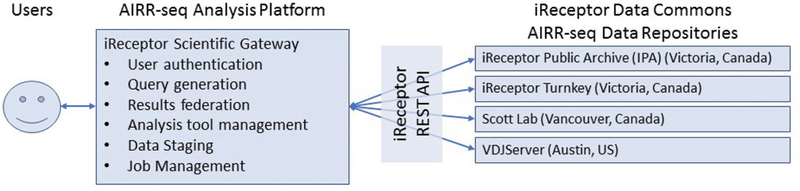
Next-generation sequencing allows the characterization of the adaptive immune receptor repertoire (AIRR) in exquisite detail. These large-scale AIRR-seq data sets have rapidly become critical to vaccine development, understanding the immune response in autoimmune and infectious disease, and monitoring novel therapeutics against cancer. However, at present there is no easy way to compare these AIRR-seq data sets across studies and institutions. The ability to combine and compare information for different disease conditions will greatly enhance the value of AIRR-seq data for improving biomedical research and patient care. The iReceptor Data Integration Platform (gateway.ireceptor.org) provides one implementation of the AIRR Data Commons envisioned by the AIRR Community (airr-community.org), an initiative that is developing protocols to facilitate sharing and comparing AIRR-seq data. The iReceptor Scientific Gateway links distributed (federated) AIRR-seq repositories, allowing sequence searches or metadata queries across multiple studies at multiple institutions, returning sets of sequences fulfilling specific criteria. We present a review of the development of iReceptor, and how it fits in with the general trend toward sharing genomic and health data, and the development of standards for describing and reporting AIRR-seq data. Researchers interested in integrating their repositories of AIRR-seq data into the iReceptor Platform are invited to contact support@ireceptor.org.
Keywords: cancer immunotherapy; data sharing; distributed data federation; immune repertoires; therapeutic antibodies; vaccines.
© 2018 John Wiley & Sons A/S. Published by John Wiley & Sons Ltd.
Conflict of interest statement
CONFLICT OF INTERESTS
None.
Figures
References
-
- Global Alliance for Genomics and Health TGA for G and. A federated ecosystem for sharing genomic, clinical data. Science [Internet] 2016. June 10 [cited 2018 Feb 3];352(6291):1278–80. Available from: http://www.ncbi.nlm.nih.gov/pubmed/27284183 - PubMed
-
- Breden F, Luning Prak ET, Peters B, et al. Reproducibility and Reuse of Adaptive Immune Receptor Repertoire Data. Front Immunol [Internet] 2017. November 1 [cited 2018 Feb 3];8:1418 Available from: http://journal.frontiersin.org/article/10.3389/fimmu.2017.01418/full - DOI - PMC - PubMed
-
- Sakano H, Maki R, Kurosawa Y, Roeder W, Tonegawa S. Two types of somatic recombination are necessary for the generation of complete immunoglobulin heavy-chain genes. Nature 1980;286(5774):676–83. - PubMed
-
- Weigert MG, Cesari IM, Yonkovich SJ, Cohn M. Variability in the lambda light chain sequences of mouse antibody. Nature 1970. - PubMed
-
- Glanville J, Zhai W, Berka J, et al. Precise determination of the diversity of a combinatorial antibody library gives insight into the human immunoglobulin repertoire. Proc Natl Acad Sci [Internet] 2009;106(48):20216–21. Available from: http://www.pnas.org/content/106/48/20216%5Cnhttp://www.ncbi.nlm.nih.gov/... - PMC - PubMed
Publication types
MeSH terms
Substances
Grants and funding
LinkOut - more resources
Full Text Sources
Other Literature Sources
Molecular Biology Databases
