


Core knowledge translation competencies: a scoping review
- PMID: 29945609
- PMCID: PMC6020388
- DOI: 10.1186/s12913-018-3314-4
Core knowledge translation competencies: a scoping review
Abstract
Background: Knowledge translation (KT) is the broad range of activities aimed at supporting the use of research findings leading to evidence-based practice (EBP) and policy. Recommendations have been made that capacity building efforts be established to support individuals to enact KT. In this study, we summarized existing knowledge on KT competencies to provide a foundation for such capacity building efforts and to inform policy and research. Our research questions were "What are the core KT competencies needed in the health sector?" and "What are the interventions and strategies to teach and reinforce those competencies?"
Methods: We used a scoping review approach and an integrated KT process by involving an Advisory Group of diverse stakeholders. We searched seven health and interdisciplinary electronic databases and grey literature sources for materials published from 2003 to 2017 in English language only. Empirical and theoretical publications in health that examined KT competencies were retrieved, reviewed, and synthesized.
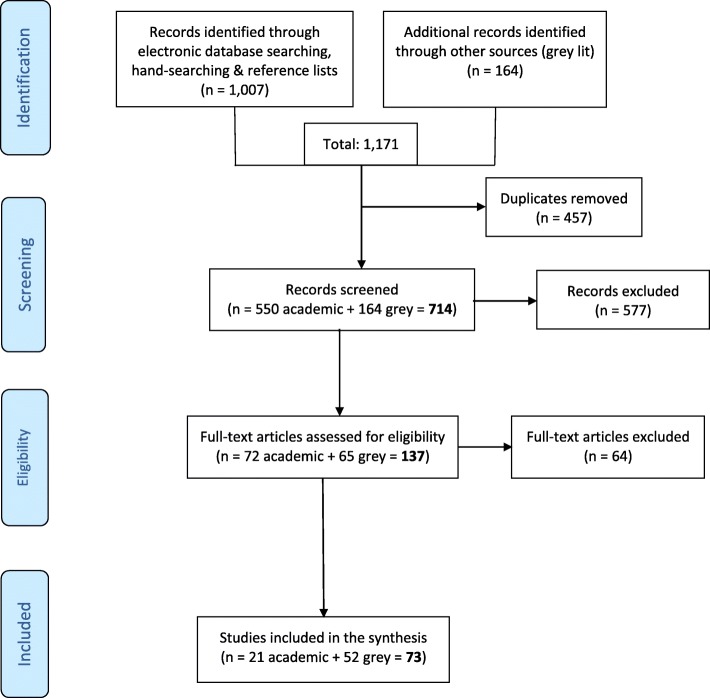
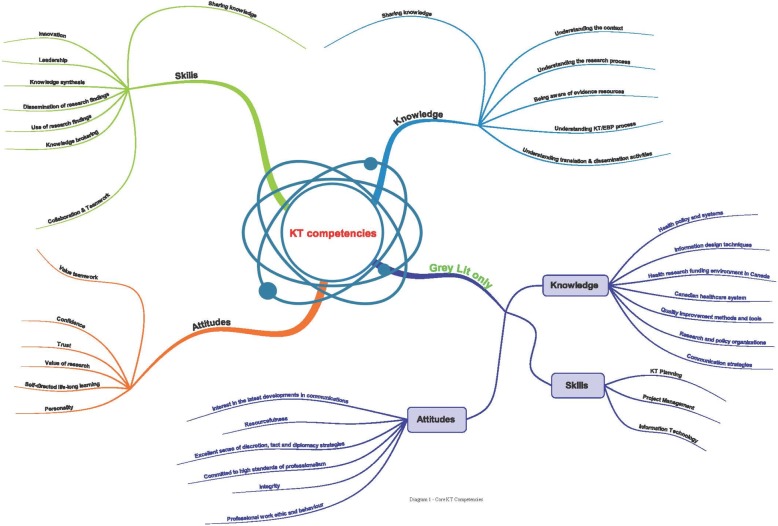
Results: Overall, 1171 publications were retrieved; 137 were fully reviewed; and 15 empirical and six conceptual academic, and 52 grey literature publications were included and synthesized in this scoping review. From both the academic and grey literature, we categorized 19 KT core competencies into knowledge, skills, or attitudes; and identified commonly used interventions and strategies to enhance KT competencies such as education, organizational support and hands-on training.
Conclusions: These initial core KT competencies for individuals provide implications for education, policy, knowledge brokering, and future research, and on the need for future evaluation of the KT competencies presented. We also discuss the essential role of organizational support and culture for successful KT activities/practice.
Keywords: Competencies (attitudes; Evidence-based practice; Knowledge; Knowledge brokering; Knowledge translation; Knowledge utilization; Professional competencies; Scoping review; Skills).
Conflict of interest statement
Authors’ information
AM (RN, PhD) is assistant professor in the School of Nursing at University of Victoria, Victoria, British Columbia, Canada.
PA (BCom, MPA) is manager of BC’s health services research network, InspireNet
LC (MLIS, BScPT) is a research librarian at Alberta Innovates - Health Solutions, and John W. Scott Health Sciences Library, University of Alberta, Edmonton, Alberta, Canada.
NF (RN, PhD, FAAN) is professor in the School of Nursing at University of Victoria, Victoria, British Columbia, Canada.
SG (OT, MSc, PhD candidate) is an occupational therapist and the Knowledge Broker Facilitator with the Child Development & Rehabilitation Evidence Centre at Sunny Hill Health Centre for Children, a Clinical Instructor in the Department of Occupational Science & Occupational Therapy, and a doctoral candidate in the School of Rehabilitation Sciences at the University of British Columbia, Vancouver, British Columbia, Canada.
GS is Director, Knowledge Translation at the Michael Smith Foundation for Health Research, Vancouver, British Columbia, Canada.
Ethics approval and consent to participate
Not applicable.
Consent for publication
Not applicable.
Competing interests
The authors declare that they have no competing interests.
Publisher’s Note
Springer Nature remains neutral with regard to jurisdictional claims in published maps and institutional affiliations.
Figures
References
-
- MacDonald W, Frank B, Mann K. Knowledge translation and exchange: a summary report prepared for the Nova Scotia Health Research Foundation. 2008.
Publication types
MeSH terms
LinkOut - more resources
Full Text Sources
Other Literature Sources
