. 2018 Jul 9;7(7):bio035394.
doi: 10.1242/bio.035394.

Characterization of a cdc14 null allele in Drosophila melanogaster

Affiliations

Characterization of a cdc14 null allele in Drosophila melanogaster

Leif R Neitzel et al. Biol Open. .

Erratum in

Abstract

Cdc14 is an evolutionarily conserved serine/threonine phosphatase. Originally identified in Saccharomyces cerevisiae as a cell cycle regulator, its role in other eukaryotic organisms remains unclear. In Drosophila melanogaster, Cdc14 is encoded by a single gene, thus facilitating its study. We found that Cdc14 expression is highest in the testis of adult flies and that cdc14 null flies are viable. cdc14 null female and male flies do not display altered fertility. cdc14 null males, however, exhibit decreased sperm competitiveness. Previous studies have shown that Cdc14 plays a role in ciliogenesis during zebrafish development. In Drosophila, sensory neurons are ciliated. We found that the Drosophila cdc14 null mutants have defects in chemosensation and mechanosensation as indicated by decreased avoidance of repellant substances and decreased response to touch. In addition, we show that cdc14 null mutants have defects in lipid metabolism and resistance to starvation. These studies highlight the diversity of Cdc14 function in eukaryotes despite its structural conservation.

Keywords: Cdc14; Chemosensation; Drosophila; Mechanosensation; Sensilla; Sperm.


Conflict of interest statement

Competing interestsThe authors declare no competing or financial interests.

Figures
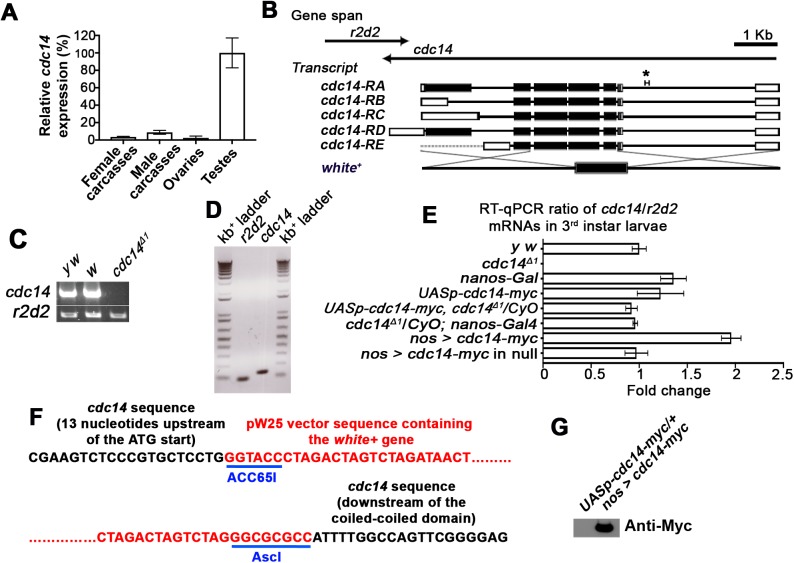
Fig. 1.
Fig. 1.
High expression of cdc14 in the testes and generation of Drosophila cdc14 null mutants by homologous recombination. (A) Relative expression of endogenous cdc14 in adult flies as determined by RT-PCR. The highest level of expression is in the testes. cdc14 expression was normalized to Rp49. cDNA was generated from adult carcasses (n≥50) or excised gonads (n≥200, n=3 independent biological replicates with n=3 technical replicates). (B) Structure of the Drosophila cdc14 and its five alternative transcripts. Black boxes are exons, white boxes are UTRs, and lines are introns. Ends-out homologous recombination of cdc14 was used to replace cdc14 with the white+ gene. Asterisk (*) indicates the 371 bp (2L:7,807,273 to 7,87,543) region of cdc14 used for PCR depicted in C. A region (2 kb; not shown) of the overlapping housekeeping gene, r2d2, was used as a positive PCR control. Control r2d2 PCR product is 2 kb. r2d2 is upstream of cdc14 (PCR region not depicted). White+ gene is not to scale. (C) A cdc14 null line was generated in a y w background and verified by PCR amplification of genomic DNA. The control lines, y w and w1118, and the adjacent housekeeping gene, r2d2, were used as positive controls. The cdc14Δ1 null allele was used for all subsequent experiments and for generation of the rescue line. The gel is a representative result from n=3 replicates. (D) Final products from the RT-qPCR reaction of y w third instar larvae run on a 1% agarose DNA gel. Only a single product was amplified, suggesting high specificity of the primers used in E. (E) Fold changes of cdc14 mRNA normalized to r2d2 mRNA. The level of expression is normalized to the y w control. No cdc14 expression was detectable in the cdc14 null line, but r2d2 expression was equivalent to that of the y w control line. cDNA was generated from late third instar larvae (n≥30, n=3 independent biological replicates with n=3 technical replicates). (F) Nucleotide sequence of the boundaries of the cdc14 null mutation. Two of the restriction endonuclease sites (ACC65I and AscI) used for cloning the two homologous arms of cdc14 into the pW25 vector for recombination are shown. (G) Anti-Myc immunoblot of 0–2 h old embryos demonstrates expression of UASp-cdc14-myc using the nanos-Gal4 driver.
Fig. 2.
Fig. 2.
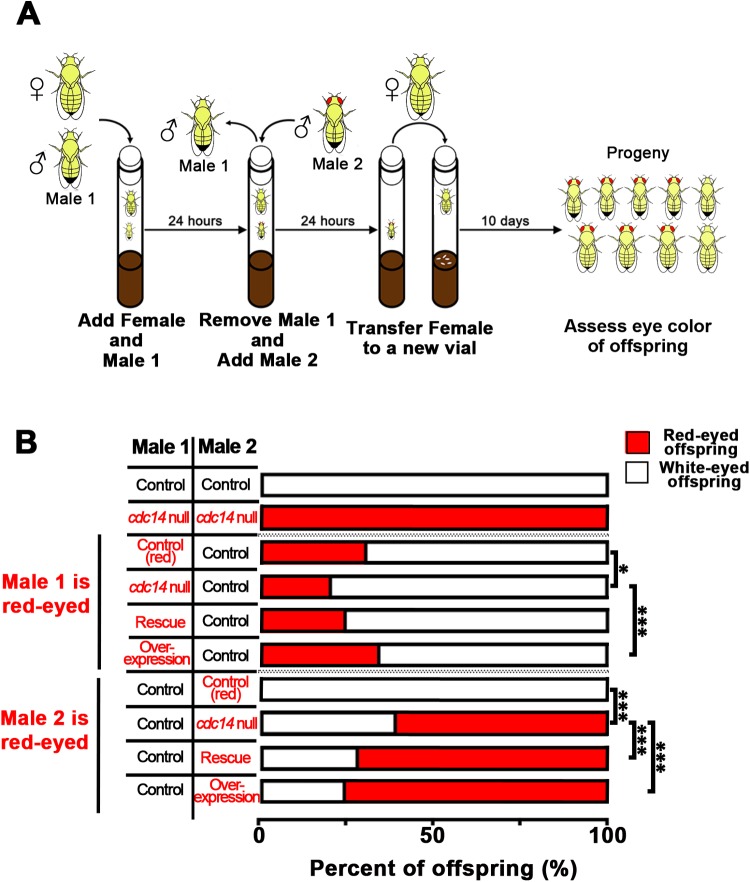
cdc14 null males exhibit decreased sperm competition. (A) An example of a sperm competition assay in which a single y w virgin female (white-eyed) is mated to a single male (white-eyed) for 24 h. The male is then removed and the female is mated to a second male with red-eyes for 24 h. The female is then transferred to a fresh vial and allowed to lay eggs. The female is removed, and offspring are allowed to develop and assessed for eye color (red or white). The assay is repeated using a red-eyed male first and then a white-eyed male. (B) A control experiment was performed using white-eyed y w males for both the first and second males. A second control experiment was performed using red-eyed cdc14 null males for both the first and second males. The cdc14 null males are less competitive compared to control males regardless of whether they are the first or second male to mate. Results for a single representative replicates (n≥15 vials per cross) are shown. Additional data can be found in Fig. S5B. Data were analyzed using a Chi-squared test with Bonferroni correction. Six pairwise comparisons were made. Red-eyed control males were compared to the cdc14 null, rescue, or overexpression males; cdc14 null males were compared to rescue or overexpression male; and rescue males were compared to overexpression males. *P<0.009 and ***P<0.0002.

References

    1. Ali Y. O., Escala W., Ruan K. and Zhai R. G. (2011). Assaying locomotor, learning, and memory deficits in Drosophila models of neurodegeneration. J. Vis. Exp. 49, e2504 10.3791/2504 - DOI - PMC - PubMed
    1. Anreiter I., Vasquez O. E., Allen A. M. and Sokolowski M. B. (2016). Foraging path-length protocol for Drosophila melanogaster larvae. J. Vis. Exp. 110, e53980 10.3791/53980 - DOI - PMC - PubMed
    1. Apostolopoulou A. A., Hersperger F., Mazija L., Widmann A., Wust A. and Thum A. S. (2014). Composition of agarose substrate affects behavioral output of Drosophila larvae. Front. Behav. Neurosci. 8, 11 10.3389/fnbeh.2014.00011 - DOI - PMC - PubMed
    1. Arrese E. L. and Soulages J. L. (2010). Insect fat body: energy, metabolism, and regulation. Annu. Rev. Entomol. 55, 207-225. 10.1146/annurev-ento-112408-085356 - DOI - PMC - PubMed
    1. Avila F. W. and Wolfner M. F. (2009). Acp36DE is required for uterine conformational changes in mated Drosophila females. Proc. Natl. Acad. Sci. USA 106, 15796-15800. 10.1073/pnas.0904029106 - DOI - PMC - PubMed

LinkOut - more resources